‘Fjord’ shows the limits of Western tolerance – and the promise of solidarity
Dramatizing a famous case of government overreach involving Christian immigrants in Norway, the acclaimed film asks: Who needs protection from who?
I once mentioned to a friend that I was spanked as a child, which I considered a passing reference until the conversation screeched to a halt. Wasn’t I traumatized? Not particularly – the last spank I received was for kicking my brother in the face in the heat of a living room wrestling match, and I got off easy compared to the other parties involved. This is neither an endorsement or condemnation of corporal punishment; I just remember that my friend and I reached a point of mutually assured incomprehension on this subject.
“Fjord,” the latest from Romanian filmmaker Cristian Mungiu and the most recent recipient of the prestigious Palme d’Or, is perhaps the first film this century to tap into our current confusion, a world where just because there is no objective truth, doesn't mean you can’t be wrong.
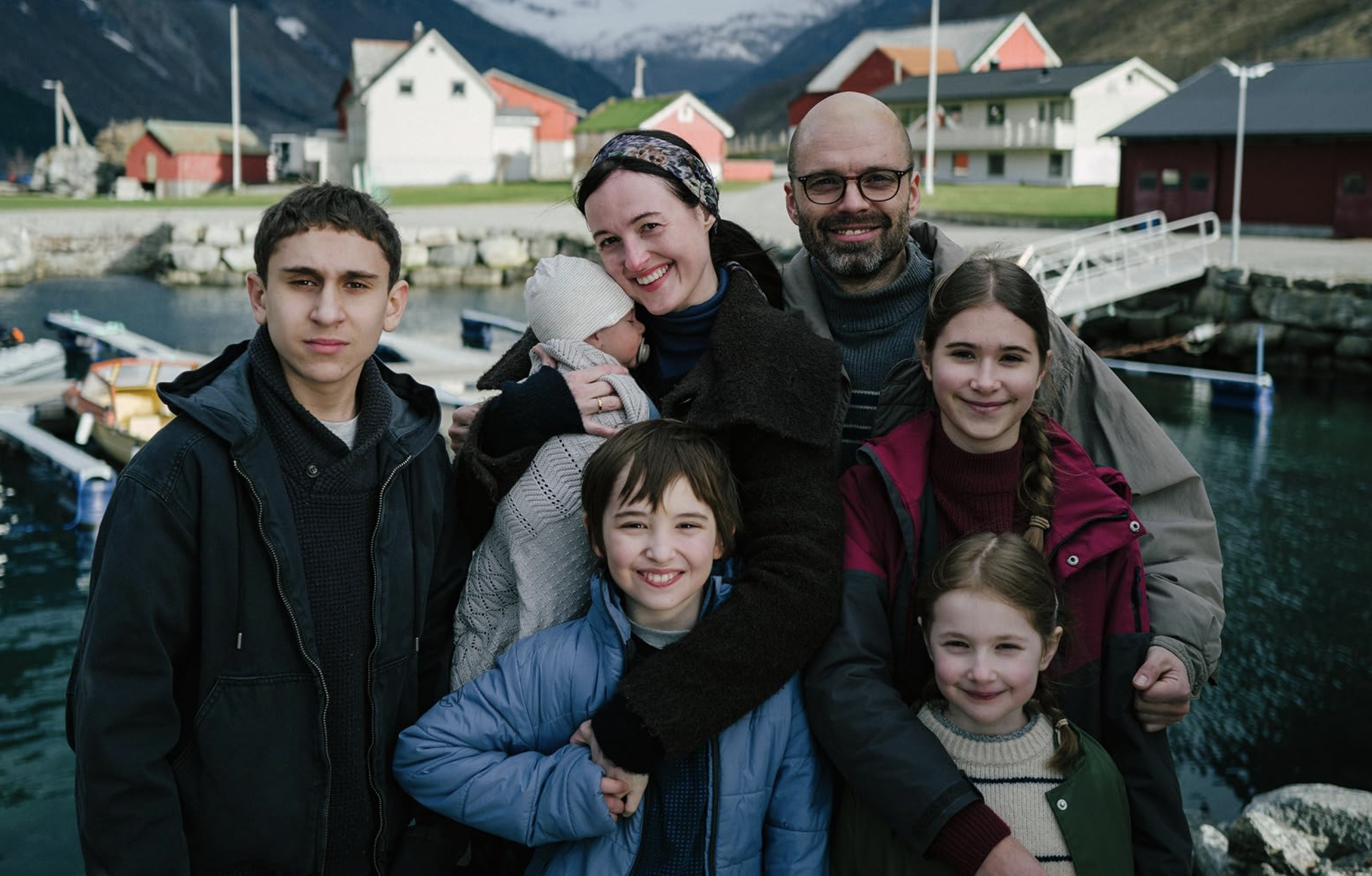
The film follows the Gheorghiu family, who are moving from the native Romania of husband Mihai (Sebastian Stan) to his wife Lisbet’s (Renate Reinsve) homeland of Norway. Their new town is welcoming, though it becomes readily apparent that a culture clash is not far off. They have five children (astronomical in comparison to typically frigid Nordic fertility) and they’re evangelical Christians – making them devout or fanatical, depending on which side of the stained glass you’re peering through.
From this Catholic’s perspective, they’re a normal family. The kids aren’t allowed phones and tablets, filling their time with hymns and bible study instead. But the family aren’t shut-ins, socializing and integrating well within their new home. The neighbor girl takes a particular shine to the older siblings and there’s something of a cross-pollination, with her making them more rebellious and them getting her interested in baptism. This alarms her father, who considers the former good old fashioned assimilation, and the latter proselytization.
That’s the fascinating unspoken current through the movie’s first act, as the family shares their faith reflexively and you see the townsfolk hold their stare for just a second too long.
Lisbet is a nurse who invites the grieving daughter of a patient to her church. To her, this is just basic kindness; to her coworker, this is exploiting the vulnerable. Mihai absent-mindedly noodles “Amazing Grace” on the school piano and gets a slightly sterner rebuke than he deserves. Secular liberalism respects all beliefs and practices, so long as they stay parceled to their particular realm. This has always been the social contract and the family tries their best to oblige.
But what happens when it’s the state that doesn’t hold up their end of the bargain? The trouble starts when a teacher spots bruises on one of the kid’s shoulders. The movie remains ambiguous on where they originate, but offers several plausible alternatives. Yet for the school this is just confirmation of a suspicion barely oppressed, and they quickly move to remove the children from their care.
The Norwegian CPS is a famously, some would say notoriously, proactive organization. What in other Western countries would be the last resort is their opening salvo: putting the Gheorghius on the backfoot and forced to absolve their guilt before they can prove their innocence. The state insists it has the children’s best interest at heart, and you believe them. If only there was a saying about the road to Hell and what its asphalt consists of.
The process seems less vested in fixing the Gheorghius than confirming them as monsters. Every time Mihai raises his voice raises their eyebrows, his vehemence mistaken for violence. The couple admits to spanking, which is then logged as “hitting” on the police report. In Norway they’re synonyms, while in Romania (and indeed 1990s Tacoma, Washington) they’re distinct. It doesn’t help that they all speak English as a lingua franca, which opens so many more cracks for ambiguities to slip through.
On paper all this reads like a Daily Wire fantasy, and some critics maintain this is conservative propaganda. Director Cristian Mungiu has denied this and points to his own past films on abortion and the abuses of the Orthodox Church as proof he isn’t exactly Ben Shapiro. His story draws from child protective services cases in Norway, particularly one involving the Bodnariu family from Romania ten years ago, which sparked global media coverage and political debate.
Few filmmakers like Mungiu have the credibility to point out the overreach of secular liberalism and how it undermines itself when it tries to impose what it sees as common sense. Each side levels accusations of brainwashing at the other: it seems the only thing both parties agree on is how obvious the truth is and how the other can’t see it.
The most illuminating moment comes when the parents negotiate to keep breastfeeding their infant. The state seems unmoved until the family lawyer hits on the key phrase that breastfeeding “is important in their tradition,” which results in permission being granted. But this infuriates Mihai more than the prohibition, that plain humanity has to be translated into something quaint and provincial to be understood. The Gheorghius never wanted the state to bend over backwards in accommodation: merely to treat them as human beings.
The film is called “Fjord.” Simple enough, as it’s set in a fjord after all. But a fjord is also a stab wound from a glacier, the land slashed into two implacable faces with a thin ribbon of inlet shared between. The town is only there because there’s nowhere else for it to go, a community forced to rub shoulders in nature’s corridor. At times there are rumblings from the hills above, as snow spills down and all parties startle and stare in unison. The film offers no solution save solidarity; that for whatever our many, many differences, everyone looks the same under the avalanche.
Joseph Joyce is a screenwriter and freelance critic based in Sherman Oaks.