2 black-and-white movies wicked enough for Halloween
These two movies from the '50s and '60s are not traditional horror films for Halloween, but the themes within them are scary.
Eddie Muller, popularly known as “the czar of noir,” once described Edgar G. Ulmer’s “Detour,” a noir classic, as a “fever dream.”
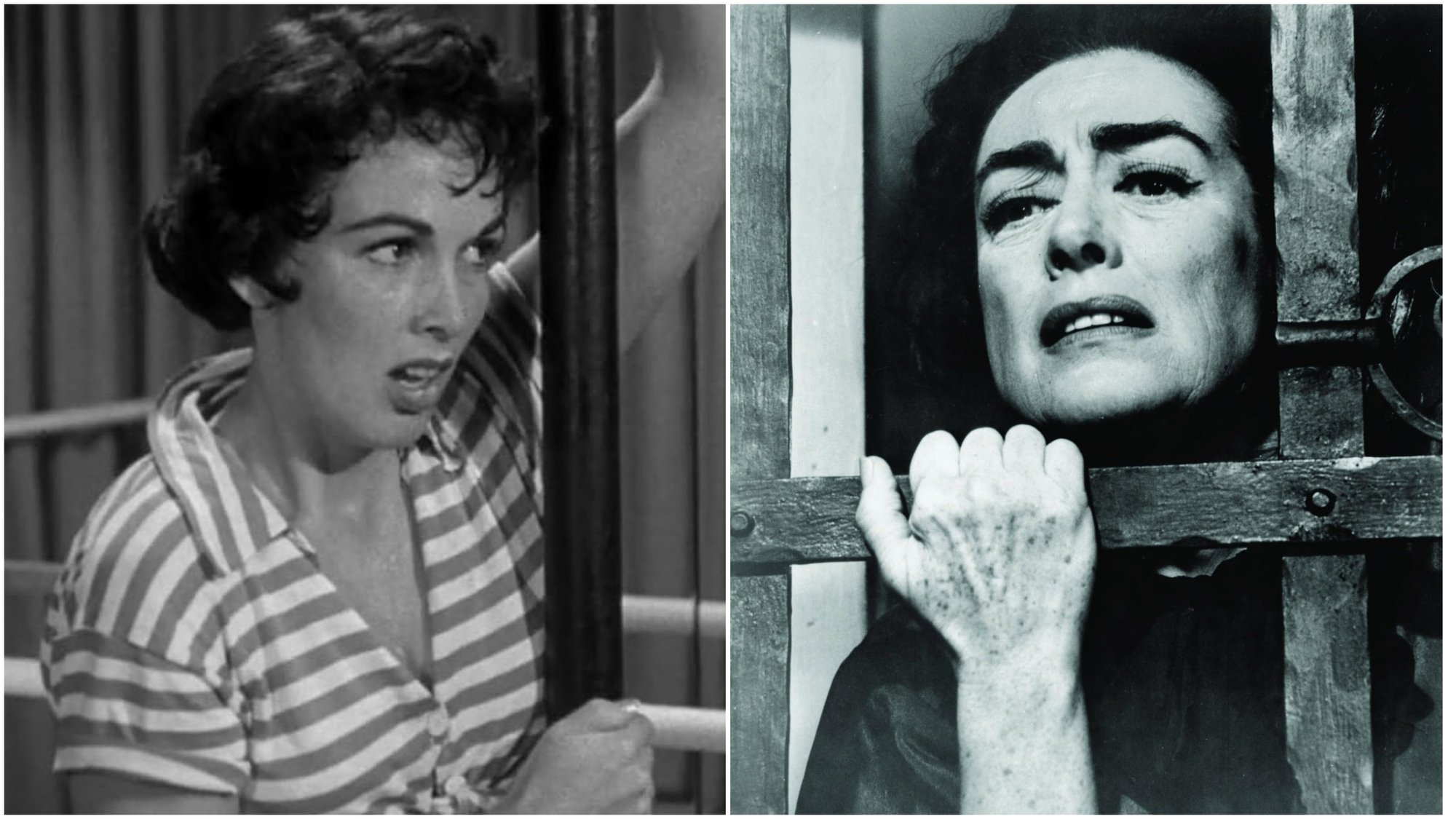
He could just as well have been talking about two films by the American director Robert Aldrich — “Kiss Me Deadly” (1955) and “What Ever Happened to Baby Jane?” (1962). Both set in LA, they could make for a cockeyed Halloween double feature.
“Down these streets a man must go who is not himself mean,” Raymond Chandler famously wrote of his LA private eye Philip Marlowe.
But Mike Hammer, the protagonist of “Kiss Me Deadly” and the creation of American pulp fiction author Mickey Spillane, is no Philip Marlowe. Hammer (played by Ralph Meeker) is blunt (get it?) and mean. He runs a sleazy PI firm specializing in divorce, and farms out his secretary-girlfriend Velda to seduce the husbands of his female clients (he’s the honey bait for wives of his male clients). He’s a wild-card lone wolf street vigilante whose code of honor is brute violence.
The film’s opening is iconic: Christina Bailey (Cloris Leachman), naked and barefoot in a trench coat, is caught in the headlights of Hammer’s sports car as she desperately flags him down on a deserted road at night. Another car forces them off the road. We see only the polished black dress shoes of the men who approach. Hammer and Christina are taken to an abandoned house.
We see Christina’s bare legs and feet dangling from a table. We hear her screams.
They torture Christina to death, beat Hammer unconscious, put them in a car, and shove it over a cliff — where it bursts into flames.
But Hammer survives. And before the thugs pulled him and Christina over, he’d stopped at a gas station, where it turns out Christina (having read his name and address off the registration certificate taped to the steering wheel column) had mailed him a letter.
“Remember me!” it reads, a line from the 19th-century romantic poet Christina Rossetti after whom she was named.
This combination of poetic femininity, brute male violence, and against-type characters lends the film a peculiar depth. Innocent bystanders listen to opera. Hammer’s apartment, unexpectedly sleek and refined, oozes mid-century modern sophistication. Hammer’s girlfriend, Velda (for whom in the end Hammer is willing to risk his life), practices ballet.
Together, they will uncover a terrifying Cold War conspiracy to end the world in a nuclear conflagration — and barely escape the conflagration themselves.
Aldrich (1918-1983) escaped the worst of the McCarthy witch hunts but, blackballed by the powerful movie mogul Harry Cohn, was essentially exiled from the studios for several years.
“What Ever Happened to Baby Jane?” marked his U.S. comeback, and it’s “Sunset Boulevard” on steroids. No courtly Cecil B. DeMille here to shield faded film star Norma Desmond from facing the ravages of age. Blanche (Joan Crawford) and Jane (Bette Davis), former child stars now in their twilight years, are locked into a psychotic prison of sibling rivalry, codependent enmeshment, neurotic guilt, and a pathological attachment to their brief moment in the sun.
Blanche is in a wheelchair: Jane, drunk at the wheel after a wild party, supposedly paralyzed her decades ago.
Now charged with Blanche’s care, Jane is slatternly vulgar and seething with pent-up rage. In white pancake makeup that clings to her caverned face, black eyelashes so thick with mascara they could be spiders, and a ratty blond wig arranged in girlish braids, Davis is at her over-the-top height.
Crawford, too, turns in a bravura performance: steely and calm, but with good reason increasingly terrified. Aldrich stops just short of making the sisters so grotesque we can dismiss them. They live in a moldering mansion (real-life address: 172 South McCadden Place in Hancock Park), and even today could be our next-door neighbors in Hollywood, or Silver Lake, or Los Feliz.
But Jane is descending into true madness. She schemes, she tortures; she murders. And a final reveal injects a note of genuine pathos: “You mean ... all this time we could have been friends?” Jane croons to a dying Blanche, then runs to fetch them ice cream.
The finales of both “Kiss Me Deadly” and “What Ever Happened to Baby Jane?” were filmed on the same stretch of shoreline in Malibu: Westward Beach near Point Dume.
In fact, the same beach house that explodes in a fireball at the end of “Kiss Me Deadly” is the same house seen briefly at the end of “What Ever Happened to Baby Jane?” where the beach-going crowd and the cops circle around Blanche Hudson, dressed in black and lying face down on the sand, while Jane, in her delusion, believing the crowd to be an admiring audience, performs a final bonkers dance in her virginal white dress.
One film concludes with the threat of nuclear annihilation; the other with personal emotional, spiritual, and emotional annihilation. Both end at the edge of the Pacific, with its evocation of re-baptism. Perhaps a new life awaits Jane in a sheltered mental asylum. Maybe Mike and Velda, drenched and purified by the waves, will make their way back to shore, and quit trying to corrupt their clients’ spouses.
Those may be pipe dreams, but why not hope? After all, Halloween derives from All Hallows Eve, the vigil of the feast of All Saints, with All Souls the next day.
As Christina Rossetti wrote:
“Remember me when I am gone away, / Gone far away into the silent land; / When you can no more hold me by the hand, / Nor I half turn to go yet turning stay.”