“At length did cross an Albatross, / Thorough the fog it came; / As if it had been a Christian soul, / We hailed it in God’s name…”
— Samuel Taylor Coleridge, 1834
What power does the sea have upon the soul?
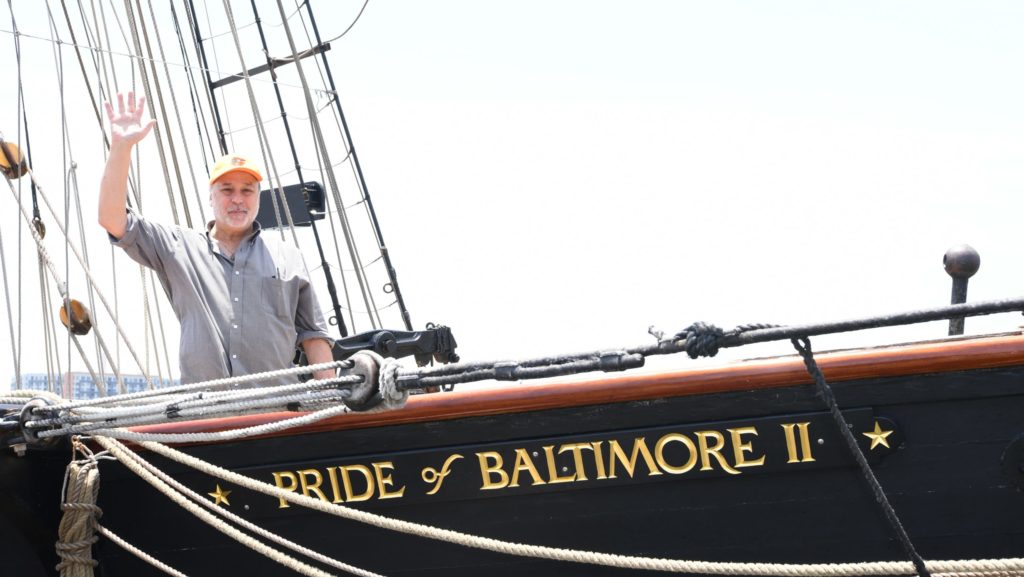
Sailing on the Pride of Baltimore II clipper ship from the Baltimore waterfront to New York harbor this summer was a good time to ask. The trip, a little less than a week, celebrated the 250th anniversary of American independence from Great Britain. Pride II cruised under sail in a parade of 60 ships from 30 nations — both tall-masted and modern; the Statue of Liberty and her promise of refuge and freedom high above the Hudson River.
On the second day I prayed the Glorious Mysteries of the rosary on deck; the sun glinting off the beads in my hand, the vessel surrounded by the great Atlantic as we passed Cape May, New Jersey.
With a peace I’d never been able to achieve before embracing the rosary at a pivotal moment nearly 40 years ago (I was lost, now I’m found), I contemplated the work of the Holy Spirit in my life while gazing across the water. Without its uninvited intervention at the shrine of Our Lady of Lourdes in France in 1990, I wouldn’t be here to tell this tale.
I was reminded of the slow unraveling of my problems in the decades following Lourdes while watching the crew untangle fire hoses to scrub the deck. We were passing the Turkey Point Lighthouse at the tip of Elk Neck Peninsula in Cecil County, Maryland. Watching them, I recalled that one of the Blessed Mother’s many names is “Mary, Untier of Knots.” Once the hoses straightened out, water did not flow, it gushed. And the deck gleamed.
Genesis says that on the fifth day of creation God filled the waters on the Earth “with an abundance of living creatures … He created the great sea monsters and all kinds of crawling living creatures with which the water teems … [and] he blessed them, saying: be fertile, multiply, and fill the seas …”
I didn’t see any biblical beasts breaking the surface of the waves as Pride II rolled north, neither mighty Leviathan nor a school of sleek dolphins. I hoped to glimpse an albatross, having seen one as a teenager while a deckhand on the S.S. Mayaguez container ship, but mid-Atlantic sightings are rare. Only a vast field of open sea on which to meditate as I moved through the mysteries.
Water is not a living thing, yet there would be no life without it. Perhaps that’s why the Almighty created it first.
It was miserably hot down below during the historic Fourth of July “heat dome” with temperatures topping 101 degrees. For the first time since I was a kid, I found myself drinking a tall (though warm, ice and refrigeration at a premium on board) glass of Tang. I did not grow up to be an astronaut.
The crew took many of their meals on deck. Between standing watch and the rigors of raising and lowering sails on the near-replica of a 19th-century Baltimore clipper — fast, nimble vessels famed for their daring during the War of 1812 — they made time for themselves. And I saw 23-year-old deckhand Madie Li from Flushing, Queens, reading a weathered copy of “Desiring God” by the Baptist theologian John Piper.
The book's subtitle — “Meditations of a Christian Hedonist” — captivated this sinful Catholic. You mean I don’t have to throw my Rolling Stones records overboard? That, within reason, I can appease the animal within and stumble toward Christ at the same time?
Piper’s essays are built around his contention that “God is most glorified in us when we are most satisfied in Him.”
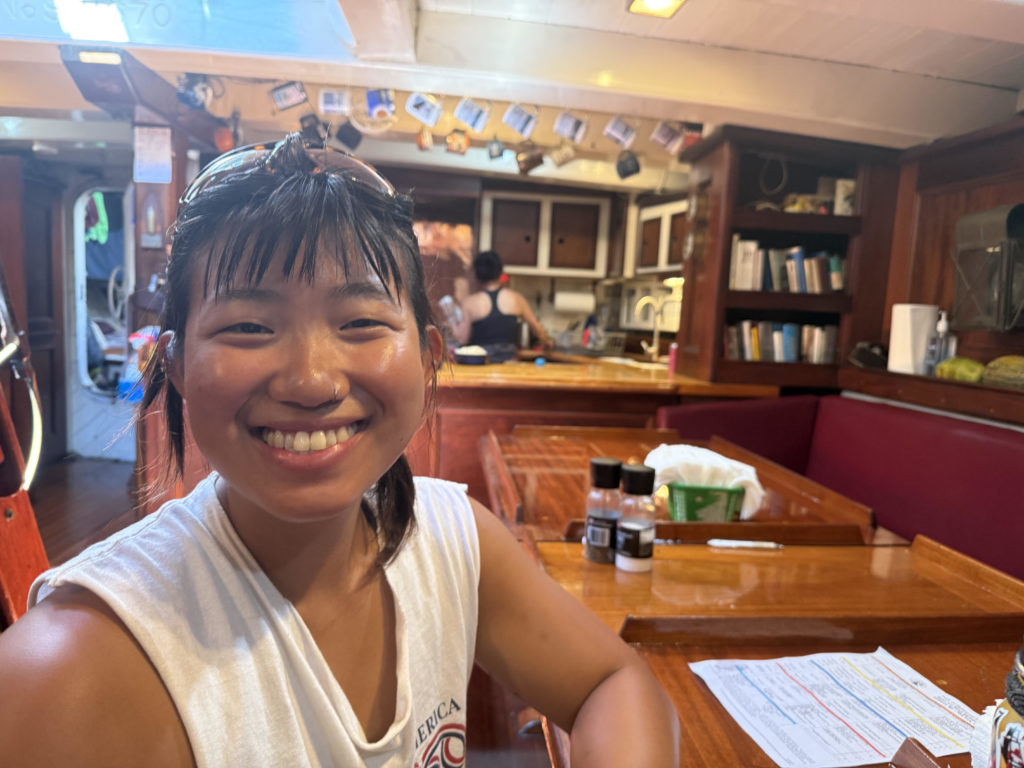
Li, raised evangelical in Queens and baptized in the Presbyterian church during college, is profoundly satisfied in her relationship to God while working at sea. A deckhand, she was mending a sail with needle and thread the first time I passed her on deck.
“I’m living an answered prayer right now,” said Li, who holds a degree in astronomy from Barnard College and chose seafaring over a possible career at NASA. “Two years ago when I first got into Tall Ships and saw Pride at the Great Chesapeake Bay Schooner Race, I knew I had to sail on her. Here I am, living out that answered prayer.”
Asked where on the ship she preferred to pray, she said, “Whether in the headrig or aloft or in the galley doing dishes, I love singing small prayers [of] praise to God. I take time to look at my surroundings — the sails full, the ocean, the deep, deep blue with seafoam washing against the [hull].”
Li’s favorite shipboard place to commune with her Maker?
“On the bowsprit. Up there, I face the bow, feel the wind against my skin, the sun, and take a deep breath. I love saying prayers aloud because I can fully emphasize my emotions about whatever I am talking to God about.”
Praying at sea, she said, even under stormy skies, “brings a peace I cannot experience on land. And I know He listens. He loves to listen.”
Father Sinclair Oubre, JCL, the pastor of St. Francis of Assisi Church in the Texas town of Orange on the Sabine River, is a longtime friend, our relationship bound by faith, blues music of the Gulf Coast and the world of ships. Sinclair was not on the Pride II for the journey from the town of former shipyard worker Frederick Douglass to the city of Walt Whitman, whose oil portrait hangs in a saloon near Pier 16 South Street.
Not only has Sinclair prayed at sea as an able-bodied seaman with the Seafarers International Union (“I get irritable if I don’t,” he said), he has celebrated Mass on ships and ocean-going tugs for several decades.
“I get 30 days off a year [from parish work] and would go down to the union hall and grab a job,” said Oubre, 68. Along with work boots and foul weather gear, he packed a Mass kit to celebrate the Eucharist in his room or the officers’ lounge depending on how many shipmates showed up for the service.
A regular participant on a Crowley tug pulling roll on/roll off barges from Jacksonville, Florida to Puerto Rico was the captain, a Baptist. Two Catholic mates were also aboard, one devout and one not at all. The man who’d left the faith behind would take the bridge watch so the believer could attend Mass, a quiet act of charity.
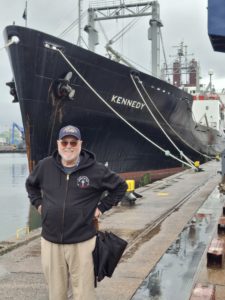
Raised near the water in Port Arthur, hometown of Janis Joplin, Sinclair realized early in his seminary days that the sea, and not the forest, was the portion of God’s creation for him.
“In 1976 I started at St. Mary’s Seminary in Houston and each spring we’d have a retreat in the woods, a Franciscan nature experience of seeing God shining through butterflies,” he said. “But when I go into the woods I see copperhead snakes, carcasses of dead animals and termites eating rotten trees — death all around me."
At sea, he said, “You see the sun coming up and the sun going down, flying fish and whales. There’s a tremendous peace and manifestation of God.”
The same day I said the rosary on deck, I fell into conversation with Christopher Nolan, 73, a fellow guest onboard and my bunkmate (no, not the famed Hollywood director). The son of devout Irish Catholics from Pennsylvania, Nolan no longer practices the faith and does not remember his confirmation name.
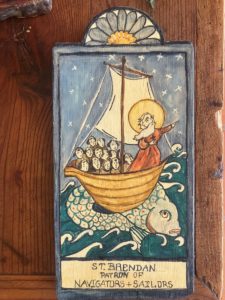
But it was from him that I learned of St. Brendan the Navigator (484-577), patron of mariners. Of the monk’s many voyages to islands between Ireland and France, the best known is a search for the Garden of Eden. In the legends of Brendan, the garden is also called the “Isle of the Blessed” or “St. Brendan’s Island.”
Nolan’s mother — Dorcas Dughi Nolan — sang with Fred Waring’s Pennsylvanians and died in 2010. She prayed the rosary daily and kept one under her pillow. His father, John, a mechanical engineer with Bethlehem Steel, was a Navy Seabee in the Pacific during World War II and was always attracted to the sea.
It was the stories of St. Brendan’s adventures that captivated Nolan’s father. With that and his heritage in mind, he made a pilgrimage to the coast of County Kerry to see a statue of Brendan on the Samphire Rock of Dingle Peninsula. “He stands on a point that is as far west as you can go in Ireland,” he said.
If I find out that Pride of Baltimore II has plans to visit the harbor where the bronze Brendan stares out across the Atlantic, I will dispatch another report from her rail.