‘Unconquered heralds of Christ’: Georgia martyrs beatified before 10,000 in Savannah
The five 16th-century Franciscan missionaries in Georgia were declared blessed at a Mass presided over by Cardinal Frank Leo as papal delegate.
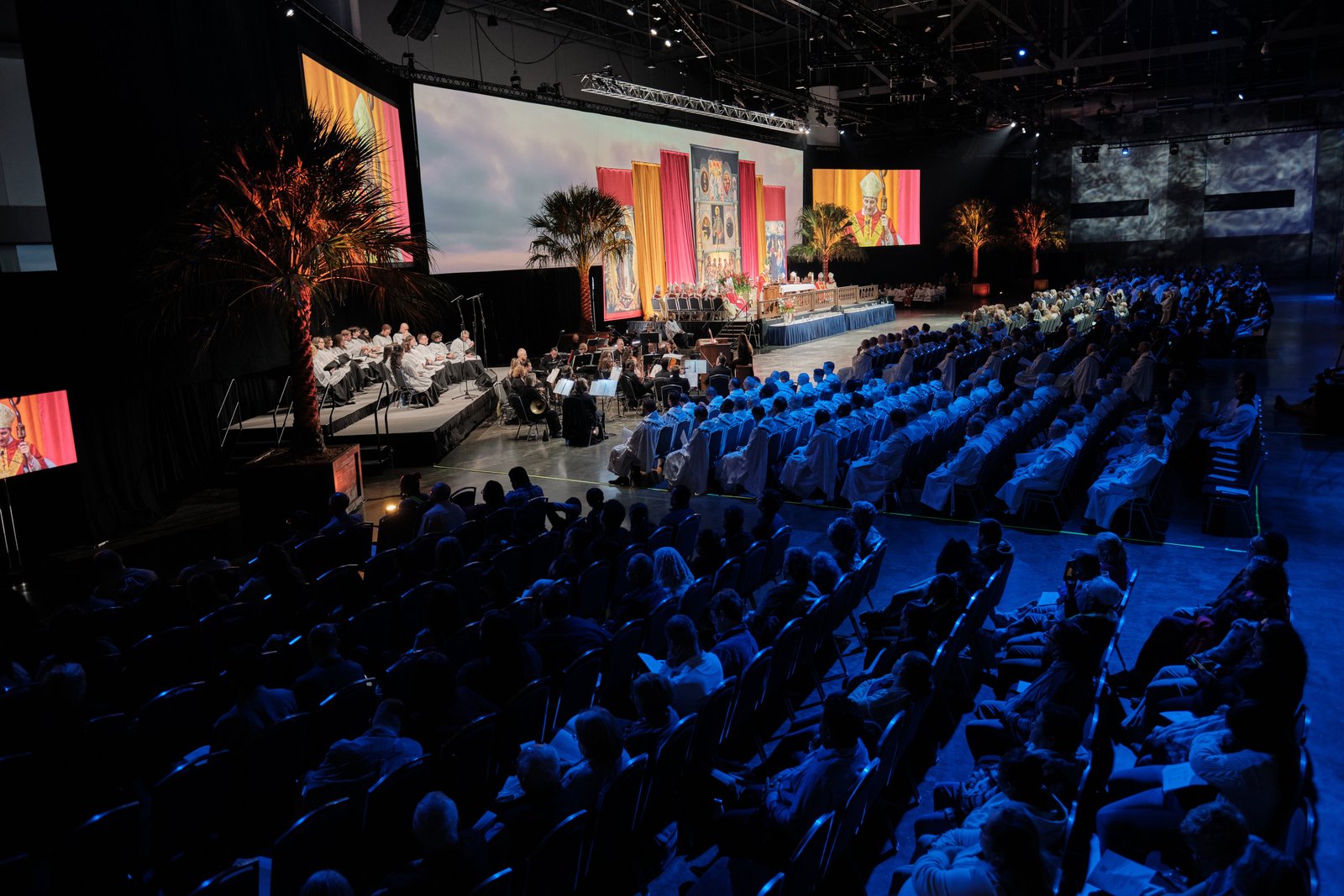
Five 16th-century Franciscan friars killed in present-day Georgia for defending Church teaching in 1597 were beatified Oct. 31 in a Mass attended by some 10,000 people.
The Mass at the Savannah Convention Center was presided over by Cardinal Frank Leo of Toronto, the papal delegate, along with several bishops and dozens of priests.
During the Mass, Cardinal Leo read aloud Pope Leo XIV’s apostolic letter proclaiming the five friars beatified. The letter called the martyrs “unconquered heralds of Christ” who “placed the saving truth of the Gospel before their own safety.” It also established Sept. 22 as the martyrs’ liturgical memorial.
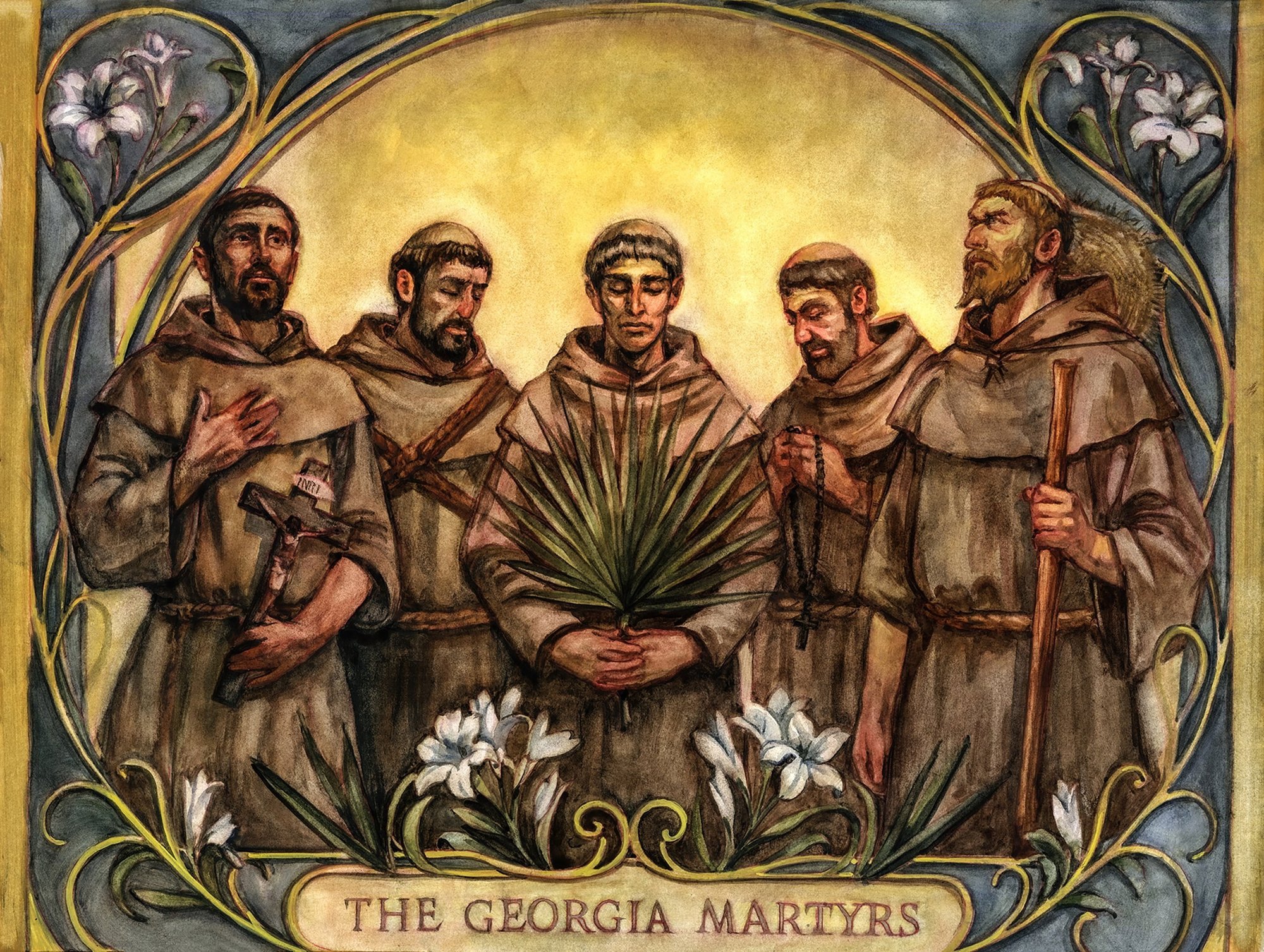
With the official proclamation, the official beatification image of the five friars was unveiled to the hymn “Holy God, we praise thy name.” Drawing on traditional depictions of the martyrs, the artwork “The Georgia Martyrs” by Savannah artist Jared Matthew Seff won a contest for the official image held this year by the Diocese of Savannah.
1597 Guale Uprising
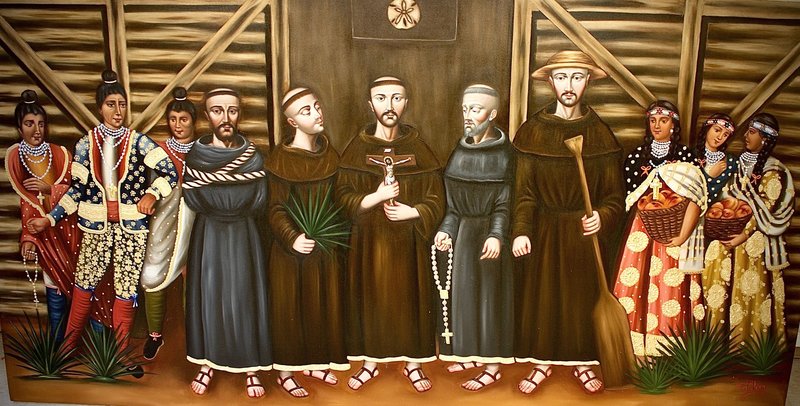
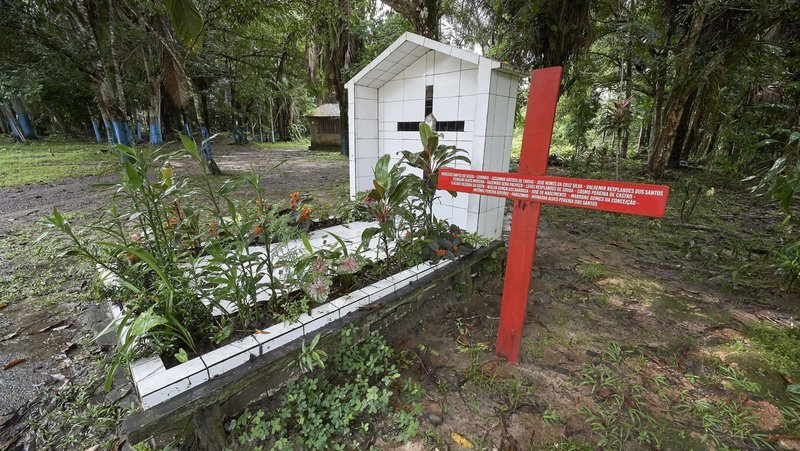
In 1597, the Spanish Franciscans Pedro de Corpa, Blas Rodríguez de Cuacos, Miguel de Añon, Antonio de Badajoz, and Francisco de Veráscola were ministering at five missions along the coast and barrier islands of present-day Georgia when they were killed out of hatred for the faith by a band of indigenous men Sept. 14-17.
The friars’ murders were prompted by Father de Corpa angering the heir to a Guale chiefdom, Juanillo, by telling him that as a baptized Christian, he could not follow his culture’s custom and take a second wife. Juanillo and his men killed the priest at a mission near the contemporary city of Eulonia, Georgia, before killing four of the other five Franciscan missionaries ministering in the area. The sixth friar, Francisco de Avila, was kidnapped and tortured for months before being set free. The incident is known as the 1597 Guale Uprising.
At the time, the Spaniards knew the wider coastal area as La Florida, home to the settlement of St. Augustine, established in 1565. By 1595, the friars had established five missions along the coast. Prior to their murders, the six Franciscans appear to have lived among the Guale and other indigenous peoples in peace, without a military presence, for two years.
While what was recovered of the martyrs’ relics was linked to miraculous cures, their current location is unknown. Remains of all the friars but Friar Francisco were identified after their deaths, and their relics and some other personal items were collected in the months and years that followed and brought to St. Augustine.
Some scholars speculate that Franciscans took the martyrs’ remains with them to Cuba when St. Augustine transferred to British rule in 1763. A skull recovered at the Fort King George State Historical Site in Darien may have belonged to one of the friars and is being tested to learn more about its origins.
Martyrs’ witness to Church teaching on matrimony
In remarks after the beatification rite, Bishop Gregory Parkes said, “I truly believe that through the intercession of Blessed Pedro de Corpa and four companions there will be greater respect for the dignity and character of the sacrament of holy matrimony.”
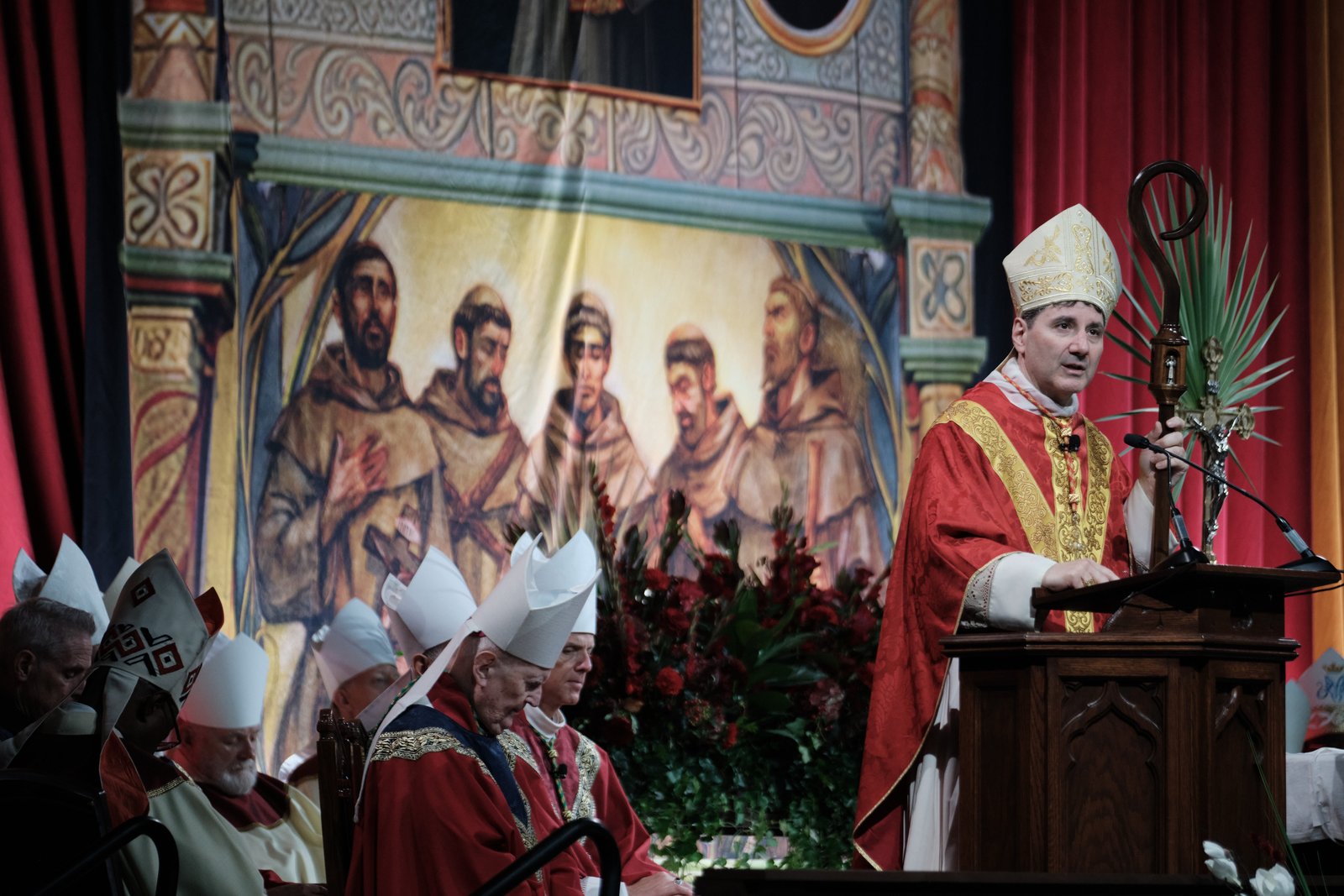
In the homily, preached in English and Spanish, Leo spoke about the martyrs’ witness to the truth of Church teaching and how their lives 400 years ago challenge Christians to more deeply embrace their faith today. In Spanish, the cardinal sent a special greeting to the delegation that came from Spain to share in this moment of faith and joy.
With their beatification, “these newly minted blesseds are constituted powerful intercessors and extraordinary examples for every believer,” he said.
“Fidelity to Christ himself is the glory of the martyrs,” Leo said. “The Church considers martyrdom an exceptional gift, and as the fullest proof of life.”
Sainthood next?
At a Mass of thanksgiving the next day at Savannah’s Cathedral Basilica of St. John the Baptist, Archbishop Gregory J. Hartmayer of Atlanta, thanked Franciscan leaders and others who championed the martyrs’ cause over decades.
“These were my brothers in St. Francis — Franciscans, Friars Minor,” said Hartmayer, a Conventual Franciscan friar who served as bishop of Savannah from 2011 until his appointment to Atlanta in 2020. “The Church asked with great patience: Did these men die because they would not betray the faith?
“In January of last year, Pope Francis answered for the full Church, and yesterday, Cardinal [Frank] Leo, legate of Pope Leo XIV, proclaimed it,” he continued. “The Church does not ‘make’ saints; she recognizes them.”
With their beatification, the Georgia Martyrs’ cause could advance to canonization with the official recognition of a miracle attributed to their intercession.
“I'll be honest: I am not sure where all of this is going to go,” Parkes said, “but I am confident in the Holy Spirit. I am confident in the continued work, the graces that will be poured out after this beatification.”
Parkes said that the martyrs’ witness is expected to inspire diocesan efforts to further promote “the dignity of marriage and healthy family life.” He said the diocese will celebrate the martyrs on their Sept. 22 liturgical memorial, and perhaps that day pray for the advancement of the martyrs’ cause, as well as for couples in Georgia preparing for marriage.
He also suggested that marrying couples include in their wedding Mass an intercessory prayer for Blessed Pedro de Corpa and companions “to work within the newly married couple.”
“There are many other ways we can continue to offer these holy men,” he said. “We have received a gift, and with any gift that we receive, we should always accept it with gratitude, with thanksgiving in our hearts.”

Maria Wiering is the Senior Writer for OSV News.
Lauretta Brown is culture editor for OSV News. Follow her on X (formerly Twitter) @LaurettaBrown6.