Why a holy death deserves more than just a celebration of life
Christians are more and more treating the corpses of their relatives with less and less care.
When my father died some years ago, my mother was near collapse. She turned to me as his body was carried out of their bedroom, and said through thin and bloodless lips, “Organize his funeral, mi corazón, I can’t do anything more.”
Over the next five days I bought a coffin, plot, and marker, planned a wake, Mass, and burial, printed prayer cards and funeral programs. It took all my strength of purpose, and all my love. The result was a pastoral and spiritual triumph — the perfect Catholic funeral rites — that were sacred and dignified. It was also a great consolation to me to honor and care for my father to the very end, in a way true to his infinite value as a child of God.
Of course, what I experienced was simple and even commonplace: the spiritual calculus of every corporal act of mercy which blesses the giver far more than the one who receives.
We understand this quite easily when it comes to feeding the poor and visiting the sick, acts whose beneficence comes flashing back at one like bright lights reflected from a mirror. Just so with burying the dead, although in our modern age that sets its face firmly against the transcendent, this last charitable corporal act is perhaps the least understood and most neglected.
It has become fashionable, even for practicing Catholics, at the moment of death to go thin where they should go thick. Influenced by the gnostic tendencies of our times, in which the human body is considered a kind of husk that merely shelters a divine spark, Christians are more and more treating the corpses of their relatives with less and less care. The bald cremation, scattering of ashes on the sea — even the sharing of ashes between family members as keepsakes — followed by an ad hoc “celebration of life” in which sweet memories of the deceased are swapped, is a model increasingly followed.
The modern plan goes wrong somewhere very deep and basic. It fails by forgetting that a human being is a single, handcrafted work in which the body and soul are inseparably meshed.
The psalmist made a song of it: “For you formed my inward parts; you knitted me together in my mother’s womb. I praise you, for I am fearfully and wonderfully made.” Our Creator God does not insert a soul into a finished body like a technician inserting an animating AI chip into a robot’s neck. God weaves our inner life and physical frame into one fabric, a body-soul unity. So rich with meaning is the human body that it was assumed by God in the Incarnation and is destined for resurrection. We will rise on the last day with our own bodies, and if our particular judgment goes well, our bodies will be glorified.
There are vast implications of the importance placed by Christianity on the human body. It precludes any act in which we treat our bodies or those of others as raw material to use and discard. It precludes slavery, fornication, mutilation, torture, abortion, surrogacy, and assisted suicide. And more to the point here, it demands that a corpse not be treated as a shell to be disposed of casually, because it is a body that Christ will raise. It cannot be scattered, because our dead are not dead but sleeping.
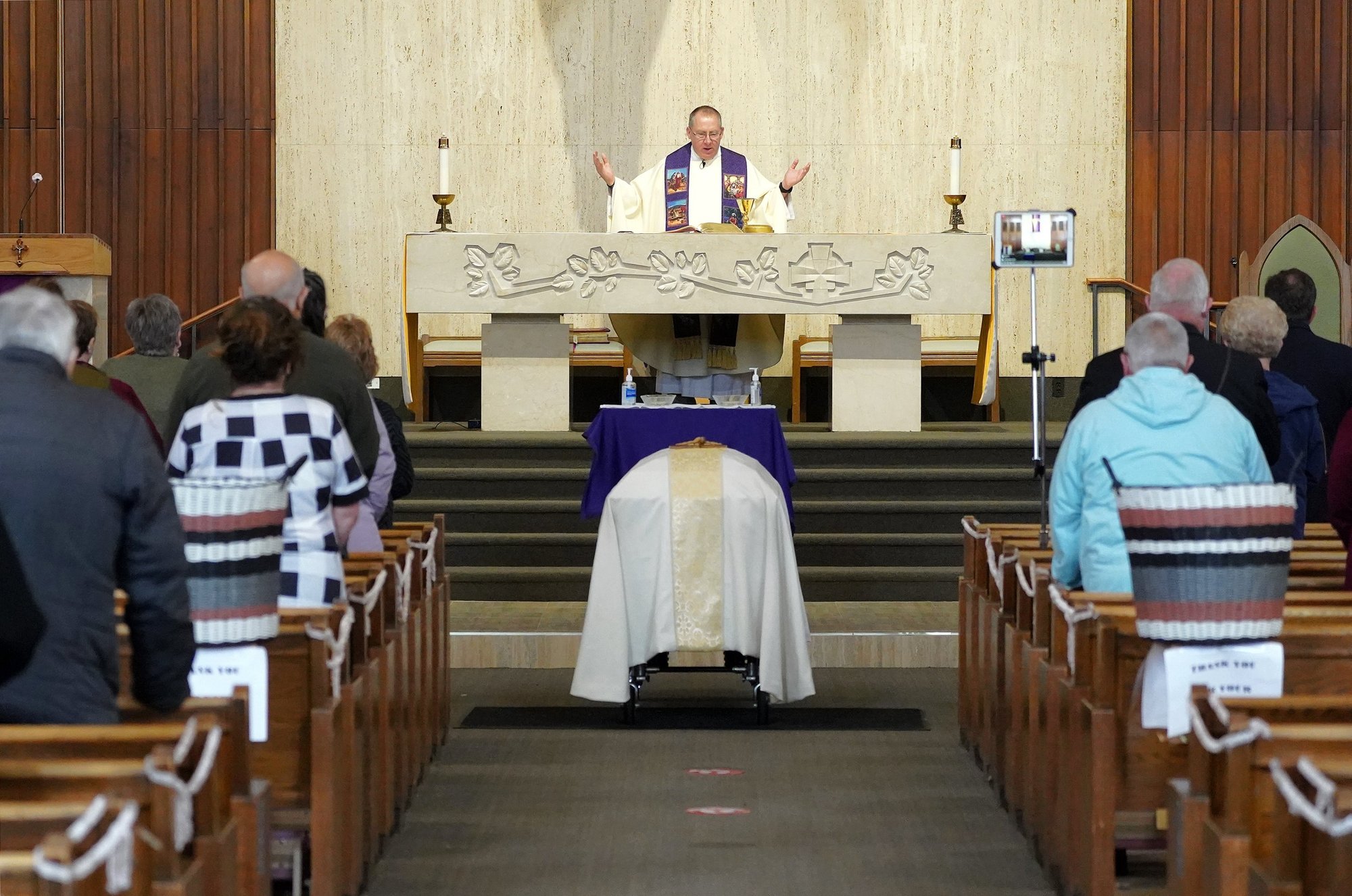
This is the theological reason for Christian funeral and burial rites, and it meshes beautifully with the spiritual needs of the mourners and the mourned alike. At a Catholic funeral, the Church does not celebrate a man’s life, but commends him to the mercy of God, offers sacrifice for him, and prays for the purification of his soul.
The body is laid, entire, if possible, and if not, cremated, in sacred ground to sleep while awaiting the resurrection. The mourners do this last office for their beloved, extending their tenderness beyond the moment of death and into the afterlife, with a resulting satisfaction and peace that has to be experienced to be believed. The Church insists, with each rite and prayer, on the Christian hope of seeing our beloved face-to-face in some distant land.
I dream at night of my father — that I find him in his favorite restaurant, sitting with my mother and their friends. I run up to him, laughing with glee, and fling my arms about him. “Papi! How I have missed your face.” He smiles at me with his irreplaceable smile, and I wake. I weep for a moment, and then I remember that I loved him until the end. I buried the dead. And one day, may God will it, I will throw my arms around his living body in reality, not just in dreams.

Dr. Grazie Pozo Christie has written for USA TODAY, National Review, The Washington Post, and The New York Times. She lives with her husband and five children in the Miami area.