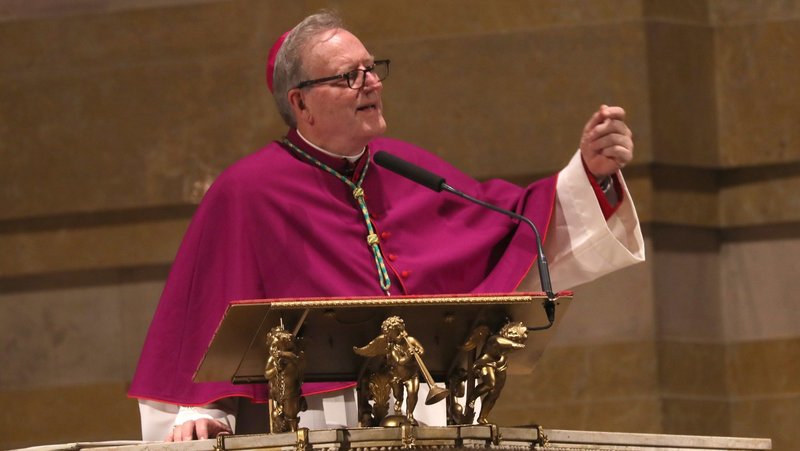
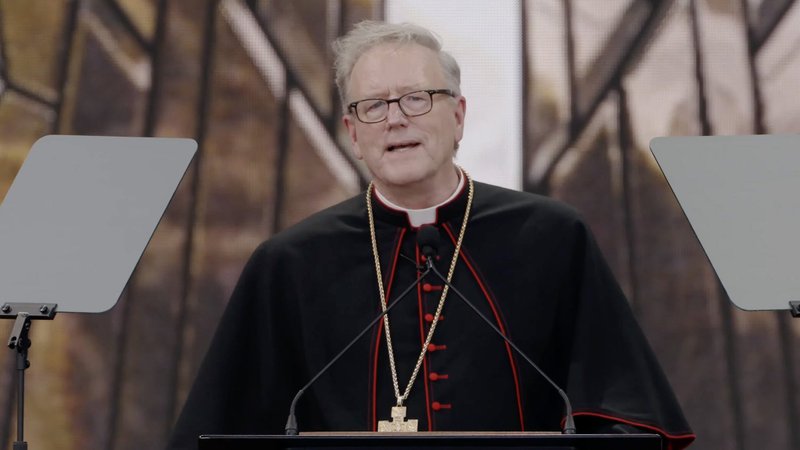
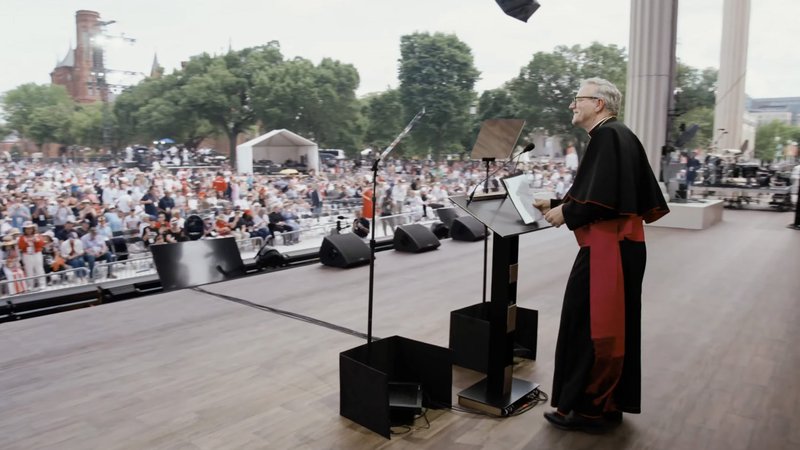
Bishop Barron’s tribute to Gothic cathedrals
As “Heaven in Stone and Glass” hits theaters around the world, Bishop Robert Barron reveals what makes these unique cathedrals special.
Gothic cathedrals are “powerful repositories of the Christian spirit.” They have a story to tell.
They must be read.
Bishop Robert Barron tells that story in his 2000 book, “Heaven in Stone and Glass” (Crossroad Pub. Co., $50).
Now Word on Fire, his global Catholic media apostolate, has launched a documentary of the same name, bringing the cathedrals alive on the screen.
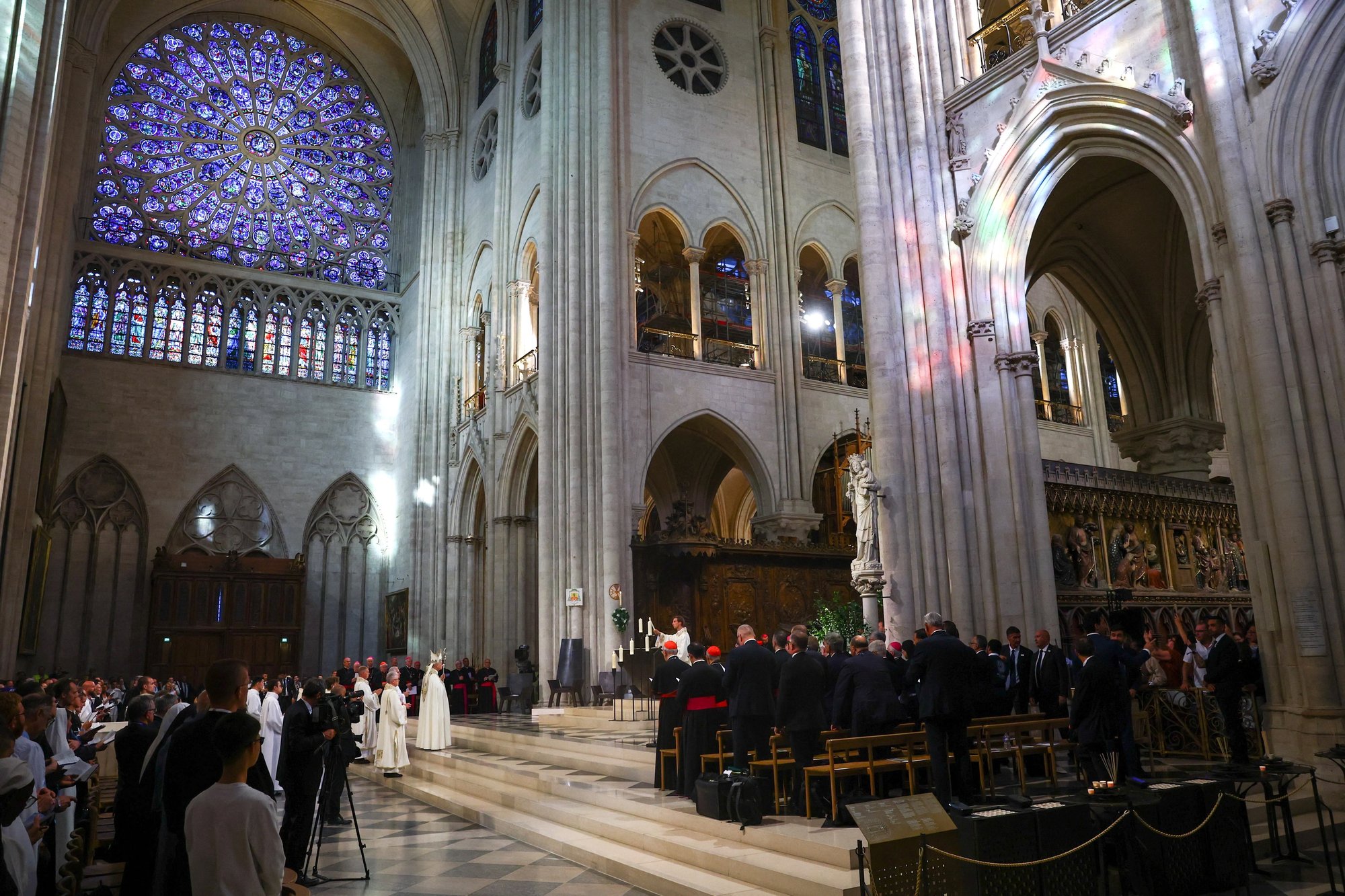
The film starts on April 15, 2019, the day Notre-Dame de Paris Cathedral burned. The whole world seemed riveted to the screen.
“Why did this event touch the soul of humanity?” he wonders.
He harks back to his student days in Paris. He’d chosen France in part precisely because he wanted to learn more about the Gothic cathedrals. His first day in town, he recounts, he was drawn to the north rose window of Notre Dame and stood, transfixed, for half an hour.
The interlude changed his life.
Thereafter, he would often return and, “in a kind of aesthetic arrest,” regard the window for 20 or 30 minutes, always feeling refreshed and enlivened afterwards.
He eventually became a tour guide at Notre Dame. He traveled throughout France to visit other notable Gothic churches. The buildings began to change how he saw the world.
Wearing a black, broad-brimmed hat, the bishop wanders among the cobblestoned streets like a pilgrim in “The Canterbury Tales.” He provides a historical perspective, paying special homage to Abbot Suger, who, under the direction of the French monarchy, gathered the best builders and craftsmen he could find and, from 1137 to 1144, rebuilt the Basilica of Saint-Denis.
King Louis VII and Eleanor of Aquitaine, present at the unveiling, were staggered at the beauty. The ribbed vaults, magnificent stained-glass windows, and pointed arches ushered in and provided the template for the whole era of Gothic architecture.
The flying buttresses of the cathedrals at Notre Dame, Amiens, and Chartres transferred the massive weight of stone walls and ceilings from the upper reaches of the building to sturdier supports on the ground.
The resulting soaring verticality made the cathedrals seem almost weightless, as if poised to float up to heaven. Over the course of the 13th and 14th centuries, Germany, England, and other European countries followed suit.
Suger was guided by the Platonic ideal and monastic traditions holding that the sensual and visible can lead to a sense of the invisible. A corollary idea is that the Church is meant to be a part of civil society, not privatized or set apart.
Everything about the church building mirrored the mystery of God, the glory of creation, and the marriage of heaven and earth. The spirit of the cathedrals is based first and overwhelmingly on a “theology of light.” God himself is pure light, as emphasized over and over again in Scripture: “And there was light” (Genesis), “The light shines in darkness,” “I am the light of the world.”
The German writer Goethe’s last words were “More light” — and that was the watchword of the Gothic builders as well.
The darkest part of a Gothic cathedral was the entryway, meant to mark the disorienting passage from the exterior world to a higher, more ethereal world — a passage that first requires a kind of death.
The centers of learning, dominated at the time by the study of liberal arts, leaned heavily on the ideals of harmony, order, and intelligibility. The Divine Mind, academics posited, was marked by a sense of proportion. Angels are at the top of the divine hierarchy; inanimate objects are at the bottom: a principle borne out among the Gothic cathedrals.
In this “mathematics of spirituality,” as Plato called it, the primordial shapes of the circle and the square took on huge theological significance. The Trinitarian number three (as well as the number nine: three cubed) was repeated over and over again: a cathedral might have three aisles, three portals, three side chapels.
To take just one example, the North Rose Window at Chartres, a marvel of symmetry, ordered numbers, and sublime blue-violet light, is meant to produce a feeling of inner harmony in the person who gazes upon it.
On the other hand, the Gothic builders didn’t shy away from the dark side. Gargoyles, devils, serpents, and monsters, sometimes in obscene poses, abound.
Many of the churches feature labyrinths. Generally located about a third of the way up the nave, these consist of a series of tight circular twists and turns, a path that is meant to start at the outer edge and to be walked slowly to the center. As with our lives on earth, there are no shortcuts; no hurrying.
To bring things full circle, Pope Leo XIV recently reflected that his September pastoral visit to France could be emblemized by a single central image: the reconstruction of Paris’ Notre-Dame Cathedral.
“It is precisely Notre-Dame, with the tragedy it has endured, that can symbolically shed light on this entire apostolic journey, offering a perspective that I would summarize in one word: rebirth.”
Or as Barron exhorts, “Let’s endeavor again to read these cathedrals and to cherish them.”
The documentary completed a limited theatrical release on Sept. 20 and 23, 2026. Word on Fire is currently soliciting donations to reach its goal of showing in 1,000 theaters nationwide.

Heather King (heather-king.com) writes memoir, leads workshops, and posts on substack at "Desire Lines: Books, Culture, Art."