The Nobel Prize winner who's 'baffled' by God
Nobel laureate Anne Carson’s work makes me wonder: how can someone who thinks God isn’t available to us be so haunted by him?
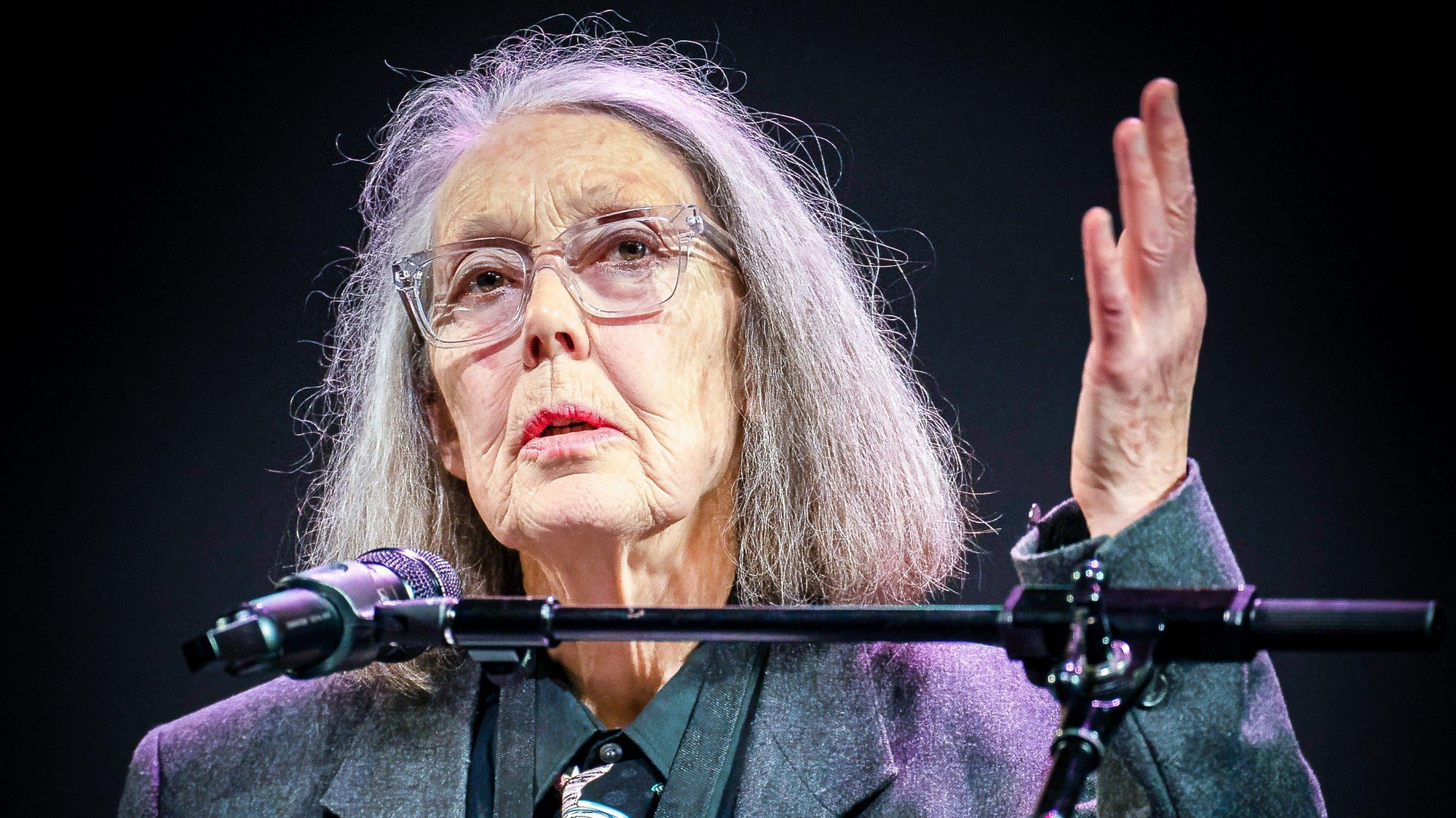
Last month, the Swedish Academy awarded Canadian classics professor and poet Anne Carson the 2026 Nobel Prize in Literature “for her bold and inventive oeuvre that, in playful dialogue with the classical tradition, has created a new form for contemporary literature.”
I was not very familiar with Carson. While researching her background, one of the first things I read about her poetry was disparaging remarks about its difficulty, some based on the non sequitur appearance of her lines and the bizarre images she used. I expected similarities with the last two Nobel laureates for literature I attempted to read: Laszlo Krasznahorkai and Jon Fosse.
Like Fosse, Carson has a Catholic connection. She is not a practicing Catholic (as Fosse is said to be), but she is haunted by religion and ideas about God. Reading some of her work and public remarks made me wonder: how can someone who thinks God isn’t available to us be so haunted by him?
She has a poem called “My Religion,” which illustrates this paradox.
“My religion makes no sense
and does not help me
therefore I pursue it.”
Carson’s words are an echo of Tertullian’s “credo quia absurdum est” (“I believe because it is absurd”). In an interview, Carson made her almost mystical confusion more explicit. The interviewer in The Paris Review asked her if she found Catholicism “a way out of self for you.”
“Quite the reverse,” Carson answered. “I don’t think I’m ever so resigned to myself as when I’m in church trying to understand why I’m in church. Sitting there thinking about my mother and all the times we sat together in church. The only good memory I have of it is leaning up against her fake-fur coat during Mass. I remember the smell of that coat, how comforting that was on a cold winter day.”
As a pastor, I think I would be puzzled and almost afraid to see her in church. Carson said that rather than “devout,” she thinks of herself as being “particularly baffled” by the God question but, “possibly because of lots of empty spaces in my life, I am open to exploring what that might mean.”
“I don’t go to church with any expectation of fulfillment or illumination. I just go because I have gone, and my mother went, and her mother went. A kind of thinking takes place there that doesn’t take place anywhere else. No matter how unattractive the service — and nowadays the Mass is rather unattractive in its modern translation — no matter how brainless the sermon, there is a space in which nothing else is happening so that thinking about God or about the question of God can happen. But nothing changes, I don’t become wise about this, I don’t become ethically better or more interesting.”
Carson’s deliberate ambivalence about God has layers. In another poem, she says:
“Sometimes God will drop a fit on you.
Leave you on your bed howling.
Don’t take it meanly.
Because the outer walls of God are glass.
I see a million souls clambering up the walls on the inside
to escape God who is burning,
Untended.”
The strange image of a God who is burning “untended” fits with the strangeness of Carson’s poetic language. Sometimes the poems seem just crazy, a jumbling of words and images that seem to have dropped on the page.
Carson’s classical learning contrasts with the homespun images (e.g., in the interview, she says she missed her mother “like an old sock”). She also does some genre-bending in her writing (she is married to a man, her second husband, but says that “I think that at different times in my life I located myself in different places on the gender spectrum.”)
One of Carson’s strangest — and most powerful — works is her tribute to her late brother Michael, who died suddenly and whom she had not seen in 20 years. This work, titled “Nox,” is more like an artifact than a poem or a book, printed on a single piece of paper and folding out like an accordion. Inspired by the famous poem Catullus wrote about visiting the grave of his brother, the “pages” or sheets of the poem reference many individual words from the Roman poet. This mosaic of memories and emotions includes photos of her brother and other illustrations, and bits of a letter he wrote to his mother about a woman he loved who had died.
Her brother, Carson explained, fled Canada to avoid going to jail and traveled through Europe and India, occasionally sending postcards to his mother and one letter. Carson includes a letter her mother was never able to send to Michael.
Ultimately, “Nox” makes for a forceful invitation into another’s experience, like Catullus’s poem but much more extensive and complex, a mosaic of memories and emotions.
“I finally decided that understanding isn’t what grief is about. Or laments,” Carson has said. “They’re just about making something beautiful out of the ugly chaos you’re left with when someone dies. You want to make that good.”
The Nobel Committee seems to like writers whose works are difficult. The New York Times critic called Carson “the easiest of the difficult poets.” In our seminary library, on the ceiling, there were representations of the arts. “Literatura speculum vitae,” was the motto under a book: “literature is the mirror of life.” It reminds me of a line from a Broadway show in which a woman carries a compact in her purse with a cracked mirror, and says, “I like to look like I feel.”
The “feel” of this Nobel laureate is that the world does not make sense. God exists but is not available. I suppose that resonates with the post-Christian intellectuals of Europe. While Carson has rejected comparisons with another brilliant Canadian writer, Alice Munro, she admitted in 2004: “What we have in common is perhaps an attitude that however bad life is, what’s important is to make something interesting out of it.”
Her writing makes for fascinating reading and provokes meditation. We should pray for Carson and all our other contemporaries who are like the lost sheep waiting for the Shepherd to find them.
Msgr. Richard Antall is pastor of La Sagrada Familia parish in Cleveland, Ohio, and the author of several books. His latest novel, “The X-mas Files” (Atmosphere Press), is now available for purchase.