The globe-trotting writer who experienced the wonders and woes of the world
Martha Gellhorn covered, among other events, the Spanish Civil War, World War II’s D-Day, and the liberation of Dachau.
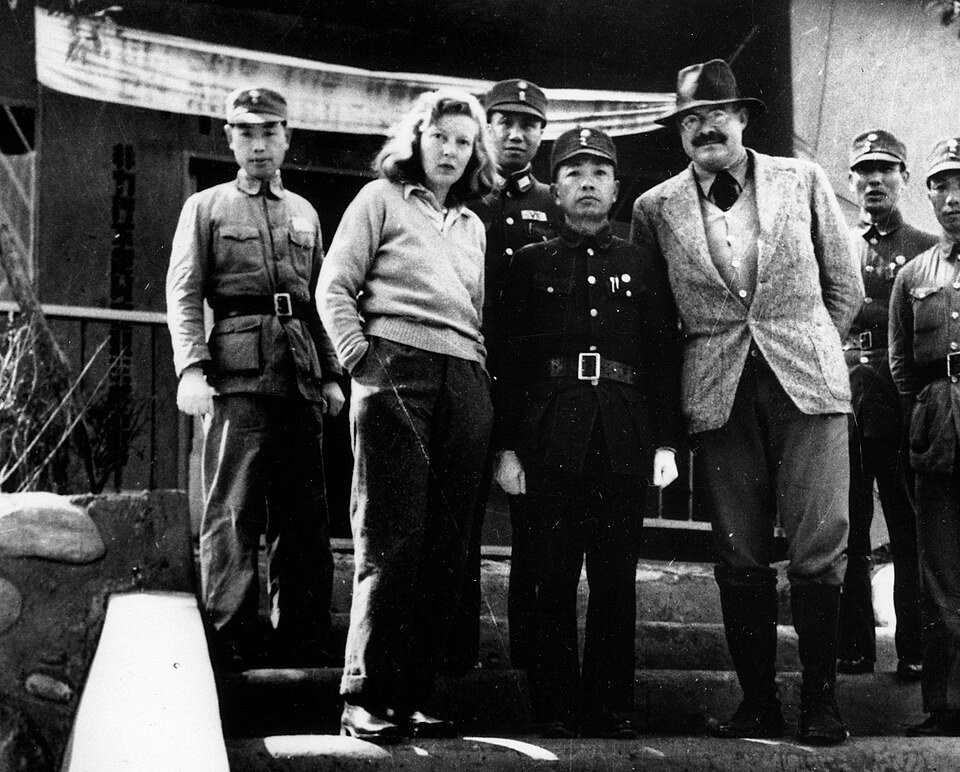
Martha Gellhorn (1908-1998) was the globe-trotting journalist who covered, among other events, the Spanish Civil War, World War II’s D-Day, and the liberation of Dachau.
In many ways, she’s the ideal of a strong, independent woman. She suffers insane discomfort, inconvenience, and squalor in the course of her reporting, but never whines. She never complains about being female in a man’s world. She’s highly opinionated, not politically correct, and admits her many faults and failings. She doesn’t suffer fools gladly, but she suffers them, over and over, as we must in this world — being fools ourselves.
She has a bone-dry sense of humor.
And she’s a flat-out terrific, and terrifically entertaining, writer.
“Travels with Myself and Another” (Tarcher, $15.64), one of her roughly 20 fiction and nonfiction books, is a memoir of sorts in the form of several long, loosely related essays.
In “Mr. Ma’s Tigers,” she drags the U.C. (Unwilling Companion: a pseudonym for Ernest Hemingway, to whom she was married from 1940 to 1945) to China. It’s 1941 and they’re to cover the Sino-Japanese War.
He’s a good sport, but the trip is pretty much a debacle from beginning to end.
She reports on the pavement dwellers, opium dens, and brothels: “Two dollars a night per man per girl.”
“These people were the real Hongkong and this the way most cruel poverty, worse than any I had ever seen before,” she continues. “Worse still because of an air of eternity; life had always been like this and always would be. The sheer numbers, the density of bodies, horrified me. There was no space to breathe, these crushed millions were stifling each other.”
In Africa at the pool of a resort hotel, she observes, “White skin is horrid.” Later, at a native dance, she also observes, “There were old women — hags … with rouge dabbed in flat brilliant red circles on their cheeks, beat-up straw hats on their shaved black fuzz, and the shapeless dirty printed calico dresses which must be the missionaries’ legacy to African womanhood.”
Then she hires a driver, a delicate young black man who, it turns out, has never been outside Nairobi, is terrified of wild animals, has no license (because he doesn’t know how to drive), and she finally figures out is gay.
In spite of the almost unrelieved torment and anxiety of their voyage across the savanna, she fell in love with the continent, bought a house high in Kenya’s Rift Valley, and lived there, off and on, for 13 years.
But it’s the essay “One Look at Mother Russia” that’s truly priceless. Martha has struck up a correspondence with Nadezhda Mandelstam, widow of the revered Russian poet Osip Mandelstam, who died in the Stalinist camps. She’s read Nadezhda’s two memoirs, and deems them masterful; they’ve reduced her to tears. She’s sent off a fan letter, never expecting to hear back. Miraculously, she does. The two send chatty missives back and forth. Finally, it’s arranged: Martha will travel to Moscow so they can meet in the flesh.
Everything about the journey makes it a quintessential “horror trip.” Russia is hideous, incomprehensible, and unworkable. Everything is maximally opaque and maximally difficult.
The buildings are squat, brutalist, and aggressively ugly. The people are coarse, rude, and willfully, maliciously unhelpful. Everyone has to queue for hours simply to buy basic necessities, when they’re even available.
After absurd, baroque wrangling, Martha nabs a hotel room: 21 miles from downtown Moscow, necessitating a daily nightmare of scoring a taxi, bribing the driver, and a time-consuming round-trip drive through an utterly depressing landscape.
Nonetheless, she faithfully shows up each day. The apartment is filled at all times with people chain-smoking, drinking vodka, and talking over one another at full voice. The phone (which, like every other phone in Moscow, is tapped) rings every two seconds.
Martha brings classical music records, nylon stockings, and scent from home. “I’ve never had scent before,” Mrs M. exclaims, nearly weeping; later Martha spies a bottle of Chanel No. 5 on her dressing table.
People bring in plates of food and pass them around: tiny helpings of eggplant, mushrooms, potatoes. Martha, perpetually starved, splurges and hauls up bags of caviar, sausages, chocolates. Mrs M. — in her way, magnificent — thanks her, then puts it all in the cupboard for later, and offers another minuscule plate of pickled cucumbers.
Martha begins to suspect they’re playing her. A rich woman writer from the United States must have money to burn, she figures they’ve been thinking. Worse, she’s eventually bored out of her skull and speechless at the Russians’ seemingly mindless acceptance of the censorship, oppression, and hardship under which they live.
Moreover, after spending 10 hours a day with Mrs M. and her friends, Martha realizes that not once has anyone asked a single question about her own life, her work, her country. They live in their own self-contained world — and never the twain shall meet.
The pen “pallery” fizzles out. “How wearying she must have found my long discursive letters from Africa, too tedious to read,” Martha realizes.
Though she’s devoid of self-pity, a thread of melancholy runs through her writing. Gellhorn’s marriage to Hemingway was brief and unsatisfying; subsequent relationships didn’t work out either. She adopted a child in 1949, and continued to travel. Suffering from ovarian cancer and going blind, she took her own life at the age of 89.
“In one of her last letters, Mrs M. wrote, ‘Everyone who leaves here is gone forever.’ ”
What’s not gone is Gellhorn’s feistiness, her fearlessness, and her clear-eyed determination to call things as she saw them.
I bet she was a wonderful traveling companion.

Heather King (heather-king.com) writes memoir, leads workshops, and posts on substack at "Desire Lines: Books, Culture, Art."