Pope’s envoy sees Ukraine’s war and hunger firsthand
Archbishop Luis Marín de San Martín delivered aid and met some 2,000 people lined up for bread at a cathedral.
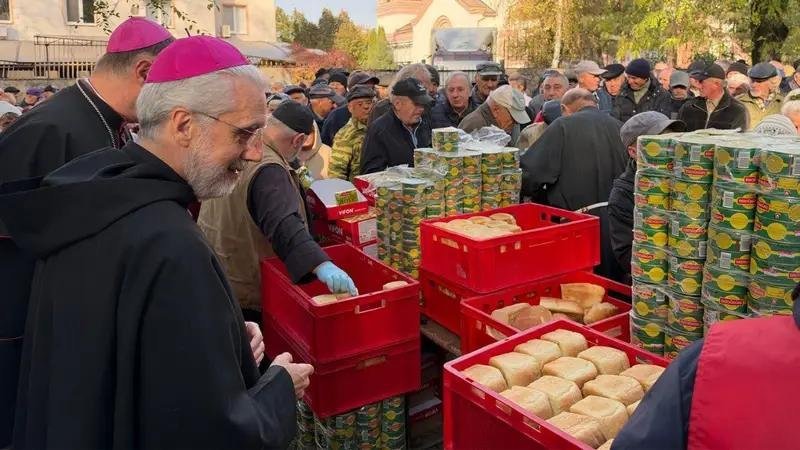
At dawn on Oct. 29, people were already lining up outside the Catholic Cathedral of God the Merciful Father in Zaporizhzhia, Ukraine. By morning, about 2,000 had gathered for bread, among them children carrying empty bags, some without their parents.
The food they received helped families get through another day.
Archbishop Luis Marín de San Martín, Pope Leo XIV's almoner and prefect of the Dicastery for the Service of Charity, witnessed the scene during a humanitarian mission to Ukraine as he prepared to distribute bread himself to the crowd. He had spent the previous night in the city as Russian attacks continued.
The next morning, a Russian drone struck a municipal bus about 650 feet from where the papal delegation was staying, according to Auxiliary Bishop Jan Sobilo of Kharkiv-Zaporizhzhia. Local authorities reported four people injured.
"I think he experienced the reality of war. He came into contact with it," Bishop Sobilo, a Polish-born bishop who has served in Ukraine for more than three decades, told OSV News. What appeared to affect the papal envoy most, however, was the crowd waiting for food.
"He looked at that crowd and was shocked that there were so many hungry people," the bishop said.
A visit of closeness
Archbishop Marín visited Ukraine Oct. 27-30 to deliver humanitarian assistance and convey Pope Leo's support to people affected by Russia's full-scale invasion, now in its fifth year. The delegation traveled approximately 1,740 miles by road and visited 12 Catholic charitable institutions, bringing a gift from the pope to each.
In Zaporizhzhia, about 12 miles from the front line, the envoy joined the Albertine Brothers in distributing food outside the Cathedral of God the Merciful Father. "Two women, both retired Protestants and good bakers, help the brothers bake bread so that those 2,000 people can receive it the next day," Bishop Sobilo told OSV News. The brothers use an oven donated through the Vatican's charitable office. The bakery provides bread to about 10,000 people a week.
Many people lining up for bread in eastern Ukraine had fled Mariupol, Melitopol, Berdiansk and other communities occupied by Russian forces, the bishop said. "They escaped to Zaporizhzhia hoping that their towns and villages would be liberated soon. Nearly five years later, many are still living in temporary accommodation, without enough income to cover basic necessities."
Some children come to the bread distribution alone. "Their fathers may be fighting, dead or missing; their mothers may be at work," Bishop Sobilo told OSV News. "Others live in families struggling with poverty or addiction.
"Apart from receiving what everyone else gets, the brothers always have something special for them, something sweet. And in the winter, they check whether a child has a hat. If not, they find one right away. Shoes, hats, jackets -- they try to take care of these children," Bishop Sobilo told OSV News.
'Every night, every day, bombs fall'
Father Lukasz Slusarczyk, director of the Caritas branch of the Archdiocese of Kraków, Poland, visited Zaporizhzhia with humanitarian aid shortly before the papal delegation arrived.
"We arrived in Zaporizhzhia at night. Shortly after 4:30 a.m., ballistic missiles struck several times near the cathedral," not more than 980 feet from them, he said.
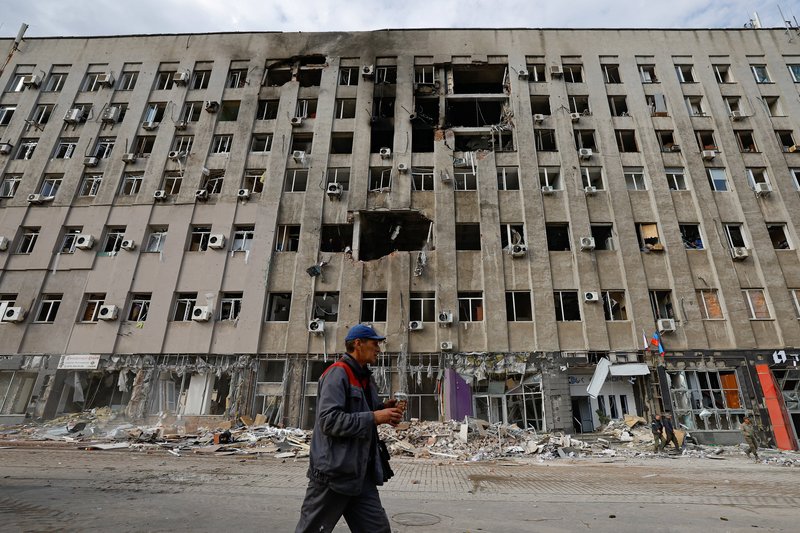
"War is visible at every turn," he told OSV News. Father Slusarczyk described anti-drone nets stretched over streets, damaged buildings and residents leaving the city as others arrived from villages closer to the fighting. After unloading food, he toured the city with Bishop Sobilo.
"People know that organizing aid is becoming increasingly difficult. We do what we can," the priest said. "When the brothers told us they were running out of canned food, we managed to raise exactly the amount of money needed to buy it."
"The brothers bake between 1,200 and 1,500 loaves of bread and distribute them several times a week, along with canned food and instant soups, to people who come for help," Father Slusarczyk told OSV News.
The priest also met Ihor, a former transport company director whose brother was killed in the war. Ihor now helps deliver humanitarian supplies and stays in Zaporizhzhia to care for his parents. He sent his wife and children to a safer location in 2022, expecting a separation of a month or two. Four years later, they are still apart.
"Every night, every day, bombs fall," Ihor said, according to an account Father Slusarczyk shared with OSV News. With the frontline only 7.5 miles from the city, "Russians want to raze Zaporizhzhia to the ground. We do not know when it will end. We entrust ourselves to God's will," Ihor told the Polish priest.
First-, second- and third-graders learning in the underground shelter
Winter poses another threat. "An even more difficult time is coming, because winter is approaching," Bishop Sobilo told OSV News. "There may be no electricity, and in some places no gas or water. Sewage systems may stop working, because without electricity the pumps don't work."
At the Catholic Don Bosco School in Zaporizhzhia, children are learning to live with danger.
Vitaliya Vovk, the school's director, told OSV News that first-, second- and third-graders attend classes in person, underground, from 8 a.m. to 5 p.m. "We study underground, in a shelter," Vovk told OSV News.
"When there is no air raid alert, the children see the sun and play on the playground, but most of the time their educational space is protected by the thick walls of the shelter."
The papal envoy also visited the school, though the pupils were away on a school break. "For our community, it is a sign that we are not alone, that we are seen and heard," Vovk told OSV News. "Today, life for children in Zaporizhzhia is a constant choice in favor of hope," she said.
"The opportunity to go to school every day is not just about education. It is a sense of safety, stability and childhood that someone is trying to take away from them."
A wounded generation
Bishop Sobilo fears the psychological damage will outlast the fighting.
"These children will be wounded," he told OSV News. "Their reactions will not be like those of children who have not experienced permanent stress." Some families who once refused to leave now consider doing so because of the effects of repeated air raid alerts and shelling on their children, he said. Some have developed serious anxiety or sleep problems.
The bishop recalled meeting a 7-year-old boy in Donetsk years earlier who stopped speaking after experiencing heavy shelling. He believes recovering from the psychological effects of war may prove more difficult than rebuilding damaged buildings.
Meanwhile, the number of people needing food is increasing, the bishop said, while donations have declined. He sees people counting coins in stores to buy part of a loaf of bread or a single sausage, and others searching through garbage containers for food.
"Nobody who can afford to buy bread would get up at five in the morning to be outside the church at six and receive a small loaf at nine," he said.
Before the visit, a Vatican collection Oct. 22-24 gathered about 600 boxes of winter clothing, blankets, sleeping bags, linens and food. Two trucks delivered the supplies to Church organizations in Kyiv and Fastiv for distribution, particularly to communities near the front, according to the Vatican.
Bishop Sobilo said he hopes Archbishop Marín will tell Pope Leo what he saw in Zaporizhzhia. He recalled accompanying Cardinal Konrad Krajewski, longtime papal almoner under Pope Francis, on visits to Ukrainians affected by the war. The food packages mattered, he said, but so did the realization that they had not been forgotten.
"They could see in the eyes of Cardinal Konrad, and now Archbishop Luis, the love and concern of the pope," Bishop Sobilo told OSV News.
Katarzyna Szalajko writes for OSV News from Warsaw, Poland.