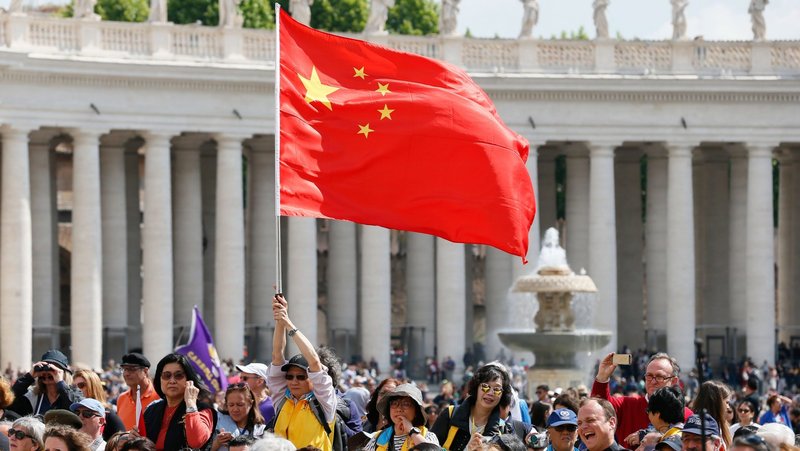
Centennial of Chinese bishops highlights tension over sinicization, Rome ties
Speakers weighed church autonomy and communion with Rome as Aid to the Church in Need pointed to growing persecution of Chinese Christians.
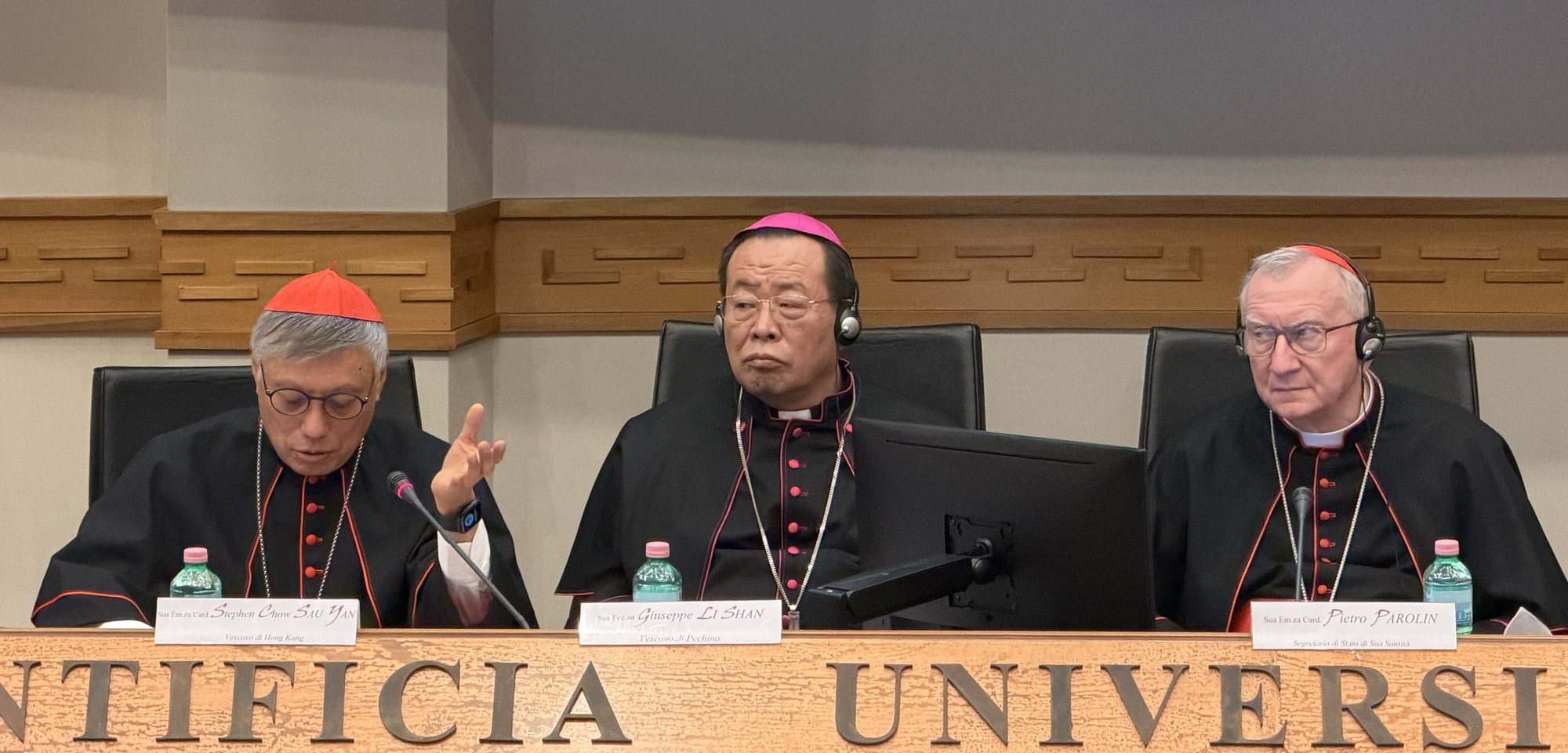
Cardinal Pietro Parolin, the Vatican's secretary of state called for more concrete expressions of communion between the pope and the Catholic bishops in China at a conference marking the centenary of the consecration of the first six native-born bishops of the modern era.
"The communion which certainly exists today in its essential form between the pope and all the bishops of the People's Republic of China may, through a gradual and shared journey, find ever more concrete ways to express and strengthen itself," he said.
Held Nov. 5 at the Pontifical Urban University, known as Urbaniana, in collaboration with the Dicastery for Evangelization, the conference brought together Vatican officials, Chinese bishops and scholars to examine a milestone in Chinese Church leadership against continuing questions about the Church's relationship with Rome and the Chinese state.
Discussions of Sinicization, patriotism and dialogue highlighted the challenge of building a Church rooted in Chinese society while safeguarding its universal identity and freedom from political interference.
Chinese leadership and communion with Rome
The 1926 consecrations marked a decisive step toward Chinese leadership, part of a centuries-long effort to root Catholicism in Chinese life and a renewed push by the Holy See to distinguish evangelization from foreign political interests.
Pope Leo XIV, addressing the conference in a prerecorded video message, situated the event within the renewal of missionary approaches in the early 20th century, described the consecration as a moment of "great significance not only for the journey of the Catholic Church in China but also for the universal Church."
Pope Leo highlighted Pope Benedict XV's 1919 apostolic letter "Maximum Illud" as a concrete expression of that shift, saying that his predecessor "reaffirmed the clear principle that the Church's missionary work cannot be confused with processes of colonization or the export of ideas or cultural models."
Pope Pius XI carried that effort forward through Archbishop Celso Costantini, the first apostolic delegate to China, who organized and presided over the first the Shanghai Synod of Bishops in 1924, which helped pave the way for the consecrations of the six Chinese bishops on Oct. 28, 1926, in Rome.
A century later, episcopal leadership remains central to Vatican-China relations. The provisional agreement on bishop appointments, reached in 2018, was renewed in 2020 and in 2022 before being extended for four years in October 2024. While its official contents remain unpublished, the Holy See has defended continued dialogue as a means of supporting the Church in China.
Speaking to journalists in October, Archbishop Paul Gallagher, the Vatican's secretary for relations with states, noted that the "imperfections of the agreement are evident, but there is a commitment to persevere in dialogue … and that is what will continue to happen."
Sinicization and dialogue
Jesuit Cardinal Stephen Chow Sau-Yan of Hong Kong, examined the contemporary challenge though Sinicization, explaining that the policy is not exclusive to the governance of Catholicism, but extends to other religions and areas of Chinese society. It involves alignment with "the Chinese Communist Party's ideologies and socialist values and the spirit of patriotism," he said.
The push under President Xi Jinping was reinforced by a 2018 restructuring that absorbed the State Administration for Religious Affairs, a government agency overseeing bodies including the Chinese Catholic Patriotic Association, into the Communist Party's United Front Work Department. Further measures, effective in May 2021, required clergy to support party leadership and promote Sinicization.
Cardinal Chow acknowledged the tension facing Catholics seeking to belong fully to both Chinese society and the universal Church, noting that Catholicism continues to be perceived as "foreign." He emphasized formation in genuine dialogue, warning that exchanges too often become "parallel monologues." His proposed intercultural approach asks participants to recognize their own blind spots and remain open to change, advocating for a "third space" where trust can develop.
Archbishop Joseph Li Shan of Beijing presented Sinicization as an expression of Catholic universality.
"The Sinicization of Catholicism is not about building a different kind of Catholicism or a Catholic Church that departs from tradition," he said. Rather, it "makes the universality of the Church concrete, rich, and mature in a real local context."
Archbishop Li described Chinese Catholics' emphasis on "patriotism, love for the Church, independence and self-management" as an adaptation to China's Church-state relationship. He linked that approach to the recent Synod of Bishops emphasis on "walking together," noting that Chinese clergy, religious and lay faithful jointly manage the Church's affairs.
The language of independence has troubled the Holy See in the past. Its 2019 pastoral guidelines acknowledged the clergy's concerns about registration requirements and recognized the choice of those unable to register in conscience.
Archbishop Li argued that obedience to legitimate civil authority was grounded in Scripture, tradition and papal teaching.
"State law and Church law do not contradict each other; rather, both complement each other on the path toward human perfection," he said, asserting that national law protects the Church's pastoral work and the rights of the faithful.
That account contrasts with restrictions documented by Human Rights Watch, including surveillance and pressure on underground Catholic clergy.
ACN: Persecution of Chinese Christians getting worse
Recently released report by pontifical charity Aid to the Church in Need noted that persecution of Christians in the country worsened compared to the previous reporting period of 2022-2024, with the organization saying that "'Underground' churches faced 'intensified' persecution, and new government regulations tightened state control of religious material such as the September 2025 Code of Conduct for Religious Teachers and Personnel."
The report also noted that "a growing number of provinces including Henan and Xinjiang prohibit anyone under 18 from participating in worship."
ACN's massive two-year report said that the September 2025 Online Code of Conduct for Religious Personnel "made publishing religious content online without a 'special licence' illegal" and "banned live-streaming liturgies, prayer meetings, and religious instruction for children, and online preaching on unlicensed websites. Only state-registered denominations are allowed websites. All online activity must demonstrate 'support for the leadership of the Communist Party of China,'" the report notes.
During the Urbaniana conference, Archbishop Li situated the Church's development within China's broader national aspirations, describing the country as pursuing "the great renewal of the Chinese nation."
"It is a changing China, a China that loves peace, and a China willing to make friends widely," he said.
Meanwhile, imprisonment of prominent Hong Kong Catholic Jimmy Lai continues, with diplomatic efforts, including by the Trump administration, not bringing a solution.
Lai is kept in solitary confinement, with Claire Lai, his daughter, telling OSV News in January that "conditions in which he's been kept have only just gotten worse" and that "he doesn't have fresh air or natural sunlight" in prison.
Matthew Santucci is a CNA Rome correspondent based in EWTN's Vatican bureau. He grew up in Connecticut and has been living in Rome since 2020. He has a B.A. in History from Fordham and an M.A. in International Relations from Luiss Guido Carli.