Saints of the day: Seven founders of the Order of Servites
Today the Church honors the seven founders of the Order of Servites. These seven men, Buonfiglio dei Monaldi (Bonfilius), Giovanni di Buonagiunta (Bonajuncta), Amadeus of the Amidei (Bartolomeus), Ricovero dei Lippi-Ugguccioni (Hugh), Benedetto dell' Antella (Manettus), Gherardino di Sostegno (Sostene), and Alessio de' Falconieri (Alexius), were born in […]
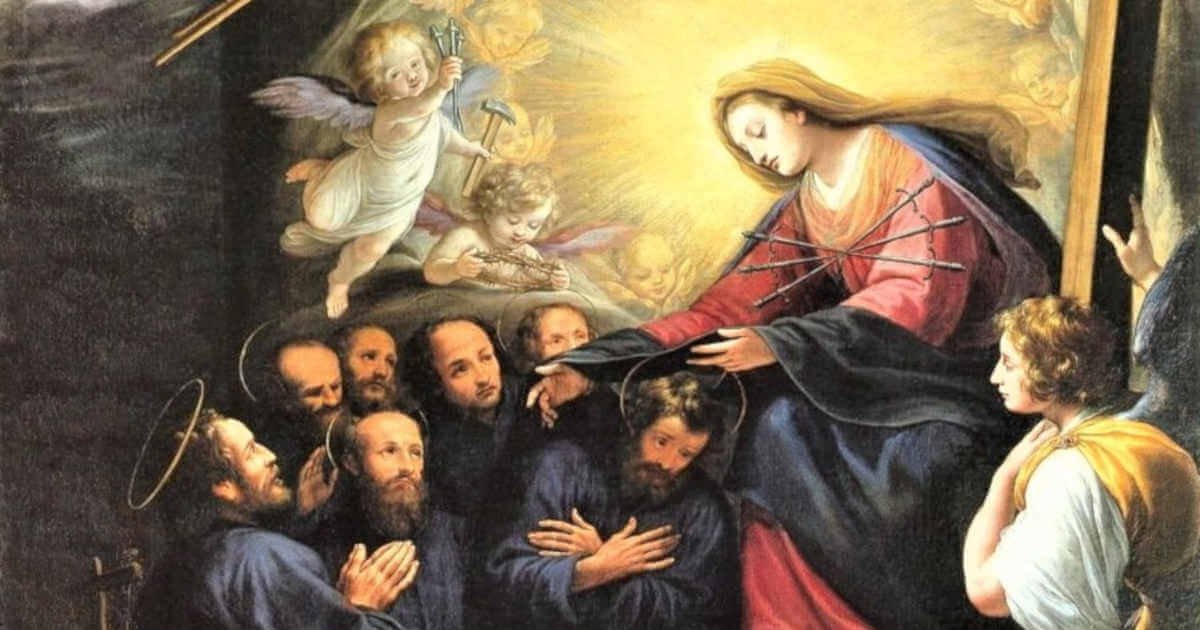
Today the Church honors the seven founders of the Order of Servites.
These seven men, Buonfiglio dei Monaldi (Bonfilius), Giovanni di Buonagiunta (Bonajuncta), Amadeus of the Amidei (Bartolomeus), Ricovero dei Lippi-Ugguccioni (Hugh), Benedetto dell' Antella (Manettus), Gherardino di Sostegno (Sostene), and Alessio de' Falconieri (Alexius), were born in Florence, Italy. They lived as hermits on Monte Senario, and were devoted to the Blessed Virgin Mary.
On Friday, April 13, 1240, the hermits received a vision of Mary. She held a black habit in her hand, and a nearby angel held a scroll that read “Servants of Mary.”
Mary told the men: “You will found a new order, and you will be my witnesses throughout the world. This is your name: Servants of Mary. This is your rule: that of St. Augustine. And here is your distinctive sign: the black scapular, in memory of my sufferings.”
The men did as Mary had told them. They wrote a rule based on St. Augustine and the Dominican Constitutions, adopted the black habit of the Augustinian monk, and lived as mendicant friars.
In 1304, the Order of Servites received the approval of the Holy See.
The Church remembers these men on Feb. 17 because that is said to have been the date of death of one of the founders, St. Alexis Falconieri, in 1310.
Pope Clement XI beatified the men on Dec. 1, 1717, and Pope Leo XIII canonized them in 1887.