One of the themes in the summer blockbuster “The Odyssey,” as I suggested in my review for Angelus, is paternity in times of crisis.
Since becoming pope, Pope Leo XIV has addressed the theme on various occasions, asking what role families should play in the face of contemporary challenges. His answer offers a more hopeful and constructive vision than, say, Christopher Nolan.
In his encyclical “Magnifica Humanitas”(“Magnificent Humanity”), Leo draws on the biblical account of the reconstruction of Jerusalem’s walls to entrust families with the task of rebuilding society, while rejecting a culture of power that treats war and violence as the only effective responses to mounting dangers.
And in his earlier meditation on the Gospel of the flight to Egypt, he suggests that families are the real antidote to the culture of power, embodied by the tyrant Herod:
“In the despotic and greedy world represented by the tyrant, it is the birthplace and cradle of the only possible answer of salvation, that of God who, in total gratuitousness, gives himself to men without reserve and without pretension.”
This discussion makes “The Holy Family at Home,” a rich exhibition at the Getty Center and on display through Jan. 10, 2027, especially timely.
Organized to celebrate the acquisition of “The Holy Family,” a masterpiece by the Dutch painter Gerard David, the exhibition features Northern European paintings and illuminated manuscripts from about 1400 to 1530, drawn from the Getty Museum and local lenders.
The works selected set the newly acquired painting within the wider context of late-medieval and early Renaissance art, highlighting the renewed importance of Joseph after the Middle Ages.
Until the 15th century, Joseph remained largely peripheral in art. He seldom appeared even in key scenes from the life of the Holy Family. When depicted, he was usually shown as an elderly guardian rather than a husband. This was due to the influence of the apocryphal Gospels, which accentuated Joseph’s advanced age to explain his chaste marriage to Mary. Joseph was portrayed as a mere spectator in the history of salvation.
“The Holy Family at Home” exhibition captures this earlier phase in the iconography of the saint through several illuminations and paintings.
In one medieval illumination of the Adoration of the Magi, for instance, Mary is accompanied only by female attendants.
Another highlight of the exhibition, Jan Gossaert’s “Holy Family,” has Joseph as an elderly man who looks perplexed at the Virgin Mary.
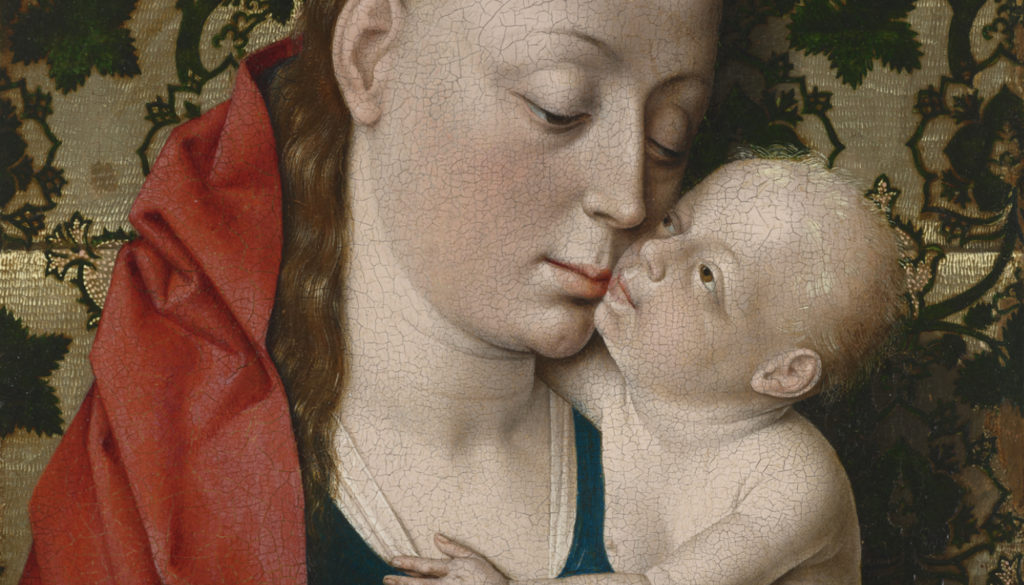
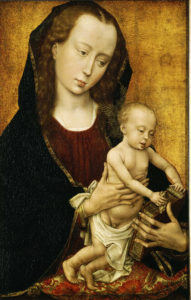
The depictions of the Virgin and Child by Rogier van der Weyden and Dieric Bouts provide important precedents for David’s work. Their informal portrayals of the Virgin tenderly embracing her child bring the sacred figures closer to the viewer. In van der Weyden’s version, the curious child opens the clasp of a book of Scripture, a reminder that he will be the fulfillment of whole Scripture. Yet Joseph remains absent from these paintings.
In the early 15th century, the work of French theologian and mystic Jean Gerson played a big role in transforming the perception of Joseph, profoundly affecting later depictions of the Holy Family.
Gerson rejected the picture presented by the apocryphal Gospels and affirmed that Mary and Joseph’s marriage was a real union. Highlighting the daily life of the Holy Family, he set up Joseph as an exemplary model of a loving husband to Mary and a caring father to Jesus.
In the Getty exhibit, this new attention to the role of Joseph is reflected in a series of 15th-century illuminations depicting the Flight to Egypt. Joseph now participates in the redemptive work of his son by protecting him and Mary.
As Leo noted last December, “Being obedient to the voice of the Lord by taking his Bride and child to safety, the gesture of Joseph is revealed in all its redemptive significance. In Egypt, the flame of domestic love, to which the Lord has entrusted his presence in the world, grows and gains strength in order to bring light to the whole world.”
The domestic love within the Holy Family is the hidden presence of God in the world. Stronger than armies and political power, unheeded by the powerful and the wise.
As the great novelist J.R.R. Tolkien put it, “the wheels of the world are often turned (…) but by the seemingly unknown and weak — owing to the secret life in creation, and the part unknowable to all wisdom but One.”
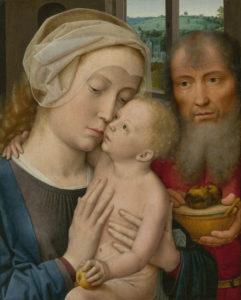
David’s painting reflects these theological developments. The Virgin and Child affectionately embrace, while nearby Joseph holds a wooden bowl with baby food (a milk soup and two cooked apples).
The artist brings the Holy Family into the foreground, creating the impression that they share the room with the viewers. The realistic details present them as a real family immersed in the simple, practical concerns of daily life.
The Virgin is dressed in contemporary clothes, and the buildings in the background are from the painter’s time, details which express that the Incarnation is still happening today.
Jesus holds an apple, a reminder that he is no ordinary child: he is destined to reconcile humanity with God after the fall of Adam. He is the new Adam, the firstborn of a new humanity.
By blending the ordinary with the supernatural, the painting captures the theological shock of the Incarnation: God became an ordinary child, in turn giving a supernatural dimension to the most menial tasks of parenting.
“In every child, in every husband or wife,” Leo said in a speech last September, “God entrusts us with His Son, with His Mother, just as He did with Saint Joseph.” He does so, Leo adds, “so that together with them, we may be a foundation, leaven, and witness of God’s love among humanity.”
Families participate in the history of salvation through their dreary everyday routines. Renaissance painters like Gerard David made this reflection visible in their work, and the Getty exhibit provides an unprecedented journey to appreciate their innovative approach.