In conversations with a variety of Catholics in recent months, an unexpected topic has been demographics. Specifically, baby boomers.
Boomers are those of us born between 1946 and 1964. We were an enormous demographic bulge in a china shop, having an outsized impact at each stage of life, from packed grammar schools to packed nursing homes.
Other age cohorts have often resented this impact, from Gen-Xers forced to live in our shadow to the also large and equally impactful millennials ready for their turn.
None of this is surprising, but what may be less expected is that it is a dynamic dividing some parishes these days.
The anecdotes come from both sides of the aisle.
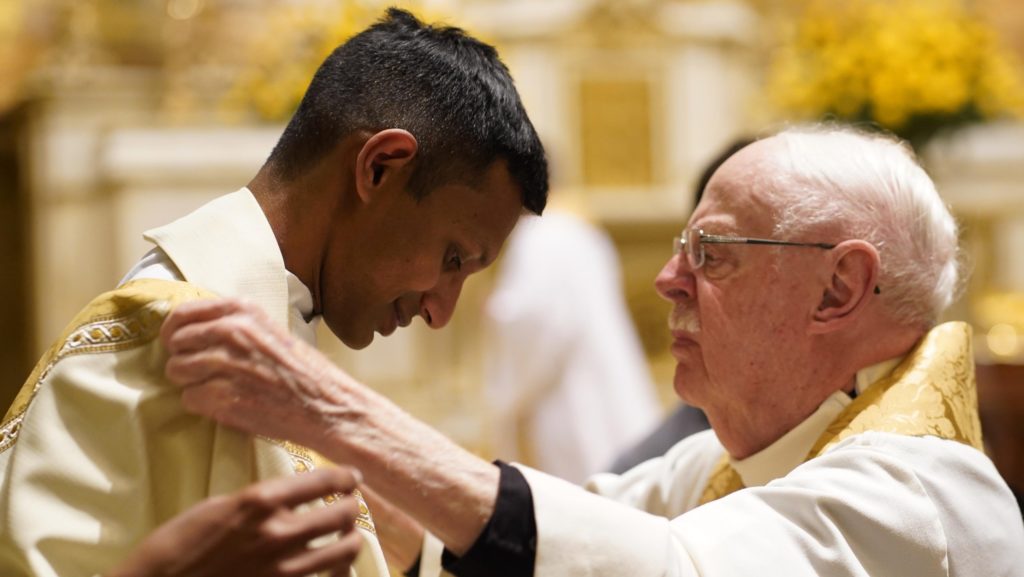
I’ve been told that many young-ish priests believe that their most frustrating parishioners are boomers. According to this telling, boomers like guitar Masses and are not fond of Latin. While younger priests may want to celebrate ad orientem (facing east with their back to the people), older Catholics are more likely to find this impersonal and off-putting. Not all, but many boomers seem uncomfortable with kneeling and receiving Communion on the tongue. And seeing young women in veils and seminarians in cassocks takes them back to a time they are not all that nostalgic for.
The first time a young priest wore a cassock in a parish I once attended, the pastor was put off and the older parishioners were too. My kids thought it was cool. “It looks like the Matrix,” my son explained.
Social media sometimes can cut to the chase, and a tweet I saw recently captured the resentment.
“Caught the end of the Novus Ordo since I’m early to church this week. The final hymn refers to Jesus as our ‘friend.’ It’s so insufferably boomer coded.”
Of course, “What a friend we have in Jesus” are lyrics that go back to the mid-19th century, and it is in Scripture as well. But that misses the barb. Boomers and their namby-pamby Novus Ordo Mass and their guitars and their warm handshakes at the kiss of peace: Well, they are all just … insufferable!
These tensions can be found in the rectories too, at least in those dioceses still lucky enough to have more than one priest in a rectory. Older priests feel they are often being judged for having “ruined the Church,” either because of the clergy abuse crisis or more generally because of Vatican II.
In parishes with younger priests and parishioners, there may be a hunger for liturgies and worship spaces they would describe as more reverent. Building campaigns now are for reverting such spaces to an older style. The Mass may still be Novus Ordo, but Latin creeps in on lamb’s feet: First the Agnus Dei, then the Pater Noster. But what is more reverent to some seems exclusionary to others.
As is so often the case when two or three Catholics gather to complain, we are dealing with gross stereotypes. And yet, I also can’t help but smile at the thought that everything is coming full circle. Boomers are cast as defenders of the status quo while in their mind’s eye they are still the Woodstock Generation.
The irony is that both sides of the aisle are reacting to the almost excruciating velocity of change that we have been enduring now for decades. Depending on the point of view, it’s the other side that are the reactionaries, while in fact all of us are wanting to hold on to something rock steady in the midst of constant upheaval.
The truth is that boomers didn’t cause Vatican II. The oldest of us were only 16 when it started. The changes it unleashed were a response to the upheavals of that era. The recovery of the pre-Trent past and a vernacular present was seen by many as a lifeline.
Likewise, today, with all the fissures and fractures of the culture wars and the creative destruction of 21st-century capitalism, the recovery of ironclad teachings, of ageless liturgies and hymns sung for generations may be the life raft that is needed by another generation.
David Brooks in his book “How to Know a Person” (Random House Trade Paperbacks, $20), talks about our need to recover essential social skills in order to truly see one another. But the foundational skill we need, he wrote, is “the ability to understand what another person is going through.” The worst thing, he added, is to be indifferent to the other.
I talked this over with a non-boomer priest recently, a priest who loves ad orientem and looks good in a cassock. Maybe it doesn’t have to be either-or, he mused. Maybe it can be both-and. How can we not make it us versus them? How do we make it one parish?
This solution won’t be from the top down. But it may have to be led from the rectory. Serving the whole parish is the mandate, after all. But if we are all claiming membership in a Church big enough to contain us all, maybe our parish and our hearts should be just as big.