Let’s celebrate the overlooked craftspeople and the objects they make
What do we lose when traditional crafts disappear?
“The Beauty of Everyday Things” (Penguin Classics, $13.76) is a classic book on aesthetics, written by Soetsu Yanagi, founding father of the Japanese crafts movement.
Yanagi (1889-1961) was a philosopher and art historian who championed the humble objects that are part of daily life and, at that point in Japan, were still often handmade — trays, vases, soup bowls — as well as the anonymous people who crafted them.
Published in 2019 by Penguin Classics and translated by Michael Brase, the collection includes essays written by Yanagi between 1920 and 1959.
“Forbearance, wholesomeness, and sincerity — aren’t these virtues witnesses to the fact that everyday objects have a heart?” he wrote. “They are rooted in the earth, deeply tied to the earthly life of honest, hardworking people, the recipients of the blessings of heaven. The world of utility and the world of beauty are not separate realms. Who is to say that spirit and matter are not one?”
“Craftland: In Search of Lost Arts and Disappearing Trade” (Crown New York, $19.99) could have taken the above paragraph for its credo. Author James Fox, a Cambridge art historian, is curious, compassionate, and a fantastic writer: the perfect guide to this exploration — part travelogue, part history — of people who work with their hands, carrying on ancient traditions.
“I’ve always loved handmade things,” he begins. “Whenever you encounter a handcrafted object — whether it’s an Old Master sketch, an antique watch, or a simple stoneware mug — you are meeting something that is by definition unique, with its own fingerprint of quirks and imperfections. That’s because every such item, no matter how accomplished or clumsy it may be, bears the indexical residue of a particular moment in time, when a human being put something into the world that didn’t exist before and couldn’t exist anywhere else.”
He then proceeds to travel all over the British Isles in search of such human beings. He meticulously lays out the history, logistics, and particulars of the craft: how, when, and why the craft originated, what materials are needed, what the process entails. And he tells a warm and detailed story of at least one person who practices the craft still.
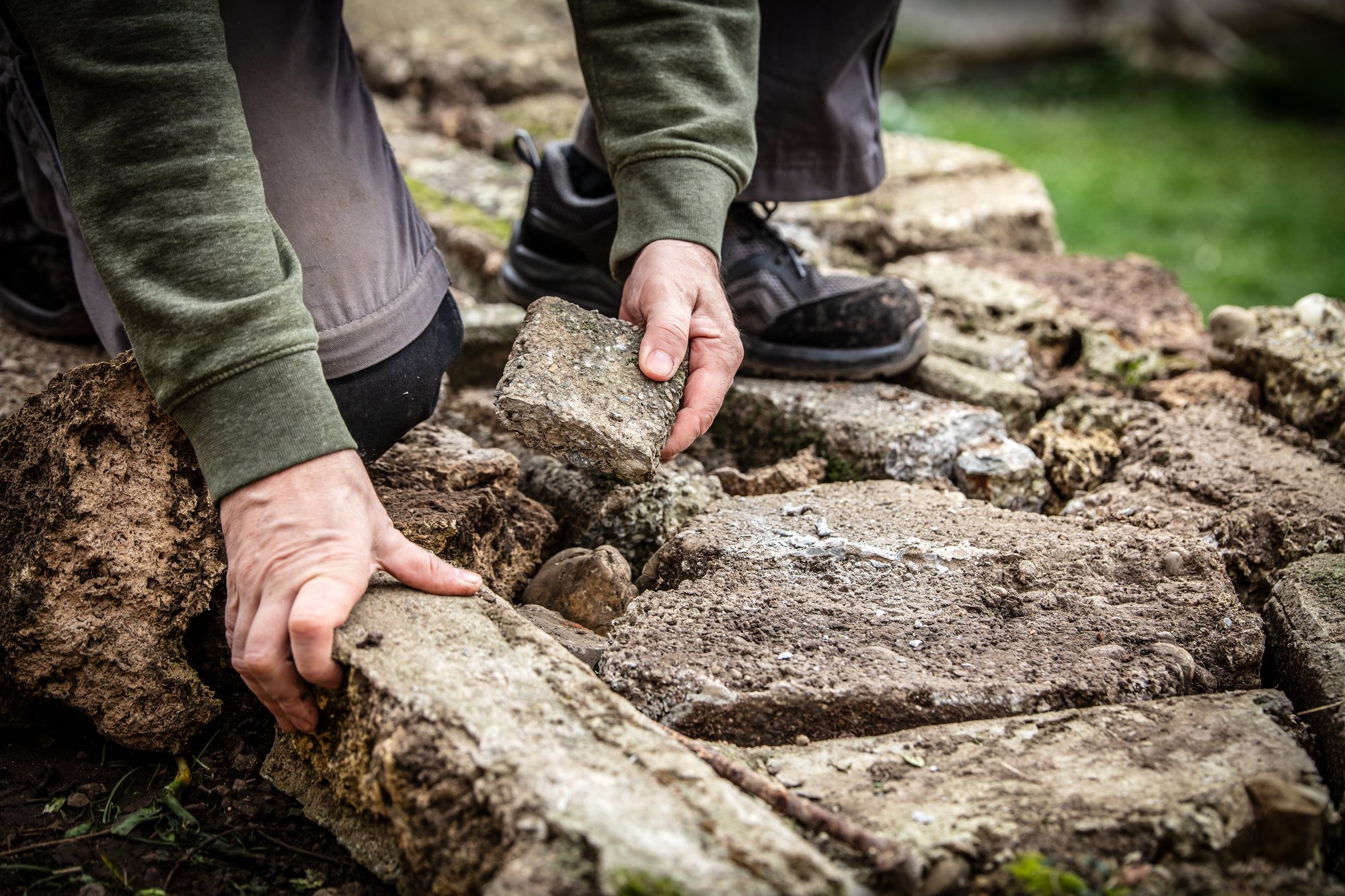
He starts with Bert and Lydia Noble, a brother-and-sister team of dry stonewallers who live and work, as their family has for four generations, out of Shepley, West Yorkshire. In driving rain one winter dawn, working wordlessly and methodically, they begin selecting stones, turning each one around and around until, with a kind of sixth sense, they find the one that fits. The hours pass. As darkness falls, they’ve moved ten metric tons of stone by hand, and built a wall that is meant to last centuries.
The work is hard and underpaid. Injuries are a hazard.
But as another dry stonewaller told Fox, over drinks at a north-country pub, “The only thing I care about is making something that will stand in the landscape long after I’m gone. That’s all the credit I need.”
Just north of the Cairngorms in Scotland, Fox visits a master thatcher who is “pulling heather”: gathering materials in “a wild and primeval woodland.” Brian Wilson’s obsession began 40 years before when he came upon the derelict thatched blackhouses that for centuries had been a feature of the Scottish Highlands and islands.
Once collected, the heather needs to be cleaned, sorted, bunched into fist-sized bundles, then fastened to the roof with hand-cut hazel spars, tied off with tarred twine, and the twine threaded through a needle that is plunged all the way through the roof and back. Wilson is one of the last of a dying breed; his apprentice, Troy Holt, is the Highland’s only emerging thatcher. Buoyed by the resurgence of Harris tweed and other traditional crafts, however, Wilson hopes that thatching may one day again take its place in the local economy and culture.
For 60 years, the domain of Andrew Jarvis has been the woods of the Chilterns, a range of chalk hills in southeast England. He is one of the country’s last makers of “spars” — the hazel pegs used by thatchers like Wilson (who makes his own spars). He’s also, to his knowledge, one of the last full-time professional coppice-workers in the Chilterns. (Coppicing is an ancient woodland technique where trees are cut down to the ground level: the stump then resprouts multiple shoots).
“This woodland,” he observes, like so many ancient woods around the country, hasn’t survived because we left it alone. It’s survived because we managed it, coppiced it, thinned it — because we used it.”
Felicity Irons, one of Britain’s last rush merchants and weavers, punts all over the Ouse and Nene rivers harvesting the material that she will then hand-plait into baskets, mats, and chair seats. Operating out of a 14th-century barn in Bedfordshire, she uses techniques that have remained virtually unchanged since Anglo-Saxon time.
Fox meets tanners, wheelwrights, basket-weavers, withy pot-makers, bell-founders, letter-cutters, watchmakers, coopers, tool-makers, and urban scribes. He writes with profound respect, deep care, and an ear for place names, unusual obsessions, and poetry.
These master craftspeople make beautiful scissors, casks, purses, and clocks. They help us to mark time, stow our stuff, rest easy under a watertight roof.
They are driven by love for their land, its natural gifts, and stalwart beauty. They march to the beat of their own drums.
Andrew Jarvis could be speaking for any of them when he says of his hazel spars: “If people like me stop making them, the skills will be lost forever. I can’t allow that.”

Heather King (heather-king.com) writes memoir, leads workshops, and posts on substack at "Desire Lines: Books, Culture, Art."