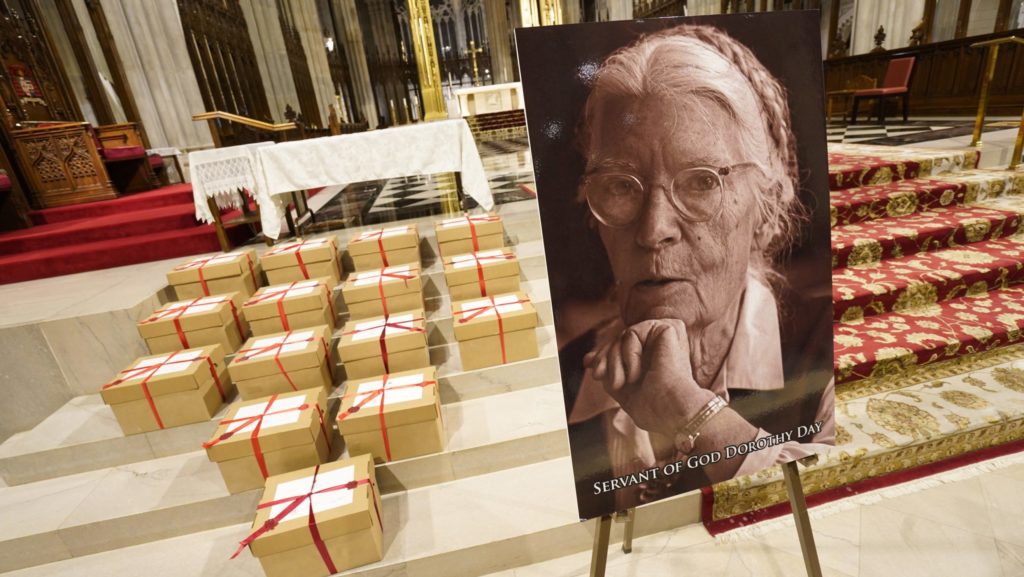
Jesus wasn’t much of a Christian. Apparently, his commandments are “in acute conflict with key Church teachings.” This is the apparent conclusion of S.V. Arbogast in an essay titled “Dorothy Day’s Complicated Cause for Sainthood” for First Things earlier this year, in which the author proposes that Day’s canonization be stalled while we debate her heroic virtues.
Arbogast claims her cause of canonization has “rested” since Pope Benedict XVI spoke well of her. That is not the case at all. Pope Francis, in his 2015 address to the U.S. Congress, praised her for her work on behalf of the poor and social justice. In a forward to a new edition of one of her books, Pope Francis referred to Day as “a great witness to faith, hope and charity in the 20th century.”
Months before Arbogast’s article, Pope Leo XIV described Dorothy Day as “a small but great American woman who had fire within her.”
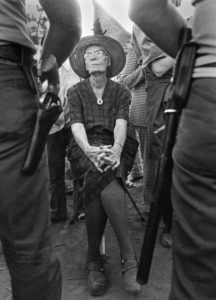
“Dorothy Day took a stand,” Leo told a gathering of Jubilee pilgrims last November. “She saw that the development model of her country did not create the same opportunities for everyone; she understood that the dream was a nightmare for too many of them, that as a Christian she had to become involved with workers, migrants, those discarded by a deadly economy.”
Since Arbogast’s article was published in April, Leo has again praised Dorothy Day … twice! In his May encyclical “Magnifica Humanitas” (“Magnificent Humanity”), the pontiff lists Dorothy Day, among others, “whose commitment has contributed to making history more humane.” (“Magnifica Humanitas,” #124).
July saw the publication of Pope Leo’s “Disarmed and Disarming,” a collection of his reflections on peace, disarmament, and nonviolence in a conflict-torn world. Among those cited for their exemplary resistance to corruption, solidarity with the poor, and dedication to peace and diplomacy is none other than Dorothy Day.
Since the First Things essay, news has emerged that the first part of the file of evidence submitted for Day’s cause for sainthood has been approved by the Dicastery for the Causes of Saints, and that the entire file may be delivered to Rome by the end of the year.
One of the reasons for Day’s papal attention was her work in Houses of Hospitality. The folks at the soup kitchen are ungrateful and smelly, their conversation taxes one’s patience and, perhaps worst of all, their clothes don’t match. To serve them once a month is an intense mortification. Day served them day in and day out for 50 years. Her writings of everyday life in this environment give witness to a heroic imitation of Christ in his most demanding requirements.
Heroic imitation of Christ isn’t sufficient for Arbogast, who builds his case for indefinitely deferring Day’s canonization on three violations of “centuries long Church doctrine”: State sovereignty, Just War Theory, and pacifism.
To my knowledge, Day never questioned the sovereignty of the United States vis-à-vis the sovereignty of other countries or the legitimacy of the Constitution. Her point was that individualism and consumerism had so corrupted the socio-economic system that she didn’t want anything to do with either party. Voting would only demonstrate an acceptance of this corruption.
Regarding just war theory, one of Jesus’ more pesky teachings — preceding any Church doctrine — is “love your enemies.” Just war theory is fine, as far as it goes, but does not enjoin anyone from abstaining from conflict. In fact, conflict avoidance through diplomacy seems to be the direction of papal instruction at least since St. Pope John Paul II.
Day’s experience with America’s entrance into World War I as a journalist for The New York Call and The Masses conforms with that of Major General Smedley Butler. After serving in the Spanish-American War, the Boxer Rebellion, the Banana Wars, and the five-year occupation of Honduras, Butler concluded that “War is a Racket” (the title of his 1935 book), promoting the interests of industrialists and inconsistent with foundational American principles.
Day’s pacifism was the reason she never became a communist. She refused to accept a violent overthrow of the system she loathed. Her anarchism was not the bomb-throwing kind, nor the affirmation of private judgment. After her conversion, it was an anarchism anchored to the authority of God; “the glorious freedom of the children of God” (Romans 8:21). Her “anarchy” was that one need not wait to be told what to do but take the initiative for improving one’s self and the world.
Arbogast further questions Day’s holiness for her endorsement of “giving up the right of self-defense.” Here again, was not Day obeying Christ’s instruction to “turn the other cheek”? Does such a witness not make a Christian wonder: Since when did the martyrs ever defend themselves?
It is no wonder that Archbishop José H. Gomez of Los Angeles praised Day as “one of the most gifted writers in Church history,” someone who “wanted to think like a saint and live like a saint.”
There is no need to debate Day’s virtues. We should all read her works and imitate her heroic virtues in the context of our own lives.