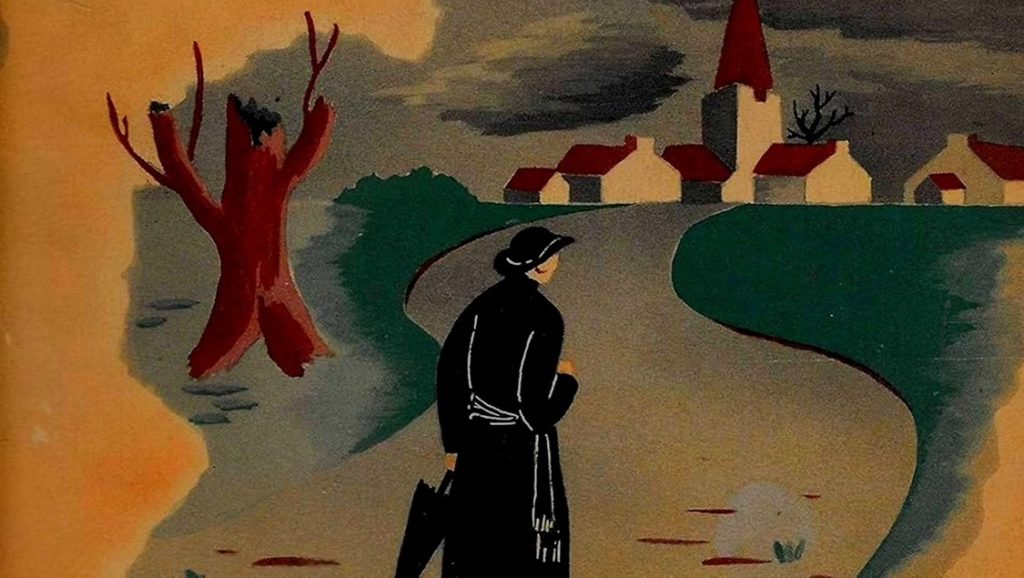
Georges Bernanos (1888-1948), the French writer, authored the iconic novel “Diary of a Country Priest” (Grand Central Publishing, $21.99).
Born in Paris to a devout Catholic family of craftsmen, Bernanos joined the conservative Action Française movement as a youth. After serving as a soldier in World War I, however, he broke with the movement. At the time, France was deeply divided: conservative monarchists, liberal republicans, anti-Catholic agnostics. Bernanos began noticing the poor and disenfranchised and wondering why the Church didn’t do more for them.
He married in 1917. He and his wife would go on to have six children.
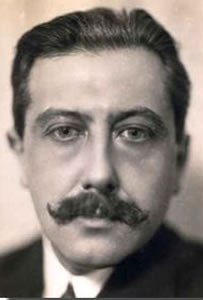
Bernanos was a wanderer, perpetually short of money and fiercely contemptuous of literary salon society. In 1932, he moved with his family to Majorca, where he wrote what would be his masterpiece: “Diary of a Country Priest.”
The protagonist, a sickly young curate, has a heart on fire for Christ, parishioners who are “bored stiff,” and stomach cancer. Unable to keep down more than bread and a glass of wine, he’s accused by the townsfolk of being a drunkard. When he tries to help a young girl, she jeeringly tries to seduce him. The countess, whose soul he desperately tries to save, rages against God for taking her infant son.
Small wonder the priest notes: “How glibly we talk about ‘family-life,’ as we do also of ‘my country.’ We ought to say many prayers for families. Families frighten me. May God be merciful with them.”
Seemingly ineffective, the priest agonizes over his frequent small missteps, believes he doesn’t know how to pray, and is tempted to despair on behalf of his parishioners. His foil, and staunch supporter, is the Curé de Torcy, a stalwart, no-nonsense, practically minded fellow priest who counsels doing one’s duty and saying one’s prayers.
But for all his insecurity, the priest has a core of steel. And for all his suffering, he thinks of his flock, not himself:
“My sorrow is not unusual,” he writes in his diary. “This very day hundreds, thousands of us perhaps, all over the world, will be dazed by a similar sentence [a cancer diagnosis]. I am probably among the least able to control a first impulse — I know my weakness so well. But experience has also taught me that I have inherited from my [working-class] mother, and no doubt from other poor women of our kind, a sort of endurance, which in the long run is almost unlimited, because it doesn’t attempt to vie with pain, but slips within, makes of it a habit in some way: that is our strength. Otherwise how can one explain the obstinate will to live in so many poor creatures, whose amazing patience finally wears down the callousness and cruelty of husband, children, relations … Mothers — Mothers of the Poor!”
When the countess, raging against God, throws a locket containing a lock of her son’s hair into the fireplace, the priest, stricken, spontaneously drops to his knees and plunges his arm into the flames to retrieve it. By speaking the truth almost harshly, he pierces through the defiance of Mademoiselle Chantal, the young seductive girl, and in the process discovers she is secretly heartbroken over her father’s affair with the governess. When her father, the count, threatens to ruin the priest’s reputation, he refuses to defend himself. He dies, clutching a rosary, in the squalid apartment of a lapsed priest friend who is living in sin with a woman and who performs the last rites.
Published in 1936, the novel was both popularly and critically acclaimed, winning the coveted Grand Prix du roman de l’Académie française.
But Bernanos was increasingly disillusioned by the spiritual bankruptcy of European politics, and by the failure of his beloved Church to model the teachings of Christ. In 1938, he published “Les Grandes Cimetières Sous la Lune” (“Great Cemeteries Under the Moon”), decrying the terror inflicted by the Spanish general, Franco, on innocent men, women, and children in the name of Catholic nationalism.
That same year, he emigrated to South America with his family and settled in Brazil. Over the course of his career, he wrote essays, plays, and several more novels.
Courted by de Gaulle, Bernanos returned to France in 1945, but the homecoming was a disappointment. A loner till the end, Bernanos died near Paris at the age of 60.
In 1951, French director Robert Bresson released a film based on “Diary of a Country Priest.” The Guardian called the performance of Claude Laydu, in his debut role, one of the greatest in the history of film.
As for Bernanos, he could have been the protagonist of his most well-known book. Like his sickly young priest, he consented to open his veins for the flock he served, to remain faithful in a world hostile to religion, to live with results so meager he must have wondered whether they were results at all. To feel oneself an ineffective witness, to plow forward anyway: this is the lot of every follower of Christ.
The strong and the stalwart serve a vital purpose. But as the Curé de Torcy himself recognized, it’s the weak, the awkward, the fragile — and the pure of heart — who often achieve true holiness.
Echoing St. Thérèse of Lisieux, the country priest’s dying words are “Grace is everywhere.”
But just as true is an insight he offered earlier: “Hell is not to love any more.”