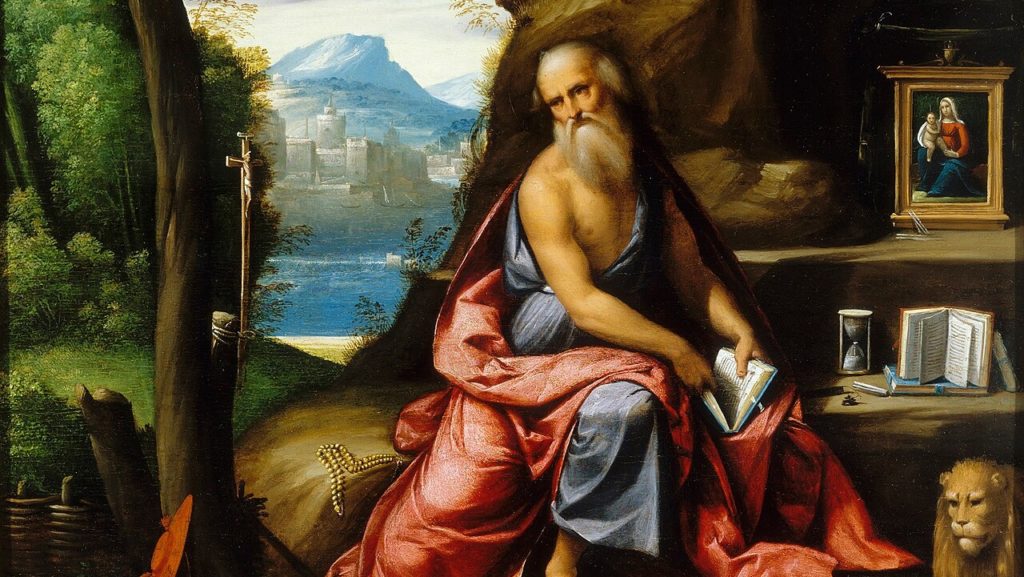
Celebrities run the risk of imprisonment in their persona. No matter what they do, people already know how to frame the story. Their friends may accentuate the positive, their enemies the negative. But friend and foe alike will highlight the personality traits that are distinctive, the particular prodigies and the eccentricities.
Alas for Jerome of Stridon, a man of the fourth and fifth centuries, whose prodigies were great, but whose eccentricities were prodigiously entertaining.
The poet Phyllis McGinley caricatured him as “the great name-caller.” And he could trade insults with the best, deriding a delinquent companion as an “effeminate soldier” for leaving behind the rigors of monastic life. He could be touchy and critical. He quarreled with many, including Augustine. He was dismissive of the accomplishments of Ambrose and Chrysostom.
When he is remembered at all, it seems, he is remembered for these idiosyncrasies. Preachers invoke him in order to give hope to their congregations: “If even Jerome could achieve sainthood, then so can you!”
I fear, however, that we too often reduce Jerome to the caricature. We speak only about his oddities while ignoring his sanctity.
This is a gross injustice. Jerome was, after all, the man who produced a readable vernacular translation of the Bible for the West. His Latin Vulgate remained the bedrock of Western civilization for more than a millennium.
Jerome was also a pioneer in the study of the Church Fathers. The biographies he wrote in “Lives of Illustrious Men” (Aeterna Press, $6.34), with their bibliographical data, are the starting point for our study of many great figures of antiquity.
And Jerome was a great catalyst in the development of religious life for women. Almost alone among his contemporaries, he recognized females as his equals (or betters) in scholarship, churchmanship, and asceticism. He promoted the work of Paula, Eustochium, Marcella, Fabiola, and Melania. They, in turn, established monastic communities, conducted scholarly research, and helped to invent the hospital.
In all of history, moreover, Jerome stands out as the great promoter of pilgrimage. As a young man, he wandered the dark, unmarked, fetid corridors of the Roman Catacombs. He relished the nearness of his Christian forebears. He learned from the inscriptions on the walls and the graffiti scratched in plaster. Later in life, Jerome moved to the Holy Land and wrote letters that have served ever since as tourist-promotion brochures.
No matter what the subject, Jerome always wrote memorably. I live more than 1,600 years after the death of Jerome, yet I find myself frequently repeating one of his lines: “Ignorance of Scripture is ignorance of Christ.” Nobody has said it better.
Every caricature contains an element of truth, which it emphasizes to unreal proportions. Every caricature is thus untrue and, to some extent, unjust. Our caricatures of Jerome can be useful insofar as they give us hope for attaining sanctity.
But, if we truly want to pursue sanctity, we need to encounter Jerome as a man in full, with heroic virtues and achievements, a man in love with Jesus Christ. Think of this on his feast, Sept. 30.