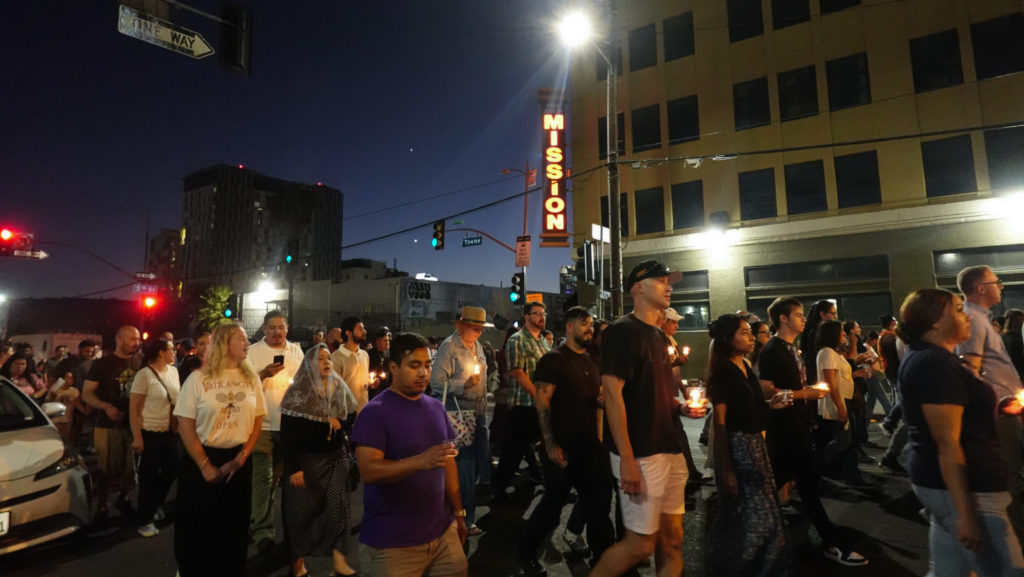
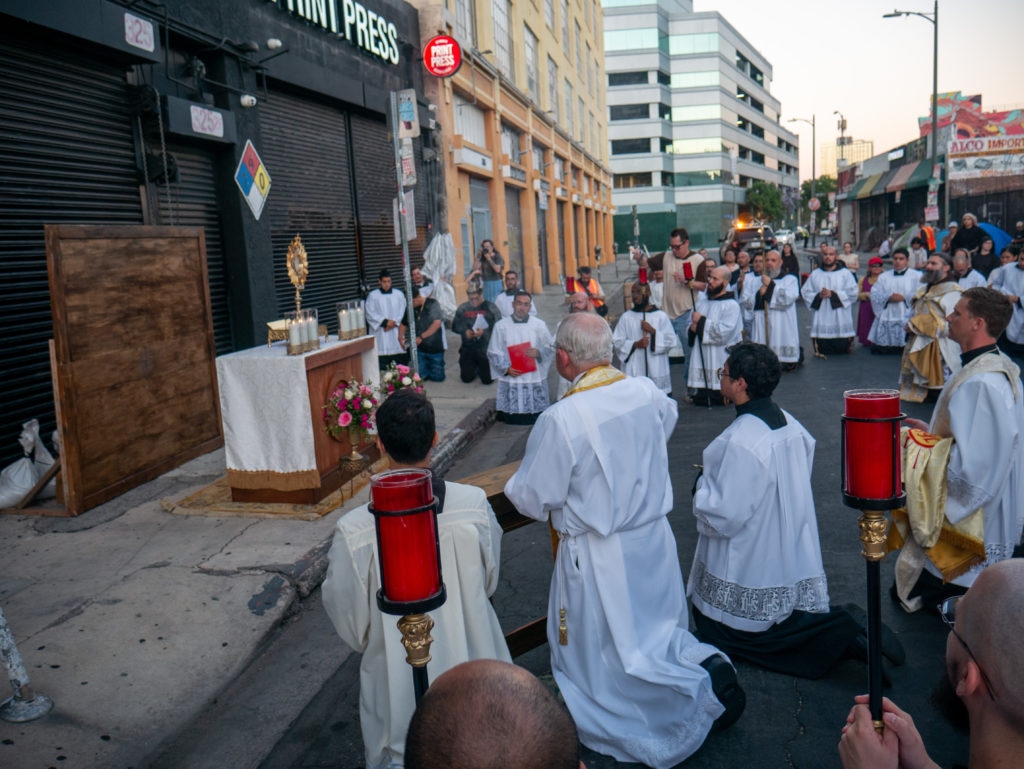
I have participated in many Eucharistic Processions during my life. And in many ways, the one I attended Aug. 1, which began at the St. Francis Xavier Chapel in Little Tokyo, was like all the others.
Whether for the Solemnity of Corpus Christi, a 40 Days of Life event, or praying in front of the Blessed Sacrament around the perimeter of an abortion mill, Eucharistic Processions tend to follow a similar pattern, and take on a common identity.
But this one was closer to home. Or rather, in this case, close to those without a home.
I have worked for five years on Skid Row in downtown Los Angeles. The first thing you realize when you make regular journeys down there (and I do mean down) is that the minute you think you have seen it all, you will see a broken human being doing something you never thought possible.
I have seen a man in rags saunter down the middle of San Pedro Street with no sense of urgency as he carried a large cardboard box that happened to be in flames. I have seen a man sitting on a ragged piece of lawn furniture casually cleaning his 9mm pistol. I have seen other activities I cannot describe in writing for a Catholic publication.
The shelter I worked out of described itself as a “mission,” but is as secular as the writer’s room at Netflix. Still, I found it staffed by dedicated men and women, many of them having experienced homelessness or some form of addiction themselves. These men and women had entered that inscrutable world of “recovery.” No one in recovery uses that word in the past tense. It is a process, a continuum that requires vigilance, a support network, and even a surrender to a “higher power.”
Many of the people at the place where I used to work who are in recovery subscribe to the famous Twelve Step program. They adhere to its tenets with religious fervor. They even have a communal prayer to that “power”: I have seen them recite it, and from a Catholic perspective it sounds familiar and alien at the same time. I keep expecting the prayer to end with and we ask this through Christ our Lord Amen. Those words never come.
For some it is Jesus. For others, it is a god in their image. I have grown to love and admire these people. They have traveled so much further in life than me, and continue to battle courageously against their baser selves.
That Saturday evening, as we walked behind the Blessed Sacrament led by Archbishop José H. Gomez, what was missing in that recovery prayer — and what is sorely missing on the streets of Los Angeles’ Skid Row — was everywhere to be found. Organized in collaboration with the Archdiocese of Los Angeles, that Eucharistic Procession was the penultimate act of a several days-long mission of the Sisters Poor of Jesus Christ. Each night of the mission, these remarkable young, brown-habited nuns were on the streets of Skid Row.
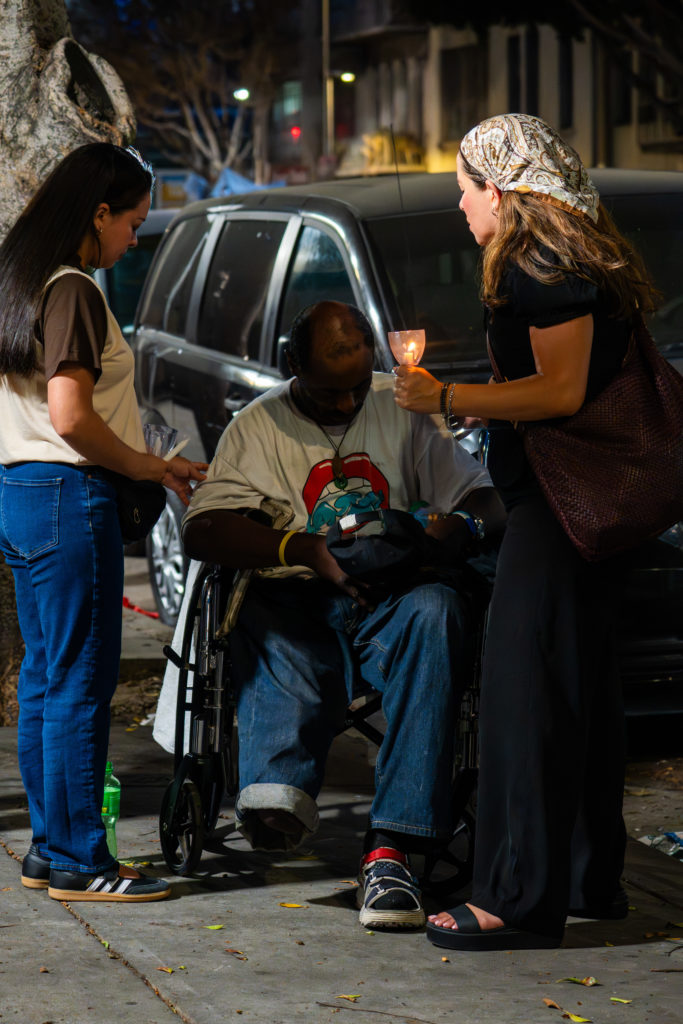
As hundreds of us walked behind the Blessed Sacrament singing and praying the rosary, the Sisters Poor of Jesus Christ fearlessly and joyfully approached countless homeless men and women. At the same time, I was keeping my head on the proverbial swivel. I knew the ground we were covering. You just did not know what to expect. The vast majority of those who are homeless suffer from either a form of alcohol/chemical addiction or a mental disease. That is just a fact. And there are times when these demons manifest themselves in real and dangerous forms. People have been murdered in the courtyard of the shelter I used to work at and fights, and stabbings are just another day at the office.
I feel blessed and grateful for being part of that shelter and helping it keep its lights on while beds are offered every night and recovery services are provided free to all who walk through the door. It is getting them to walk through the door which is the issue. Our shelter was rarely full on any given night.
The streets on that hot August night were full with some 750 people — and also strangely quiet. Did the mere physical “presence” of the Lord have a calming effect? I believe it did. As we walked, sang, and prayed, the sisters and other volunteers approached the tents and cardboard penthouses that lined the streets. That is something I would never do in the daytime, let alone after the sun went down. But with love in their hearts and full-throttled trust in the Lord, the Sisters and those volunteers put me to shame.
They distributed water, hygiene kits, and snacks, but what they offered primarily — and what few of the other shelters in this part of the world do not — is the love of Christ.
I met several of the sisters before the procession began. One, Sister Giovanna of the Most Holy Name of Jesus, had come from her home mission in Baltimore to be part of the mission here in Los Angeles. As we talked, Sister Giovanna recounted an exchange she had with a homeless man the night before. He was offered water, food and a hygiene kit but politely declined. I chimed in with my “expert” assessment telling her that people declining services is a common occurrence on Skid Row. But then Sister Giovanni continued her story: the man did say there was one thing he would be happy to accept…her prayers.
I put my expertise back in my pocket and thought about the exchange Sister Giovanna had with a man who lives inside a cardboard box. In a place where physical assistance is in abundance, the spiritual desert was watered by the higher power who has a name and, in whose name, acts of mercy and maybe a miracle or two came about on that warm summer evening.