On a recent trip to New York, I saw a fantastic exhibit at the American Folk Art Museum: “Self-Made: A Century of Inventing Artists.”
On display through Sept. 13 are almost 90 works, divided into three methods of artistic self-fashioning and “self-making”: self-portraits, alter egos, and autobiographies.
In case you didn’t know, the term “outsider artist” is no longer acceptable. “Self-taught artist” is the new, correct term.
To that end, the exhibition “examines how artists without academic training have depicted, conceptualized, and identified themselves on their own terms.”
According to the curators, the artists were “asking viewers to ‘look at me, in this way, that I have chosen.’ ”
As I said, the exhibit is terrific. And I applaud the effort to accord these artists the dignity and status they deserve. But the fact is that many of them did their work during extended stays in mental institutions. Others, Henry Darger, for example, were borderline pathological recluses with extremely unhealthy sex drives. Many others were the victims of over-the-top obsessions and compulsions.
Why try to sugarcoat? Why pretend such ways of life are “chosen?”
Aloise Corbaz (1886-1964), for example, suffered from a delusional romantic attachment to Kaiser Wilhelm II so crippling that she was committed to an asylum for 50 years. Her exuberant and explosively colorful paintings of flowers and trees are charming, but that she got up each morning and thought, “Today, I will damn well depict, conceptualize, and identify myself on my terms” boggles the imagination.
To me it makes more sense to imagine that she turned to art to maintain her equilibrium, as a sanctuary and refuge, and to act out her florid, borderline berserk, and poignant fantasies.
As Jean Dubuffet, founder of the precursor to “outsider art” known as art brut, noted of Corbaz: “She was not mad at all, much less in any case than everyone supposed. She made believe. She had been cured for a long time. She cured herself by the process which consists in ceasing to fight against the illness and undertaking on the contrary to cultivate it, to make use of it, to wonder at it, to turn it into an exciting reason for living.”
Swiss artist Adolf Wölfli (1864-1930), for example, was diagnosed with schizophrenia and spent most of his life confined to the Waldau psychiatric clinic in Bern. “St. Adolf-Giant-Creation,” part of his extensive oeuvre, was “an illustrated 25,000-page narrative in five parts, comprising over 45 volumes and 16 notebooks, into which 1620 drawings and 1640 collages were folded.”
The third part of his magnum opus, “Books with Songs and Dances,” is a hymn of praise. He described himself, among other ways, as the “inventor of 160 self-made inventions, highly valuable and each patented by the Russian Czar, and glorious victor of numerous enormous, gigantic battles.”
One of them, a drawing made with graphite and colored pencil on newsprint, depicts an elaborately complex, precise, architectural, and phantasmagorical kingdom complete with turrets, drawbridges, clockfaces, star finials, curving scripts, himself as masked avenger, and what look like giant newts.
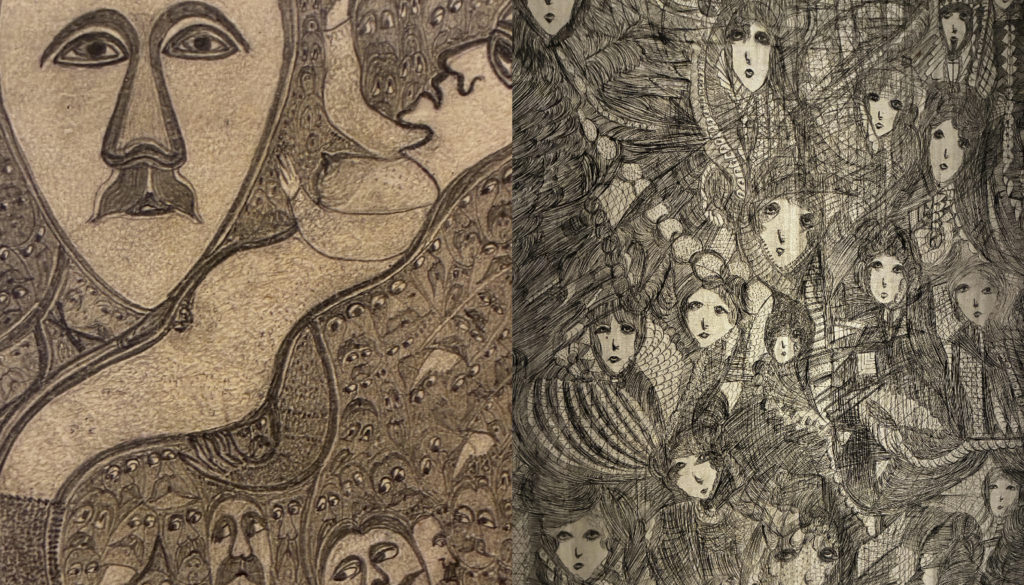
Edmund Monsiel (1897-1962) completed hundreds of monochromatic pencil drawings while hiding in an attic in Poland during World War II. The Nazis had already forced his family’s stationery shop to close, then randomly executed many of his relatives. A drawing made on the back of a cement bag is entirely covered with hundreds of repetitions of what is presumably Monsiel’s own anguished disembodied head: eyes wide, bewildered, hunted.
Madge Gill (1882-1961) made drawings based on “spiritualism,” a pursuit that was all the rage in 1920s London. She had suffered two great losses: the death of a son in the influenza epidemic of 1918, and a stillborn daughter in 1920. An untitled work, done with ink on calico from 1922-25, seems to depict mother and children reunited at last, in a ghostly, happier world.
These self-taught artists created because, like artists from time immemorial, they could. They had to.
Their achievement to my mind lies not in any effort to establish their identity but in the fact that they worked in spite of, or perhaps because of, poverty, trauma, mental and emotional illness, and in almost every case, profound suffering.
The highlight of the exhibit was discovering an artist new to me: William A. Hall (1943-2019), from our own Los Angeles. Hall lived in a succession of cars — two Cadillacs, a Buick, a Dodge — in Southern California and drew against the steering wheel for up to 12 hours a day for most of the last 20 years of his life.
His creations, done almost exclusively in colored crayon and pencil, feature cars with phantom headlights, visionary landscapes, and mythical characters doing battle in medieval dress.
His alter ego, a blind man named Lord Byron Masterfield, lived in a large stone house with a Dr. Frankenstein-created giant named Xenos, whose mission was to provide sanctuary for the citizens of the city from “cruel predatory humanoids, who have been a problem for many centuries.”
Hall also kept a meticulous real-time record of just about every moment of his life in a notebook created in 2011, written in nearly microscopic handwriting. “Black B.M.W. 2-dr. in 13th space). (Windstorm started around 9 p.m.).” “I’m 68 today at 11:43 a.m. (Looked at clock — 11:58 a.m.).”
Who knew that for all those years we had a guardian angel: faithfully keeping watch; saving us, with his trusty pencils, from ourselves.