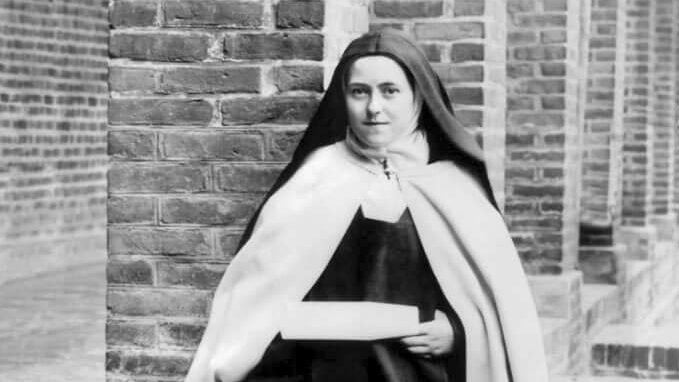
One of the saints who speaks to me is Thérèse of Lisieux, commonly known as the Little Flower. This wasn’t love at first sight. For years, I was put off and left cold and uninterested by how her person and her image have become encrusted in an overly saccharine piety. She was too sweet, too pious. Not a saint for me! That changed, thanks to a friend who told me, “Don’t read books about her — read her!” I read her and found in her a soul friend.
Who is Thérèse of Lisieux? She was a Carmelite nun who died from tuberculosis in 1897. She was only 24 years old when she died, and as a Carmelite nun hidden away in a convent in rural France, she died in anonymity, probably known by fewer than 100 people. However, during the last two years of her life, as she lay dying from tuberculosis, she kept several diaries. After her death, her Carmelite sisters sent her unpublished diaries to a few other convents, intending to let a small circle of religious women know of her death and a little about her life.
The rest is history. The manuscripts were leaked to a wider public and in less than 10 years, printing presses were literally having trouble meeting the demand for her autobiography. Her little convent in Lisieux was receiving more than 500 letters a day, and people from all over the world were beginning to come to Lisieux on pilgrimage. A hundred and thirty years later, little has changed. She remains extraordinarily popular.
Why? Why this perennial intrigue about Thérèse? Because there is something about her that touches the soul in a particularly empathic way. How so?
Thérèse had an anomalous background that produced an extraordinary character. Her life as a child was in many ways tragic. Her mother got sick at the time of Thérèse’s birth and was unable to care for her during the crucial first year of her life. She was cared for by a nurse and an aunt. As a 1-year-old, she was returned to her mother, but she was already terminally ill, and when Thérèse was 4, her mother died. Thérèse then chose her older sister, Pauline, to be her new mother. Five years later, Pauline entered the convent, and as a 9-year-old, Thérèse again lost a mother.
Shortly after this, she took ill and almost died. This was triggered by a visit to Pauline, who was then a Carmelite nun. Together with her three other sisters and her father, she had gone to visit Pauline in her convent. After Pauline had spent some time focused on her little sister, she naturally became preoccupied in adult conversation. Left out, in sheer frustration, little Thérèse stood right in front of her big sister and, shaking her dress, began to cry.
“What’s the matter?” asked Pauline. “You didn’t notice!” cried Thérèse, “I’m wearing the dress you made me!”
She then became disconsolate and on returning home took to bed for some weeks; despite the best efforts of various doctors and every kind of cajoling by her family, she hovered between life and death. Eventually, she recovered. Such was the tragedy and oversensitivity of her childhood.
Yet, and this is the great anomaly, as a child, Thérèse was doted on and loved in a way that few children ever are. Her father, her sisters, and her extended family considered her their little queen, and she was cherished and made to feel extraordinarily precious and unique. Her sister Celine photographed her every move. Few children ever grow up as nurtured in love and affirmation as did Thérèse.
And her personality bore out the effects of both the tragedy and the love. On the one side, she could be heavy, dark, withdrawn, and otherworldly. She made easy friends with mortality, was a mystic of darkness, the austere adult, the little girl-woman, who, wounded early, grew up fast. But, on the other side, she always remained the magical child, Cinderella, who, because she was so loved and graced, developed a very robust self-esteem, a confidence and a capacity to love as few others ever have.
So loved as a child, a part of her remained ever the little girl, the puella, the incarnation of childlikeness, innocence, and gaiety. Only a Thérèse of Lisieux could end all her letters with the phrase: I kiss you with my whole heart!
In a soul so formed lies her mystique, that is, her unique combination of depth, insight, and otherworldliness, even as she desperately clings to the tiniest gifts from her family and every small token of earthly affection. Only a soul so formed could, at age 22, have the complexity and wisdom to write a mystical and theological treatise that rivals that of great theological doctors, and only a soul so formed could be both a study in hyper-sensitivity and human resilience.
A saint so pathologically complex can be a soul friend to our own complex souls.