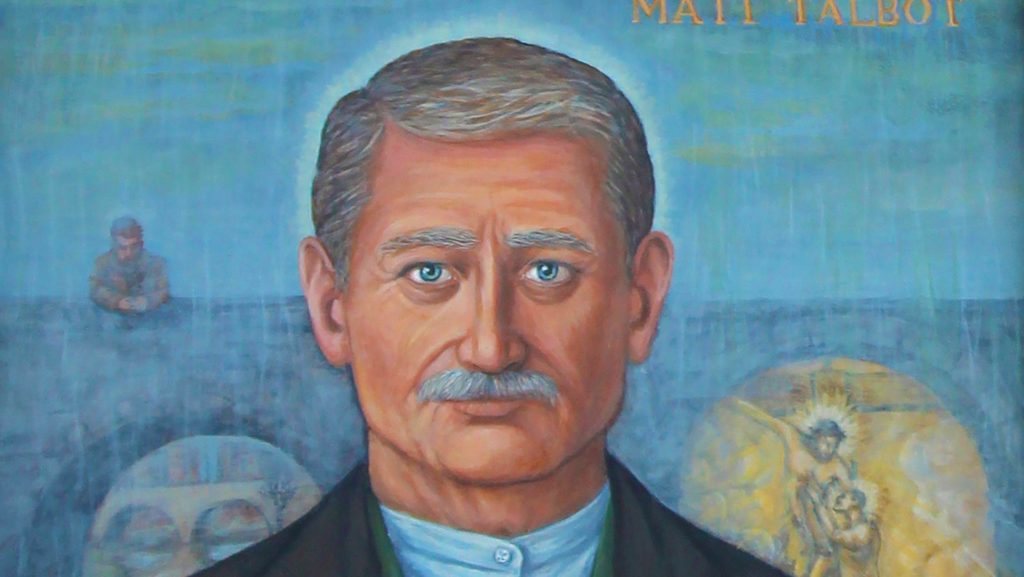
Venerable Matt Talbot (1856-1925) was born to a working-class Catholic family in Dublin, the second oldest of 12 children. At 12, he quit school to work. By the age of 13, he was a hopeless alcoholic. Crushed when his mates refused to stand him drinks one day, he became sober at the age of 28 and lived a quiet life of penitence and prayer until his death on a Dublin street at the age of 69. Chains and cords were found wrapped around his body. Some were embedded in his flesh.
Journalist Eddie Doherty, husband of the well-known spiritual writer and founder of the lay Madonna House apostolate Catherine de Hueck Doherty, wrote a biography of this figure he deeply respected.
An excerpt from the beginning of “Matt Talbot” (Bruce Pub. Co., $15.55):
“On a pitiful dry day, in the city of Dublin, Ireland, in the year 1884, a seedy young workman with a hang-over decided to quit drinking… There was nothing remarkable about Matt — not then. And there was nothing remarkable in his taking the pledge. Nothing is easier to take — nor harder to keep. But, one thing leading to another, a sinner can call on a priest, and a sot can become a saint. It was only after Matt quit drinking that he became remarkable in any way. It was only after his death that he became, not only remarkable and famous all over the world, but even an object of veneration.”
Doherty goes on to tell of the great Dublin strike and lockout of 1913. There were bloody riots, assassinations, Irish heroes, and British villains.
Through it all, Matt quietly attended early morning Mass, worked, fasted, and prayed, striking with his brothers, but never commenting further. When he was himself arrested by the British for questioning, forced to raise his hands against a wall, and stand, some accounts say for hours, his response was: “God is so good. Isn’t it a pity more men do not love him.”
He lived on dry crusts of bread and a ghastly concoction of cold tea and cocoa. His bed consisted of two rough pine planks with a log for a pillow. He allowed himself only three-and-a-half hours of sleep per night.
He rose at 2 a.m., prayed for a couple of hours, then went and knelt outside the local Jesuit church, knees bare, thin overcoat flapping in the wind, and waited for the doors to open at 6 a.m.. After Mass, he went to work for the day. If he managed to scrape together a few extra coins, he gave them away or sent them to the missions.
With a special devotion to the Blessed Mother, he wore the chains as a symbol of his desire to be a slave to Mary.
Talbot died on the street, walking to Mass, on June 7, 1925.
Ten years later, New York stockbroker Bill Wilson and Dr. Bob Smith met for the first time. The two went on to found Alcoholics Anonymous (AA). From then on, alcoholics the world over have gotten and stayed sober without the austerities practiced by Matt Talbot. AA, whose only requirement for membership is a desire to stop drinking, doesn’t remotely suggest rising at 2 a.m. to pray, daily Mass, fasting, or the wearing of chains.
And yet perhaps those things were necessary. Perhaps one man — truly anonymous during his lifetime — had to be so appalled by the hurt he had caused, so grateful to be sober, so intent on making amends, that he prayed and did penance every remaining second of his life. Perhaps one man had to love God as much as Talbot did to pave the way for the drunks who came after.
Perhaps a saint lived in solitude for 40 years so that a fellowship could be born, and the millions of alcoholics who came after him could walk the road to sobriety with trusted friends.
We ponder the phenomenon of penance deeply during Lent. I sometimes read accounts of the early martyrs, especially the virgin martyrs, and shudder. How could a young girl possibly endure having her eyes gouged out, like St. Lucy, or her breasts cut off, as St. Agnes purportedly did?
We can only surmise that such people, in extremis, were granted a supernatural grace, some special mercy hidden from us ordinary folk simply because we ordinary folk don’t need it.
Like Matt Talbot, those first martyrs were willing, and seem to have been given the grace, to undergo such extreme suffering, so that those who came after didn’t have to.
In a way, that’s true of every martyr. They take the bullet, leaving the rest of us to go about our lives unharmed. In their Christ-like sacrifice, they are continuing mysteries and, collectively, one of the Church’s most priceless treasures.
As for the rest of us, we can only say with St. Augustine: “Because I am human, therefore I am weak. Because I am weak, therefore I pray.”
Talbot spent much of his life on the docks. In “The Story of Matt Talbot” (Mercier Press), Malachy Gerard Carroll imagines him “standing on the wharf, head bent, to the chimes and the cry of the sea gulls around him, his figure one with the dust and the grime, and the oily waters.”
He imagines “heat and sweat and dust and scummy water … a thing of beauty … lifted into the presence of the Holy Trinity.”