Easter is Passover, and the early Christians celebrated it as such. In fact, they called the holiday “Passover,” and most modern languages still use the same word to describe both the Jewish holiday we know as Passover and the Christian holiday we know as Easter. They use words taken from the Hebrew Pesach. Spaniards call it Pascua, Italians Pasqua. The Dutch say Pasen. In Zulu it’s IPhasika. All these terms derive from Pesach. Only a few languages — English, German, Polish — call the feast by a word unrelated to Passover.
The name highlights the continuity in the Easter story, and it heightens our awareness of small details.
Alleluia is just a single word, and it’s so commonly used that we hardly notice it. But it is significant because the Jews of Jesus’ time associated the word primarily with Passover.
The early Church so valued the word that it was left untranslated in biblical and liturgical texts (see Revelation 19:1–6). Like the Hebrew Amen, it was considered sacred for what it expressed. Alleluia (or Hallelujah) means, literally, “Praise the Lord!” It represents the dominant theme of a group of the Psalms that are distinctive for the effusive honor they give to the Almighty for his deeds of creation and redemption. These are collectively called the Hallel, which is Hebrew for “praise.”
On Passover, these festive hymns were sung during the seder meal. The ritual divided them into two groupings, one long (the Great Hallel) and the other relatively short (the Little Hallel).
There was, in the first century, a dispute over which Psalms should constitute these groupings. The school of the rabbi Shammai prescribed Psalm 113 alone as the Little Hallel, but the school of the rabbi Hillel paired 113 with 114. We do not know which grouping was favored by Jesus.
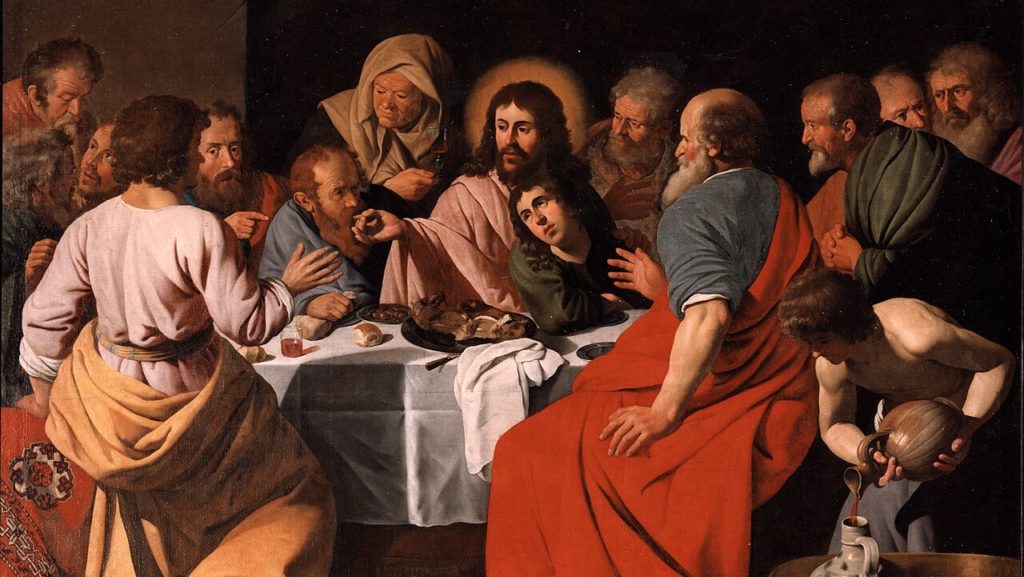
In any event, the Little Hallel was sung before the dinner began. The Great Hallel, the long sequence of Psalms 115-118, was sung with the fourth shared cup of wine. This is the “hymn” that Jesus and the eleven sang as they left the upper room and walked to the Garden of Gethsemane (Matthew 26:30).
For the Catholic Church, the Mass — like the Passover seder — is a meal of covenant renewal, and so it sometimes employs one or another of the Hallel Psalms as a responsory. But it preserves the spirit of these Passover songs in the Alleluia recited or sung before the Gospel.
In Lent, the Church suppresses the Alleluia. Why? Because Lent is a season of preparation for the Christian Passover.
So, now, as Catholics turn the calendar page from Lent to Easter, the word Alleluia does not merely return to its normal place before the Gospel; rather, it saturates the prayers of the Mass for the entire 50-day Easter Season. For Christians, as for the Jews of Jesus’ time — and Jesus himself — Alleluia is the phrase most characteristic of the Passover. In the words beloved by St. Pope John Paul II: “We are an Easter people, and [therefore] alleluia is our song.”