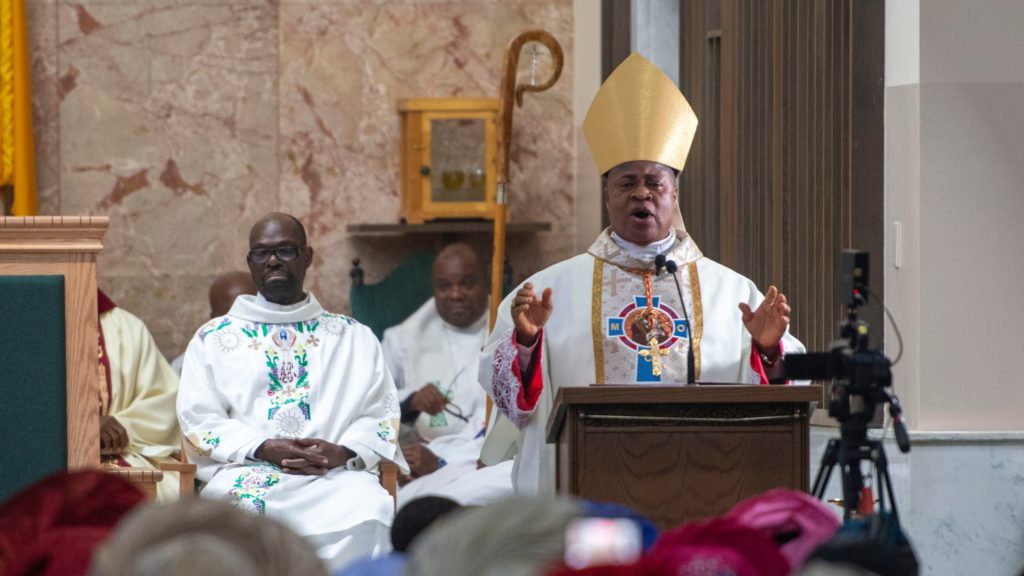
Cardinal Peter Ebere Okpaleke is the bishop of one of Nigeria’s smallest Catholic dioceses, but the job comes with some long-distance travel.
Last year, the job took him to Rome, where he was part of the conclave that elected Pope Leo XIV.
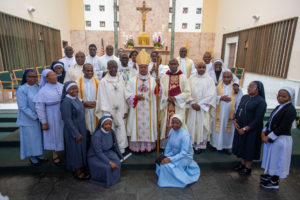
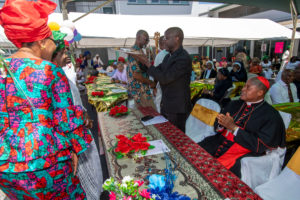
Last month, it took him to South LA, where the 63-year-old got a rousing welcome from his fellow countrymen at St. Eugene Church, the only parish in Southern California to offer Sunday Mass in Igbo, the dominant language of the heavily Catholic southeastern region of Nigeria.
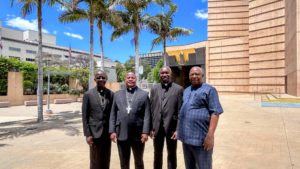
Okpaleke also got a friendly welcome in LA from Archbishop José H. Gomez, who gave him a tour of the Cathedral of Our Lady of the Angels, together with Father Jude Umeobi, the outgoing pastor of St. Eugene. Afterward, I caught up with the cardinal in the Cathedral Plaza for a brief interview.
“My vocation as priest and bishop is to gather Christ’s faithful, to be with my brothers and sisters, to encourage them,” answered Okpaleke when I asked why he’d come to the U.S. on a tour that brought him to Nashville, New York City, Corpus Christi (Texas), and the Diocese of St. Petersburg in Florida.
Okpaleke said the trip was about understanding what the Catholic Church in Nigeria can learn from the American experience, and vice versa — bringing lessons from Nigeria to the U.S.
Catholics in Nigeria, he noted for example, are doing a better job of transmitting the faith to their children than American counterparts.
“We make efforts to let our young ones see us live by example,” said the cardinal. “We bring them together to pray together, relate with one another … no matter how busy the parents are.”
Okpaleke sees the American mentality — even among Catholics — as prioritizing money and work over faith. But he sees the same trend appearing back in Africa, and wants to know what U.S. Catholics are doing to address the problem.
“People now live to work instead of working to live,” said Okpaleke. “It may have an adverse effect on the faith and even in the life of the children.”
In his gatherings last month with Nigerian Catholics around the U.S., Okpaleke said he was focused on giving them “firsthand information, authentic information, about what is going on in Nigeria. Because some are frightened by what they read on social media.”
Nigeria has suffered in recent years from well-known political tensions and sectarian violence. The country’s government has been accused by critics, including some Catholic bishops, of not doing enough to protect Nigerian Christians from massacres and kidnappings, especially from Islamist militants.
Okpaleke emphasizes that the negative headlines don’t tell the whole story about Nigeria and that the Catholic Church is largely thriving. As for the violence, the cardinal says he tells Nigerians abroad that the situation is more “complex” than the headlines they read on the internet.
“You cannot just pin it down to religious persecution or political reasons,” he told me. “There are a lot of challenges, a lot of reasons why many things happen, but one thing that is clear is that the rates at which people are being killed are unacceptable. Whether Christians or Muslims, killings are not acceptable to us.”
Okpaleke knows a thing or two about sectarian turmoil. In 2012, he was named a bishop by Pope Benedict XVI and appointed to lead the Diocese of Ahiara, Nigeria. But members of the majority Mbaise ethno-cultural group in the diocese — including some priests — refused to accept Okpaleke, insisting on a bishop from their own group. As a result, Okpaleke had to be ordained a bishop outside the diocese and never took possession of it.
After years of efforts, Pope Francis eventually gave up on trying to get the Ahiara clergy to accept Okpaleke. His resignation was accepted by the Vatican in 2018.
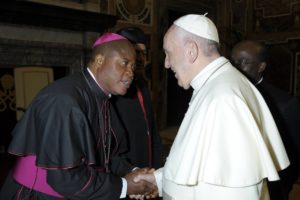
“After prayerful reflections, I tendered my resignation to the Holy Father,” recounted Okpaleke. “I resigned and continued to live my life as a priest. And after two years, it pleased the Church and God to call me and assign another diocese to me.”
That diocese was the newly created see of Ekwulobia, carved out of Okpaleke’s Igbo-speaking home diocese. But the saga didn’t end there: In 2022, Francis surprised everyone by naming Okpaleke a cardinal. Today, he is Nigeria’s only cardinal under 80. .
It was a decision that four years later brought Okpaleke to Rome to participate in the conclave to elect Pope Francis’ successor. When I asked him about the conclave — the parts not covered by the cardinals’ oath of secrecy, of course — Okpaleke’s curt expression began to change. He started to smile more. He almost got emotional.
“I got strengthened, my faith was renewed, and it made me happier to be a Catholic, proud to be a Catholic,” said Okpaleke of his time inside the Sistine Chapel.
“I went in like all the cardinals: opening ourselves to the Holy Spirit to let him direct the Church. We prayed to the Lord to give us a pope that would be fit for this age, and the result I’m seeing makes me keep saying, ‘Thank you, Jesus!’ Thank you, God, for making our dreams come true, giving us a father, a shepherd, who is part of the challenges we have now.”
As we spoke, Okpaleke couldn’t help but take some pleasure in the surprise he helped deliver.
“This pope is proof that the spirit is alive and active, and walking in the Church,” he told me. “Some of you journalists were expecting an ‘African pope’ or an ‘American pope’ or whatever, but we were looking for a pope for the universal Church, and that’s what God has given us!”
For Okpaleke, the conclave’s surprises didn’t end with the white smoke. When the cardinals filed into the dining room of the Vatican’s Casa Santa Marta the night of the election, Okpaleke sat down at the first open table he saw. Then Leo walked in.
“There was not a table reserved for him (the pope). So he just came over and sat down at our table,” said Okpaleke.
What did they talk about?
“In the context of eating, you share a lot, you make jokes, like ‘I’m sorry for you,’ ” said the cardinal. “We were congratulating him, but also sympathizing with him.”