
Three nationally known music ministers, all with ties to the Archdiocese of Los Angeles, have been honored with awards from the National Association of Pastoral Musicians (NPM).
John Flaherty, longtime music director for the Los Angeles Religious Education Congress, was named the 2026 recipient of NPM’s Jubilate Deo Award for contributions to pastoral liturgy in the United States. Since 2022, he has been a special assistant to the senior vice president of mission at Loyola Marymount University, overseeing major liturgies and events after serving nearly 30 years as LMU’s director of liturgy and music.
Rodolfo (Rudy) López and Estela García-López, husband-and-wife musicians and composers originally from Los Angeles, earned the Pastoral Musician of the Year Award for their work in parish and diocesan ministries. Now based in Portland, the couple is known locally and nationally for their contributions to bilingual liturgical music.
The recipients will receive their honors during NPM’s 50th anniversary convention on July 20-24 in Washington, D.C.
‘Liturgy is poetry and art’
Flaherty was a student teacher at Our Lady of Malibu School when the principal, Sister Breege Boyle, asked him to lead music for school liturgies — something he’d never done.
“In high school, I’d played in the folk choir at St. Thomas the Apostle in Riverside,” he said. “But it’s a different ballgame to be teaching and leading. Sister Breege would tell me what to play until I began to learn how to lead. She really encouraged me, and that kind of generosity never left me.”
That spirit of generosity has formed Flaherty’s approach to his four decades of ministry, during which he has taught at every level from elementary to post-graduate studies, worked with leading liturgical composers in concerts and recording sessions, and directed music for the U.S. Conference of Catholic Bishops conferences and retreats. He points to Psalm 116:12 — “How can I make a return to the Lord for all the great good done for me?” — as a guiding light in his approach to ministerial leadership.
“To be in ministry means that I share my gifts freely, with no expectation that you will do me a favor later,” said Flaherty, who has been married to his wife, Kathy, for 37 years and they have five adult children. “And we trust that what we do will make a positive difference.”
As founding director of the pastoral liturgy and music certification programs at LMU’s Center for Religion and Spirituality, Flaherty has mentored hundreds of students who have become ministry leaders and business professionals, teaching them to embrace learning the “why” as much as the “how” of preparing liturgical celebrations.
“Liturgy is poetry and art,” Flaherty said. “It’s much more than just following rubrics; we’re called to find deeper meanings in what’s expressed in liturgy, to discover the heart of it all. There are pastoral as well as intellectual components to what we do at Mass, and when we can connect the head to the heart, we experience the transcendent.”
Such practice is also tied to his philosophy toward embracing cultural expressions within the liturgy, as those who have attended liturgies at RECongress over the past 35 years can attest.
“The only way to become more, to build community, is to give up a little of your own power, to give up your seat,” said Flaherty, the son of a Japanese mother and an Irish-American father. “If, for example, we have a song in the Tongan language, we ask the Tongan choir to teach it to the rest of the singers, and we sing that together, rather than have one choir do this language song, and another choir do that language song, which is tokenism and not prayer. Because when we all sing together, regardless of the language, we form a new creation with all entering into the other’s experience. That’s how you build community.”
‘We keep doing music that offers hope’
Rudy and Estela grew up in East Los Angeles parishes — he at St. Alphonsus, she at Our Lady of Guadalupe. Both were drawn to the guitar and parish music ministry before they were teens, and became music leaders before they were old enough to vote.
They met when they were in their 20s, after Estela was hired as the Spanish choir director at St. Alphonsus and the pastor asked her to meet with the music director to prepare Holy Week music.
“I showed up for our meeting,” she recalled, smiling, “and this fellow walked in with a guitar, holes in his jeans and long poofy hair. That was Rudy.”
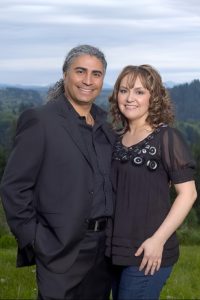
Suffice it to say, Estela and Rudy hit it off, professionally at first, composing an entire bilingual Easter Vigil Mass, and earning music degrees at Cal State Los Angeles. They were married 23 years ago, by which time they had moved to Portland, where they still reside.
Estela is a specialist in music development at Oregon Catholic Press and has sung on many recordings along with Rudy, who has produced many of those songs, some for OCP’s “Flor y Canto” music hymnals. Both serve in music ministry at Portland-area parishes and present music workshops throughout the U.S.
And they have contributed to the growth of bilingual music repertoire, with more than 90 pieces published by OCP, among them the collections “Brille Tu Luz,” “Cristo No Tiene Pies en el Mundo,” and “Misa Santa Cecilia/Mass of Saint Cecilia.”
“Whether you translate or compose bilingual or multilingual music,” Rudy said, “there has to be a real element to it. It needs to be honest and accessible. That’s the challenge.”
But it’s also essential in parishes where multiple cultures exist or when some cultures face larger challenges.
“We did see a drop in Mass attendance because of the ICE presence in our community,” Estela said. “There are people living in fear, with supermarkets delivering groceries to homes because customers were not showing up. So at the parish, we keep doing music that offers hope, encouraging people to put their trust in the Lord.”
They are delighted that their two young adult children, both music students at Portland State University, participate in music ministry, a testament to the couple’s desire to nourish and form younger music ministers.
“I had no mentor when I was young, so I want to be there for the young people in our churches today,” Estela said.
Added Rudy: “We want very much to leave the liturgical world in a better place than we found it. Let’s give young ministers a path to develop their gifts and to maintain the integrity of the liturgy.”