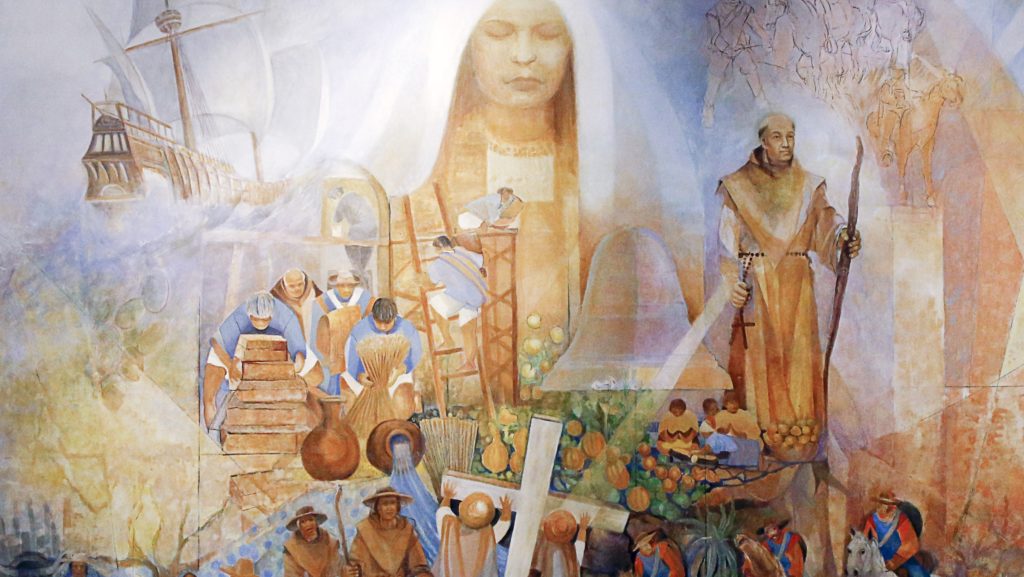
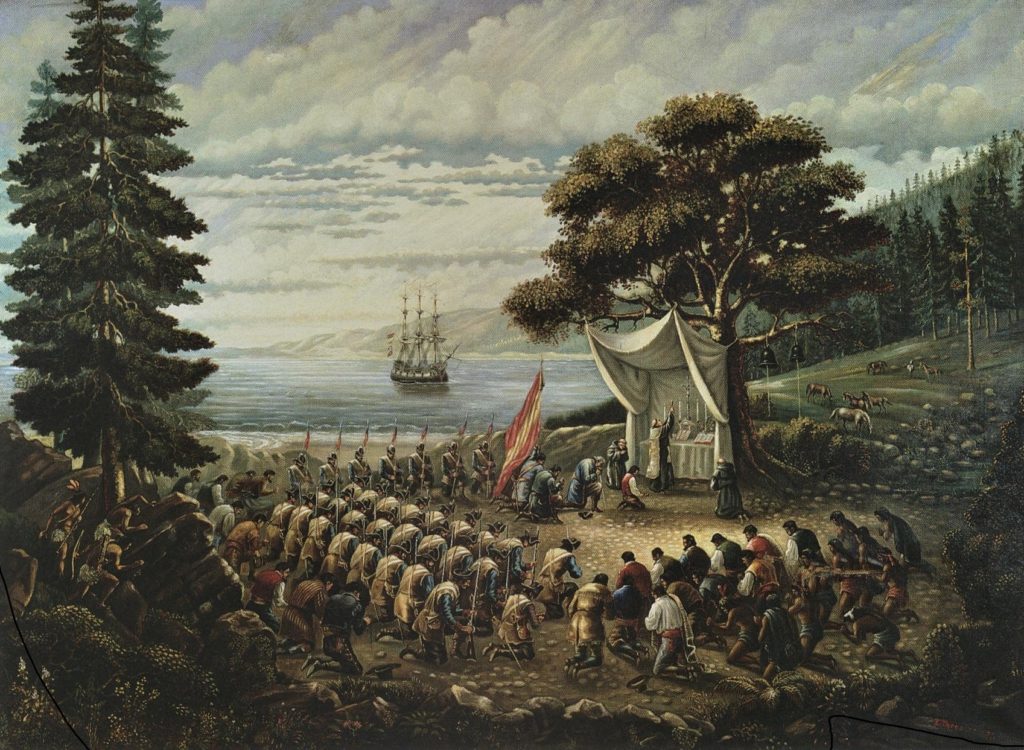
The Spanish missionaries who in 1769 first christened California with the names of Christ, the Blessed Mother, and the saints, walked in the footsteps of St. Francis of Assisi. Many, including St. Junípero Serra, were scholars who renounced an easy life for extreme hardship and isolation because they wanted to follow Christ as St. Francis did.
They often named missions for Franciscan saints, including Mission San Francisco de Asis, Mission Santa Clara de Asis, Mission San Antonio de Padua, Mission San Buenaventura, and Mission San Juan Capistrano. “The City of Angels” was never a mission, however.
In 1781, the Spanish military government established Los Angeles as a civilian pueblo, located in Tongva territory. In 1769, Padre Juan Crespi had named the region Nuestra Senora la Reina de Los Angeles del Rio Porciuncula (Our Lady Queen of Angels of the Portiuncula River). The Portiuncula is a hallowed Franciscan site; the chapel where St. Francis lived and formed his community in the medieval town of St. Mary of the Angels.
Moral critiques have rightly been made of some Franciscan interactions with and views of Indigenous Californians, and consequent harm that Indigenous people endured. Some of those critiques drew on a faulty grasp of history, such as confusing abuse committed by civil administrators at secularized 19th-century mission buildings with the actions of friars. What becomes lost in these disputes is how
Franciscan spirituality created connections between the missionaries and many Indigenous people they evangelized.
The California Franciscans imitated St. Francis by preaching in the local dialect, rather than Latin or Spanish. Shocked to encounter hundreds of California languages, none resembling tongues they had studied in what is now Mexico, they began to learn. At Mission San Antonio, for instance, Padre Buenaventura Sitjar translated a catechism into Telamé, including whistling and guttural sounds. Most friars defied government decrees to force Indigenous converts to learn Spanish, but tried to preach, teach, and converse in peoples’ heart language.
St. Francis and his brothers evangelized with song in town squares. Music was likewise essential to Franciscan witness in California. On one hand, missionaries taught Indigenous Catholics an astounding array of European instruments and musical genres. Far more astonishing was that some friars adopted Indigenous instrumentation in liturgical music. Musicologist Craig H. Russell of Cal Poly discovered notations for Corpus Christi hymns at some missions indicating drum beats each time the word “love” was sung. Drums weren’t heard in European liturgies until after Vatican II.
Peace-making and reconciliation are closely associated with Francis, and Serra and his brothers followed in that tradition. One example began in 1775, after hundreds of Kumeyaay warriors burned Mission San Diego, torturing and killing Padre Luis Jayme and six lay Spaniards. Despite what would now be called PTSD, the surviving friar immediately helped one of the perpetrators, a Catholic named Carlos, claim sanctuary. Serra attempted vigorously but unsuccessfully to stop brutal military reprisals. He declared that when he had embarked for California, “One of the most important requests I made . . . was that if the Indians, pagan or Christian, killed me then they should be forgiven.”
After two years he secured the release of all 13 convicted insurgents and spent the last nine years of his life repeatedly rescuing Carlos, a serial rebel. After Carlos was complicit in killing an Indigenous Catholic, Serra gave him sanctuary at a mission — where he plotted the overthrow of the Spaniards until his next arrest. Serra intervened to stop both his execution and an effort to consign him to a coastal exploration ship — where he feared Carlos might die without the sacraments. Serra died in 1784 while campaigning to bring Carlos back from exile in Mexico, and his successor took up the cause. Carlos was sent north to Mission San Carlos, where he died in 1809, a quarter-century after Serra.
Franciscan missionaries from Spain brought the very spirit of St. Francis to California and its native peoples.