When Anderson F. Shaw was baptized in his early 20s at Holy Name of Jesus Church in the 1960s, Los Angeles was experiencing something of a Black Catholic boom.
From the 1940s to the 1960s, thousands of Black and Creole families from the South — especially from traditionally Catholic pockets of Louisiana — migrated to Southern California in search of better lives. Bringing their faith with them, they worshipped and raised their families in parishes across Greater Los Angeles.
But as demographics shifted again over the following decades, the number of majority African American parishes in the Archdiocese of Los Angeles shrank to a small handful, which today include Holy Name Church in Jefferson Park and nearby Transfiguration Church in Leimert Park.
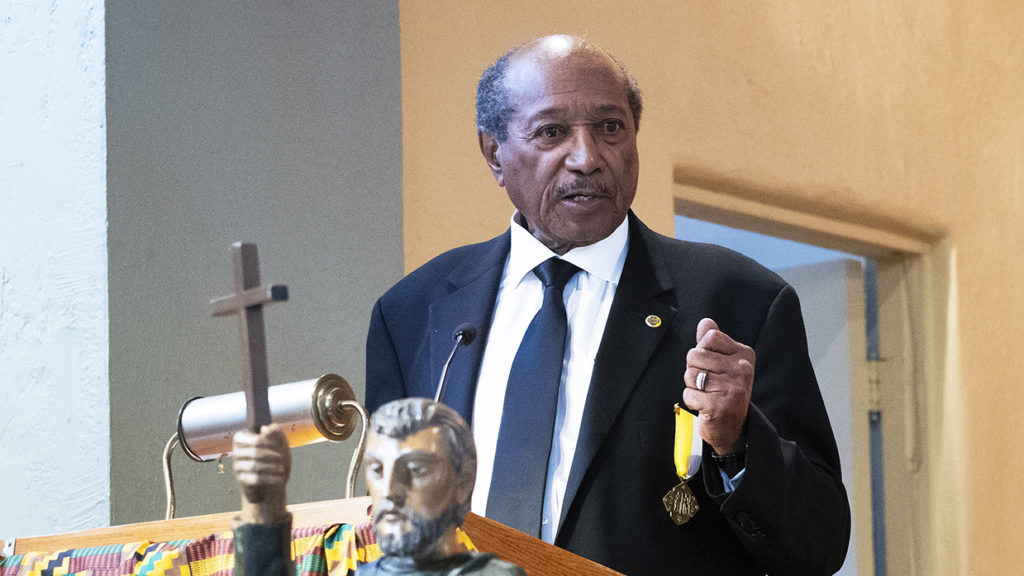
During changing times, no one did as much to keep LA’s Black Catholics together as Anderson Shaw.
“He was a stabilizing force,” said Deacon Mark Race, who worked with Shaw for decades. “He wasn’t a complainer. He was just the type of person who would get in there and say, ‘Look, this is what we need to do.’ ”
Shaw, who since 2004 was the director of the LA Archdiocese’s African American Catholic Center for Evangelization (AACCFE), died on April 3, Good Friday, at the age of 87, less than three weeks after being diagnosed with a rare, aggressive form of brain cancer known as glioblastoma.
Since his passing, friends and colleagues have described Shaw as a visionary who avoided the limelight. But his efforts to build community among African American Catholics in the archdiocese, it seems, earned him the trust and respect of just about everybody.
The oldest of six siblings born to a working-class family in rural Mississippi in 1939, Shaw grew up facing the poverty and racism typical of the Jim Crow South. He didn’t grow up Catholic — his father had been a Southern Baptist minister — but his mother made sure he was taught by nuns at the nearby parochial school.
As a teenager, he excelled as a drummer in his high school’s traveling marching band, and was a standout in its theater program. After graduating from Woodbury College in Mississippi, he followed his younger sister and came to LA, where he took a job at the UCLA Medical Center morgue, which helped him enroll in a few more college classes. He became an accountant, the start of a path that led to a successful 30-year career at aerospace firm TRW, where he quickly rose through the ranks to become assistant controller. At one point, he was the highest-ranking African American in the company.
Shaw had “always wanted to be Catholic” since being taught by those nuns, his wife, Audrey, said. He started going to Mass at Holy Name of Jesus, where he met Msgr. Jerome “Jerry” Schmit. The priest guided his conversion and welcomed him into the Catholic Church.
“It fitted my belief, my concept of what I think God wanted us to do,” said Shaw of his conversion in an interview with Angelus in 2017. “The Catholic Church had been around for over 1,000 years, while Southern Baptists were here for only decades. So this has to be where you need to be.”
Shaw and Audrey got involved in parish life at Holy Name and later, St. Bernadette Church. He served as a youth minister. He studied liturgy. He sent their kids to parochial school.
He may not have realized it at the time, but those experiences were preparing him for the day in 2004 when Cardinal Roger Mahony called him to his office to ask if he’d take over as director of the African American Catholic Center for Evangelization.
“The center wasn’t well known back then,” said Race, who accompanied Shaw downtown for the fateful meeting. “But Andy’s mind was always next level. There were things he wanted to do where others would say, ‘They’re never going to let us do that.’ ”
But Shaw did them. He organized events like the annual Martin Luther King Prayer Breakfast, and worked with groups like the Knights and Dames of St. Peter Claver to put on Masses celebrating November’s Black Catholic History Month, including at the Cathedral of Our Lady of the Angels.
“When Andy took over the [AACCFE], the vision was there, but it was being worked out,” said Race, who served for years at Transfiguration and now helps at St. Joseph Church in Hawthorne. “But to be really honest, Andy expanded it beyond just the parish, and took those events to the cathedral.”
Shaw also drew on his experience in business management and musical background to start the Sister Thea Bowman Academy for young musicians, and was instrumental in launching Loyola Marymount University’s Contemporary Black Catholic Spirituality program.
“He was always asking: ‘What is the plan? What are we going to do next?’ ” said Race.
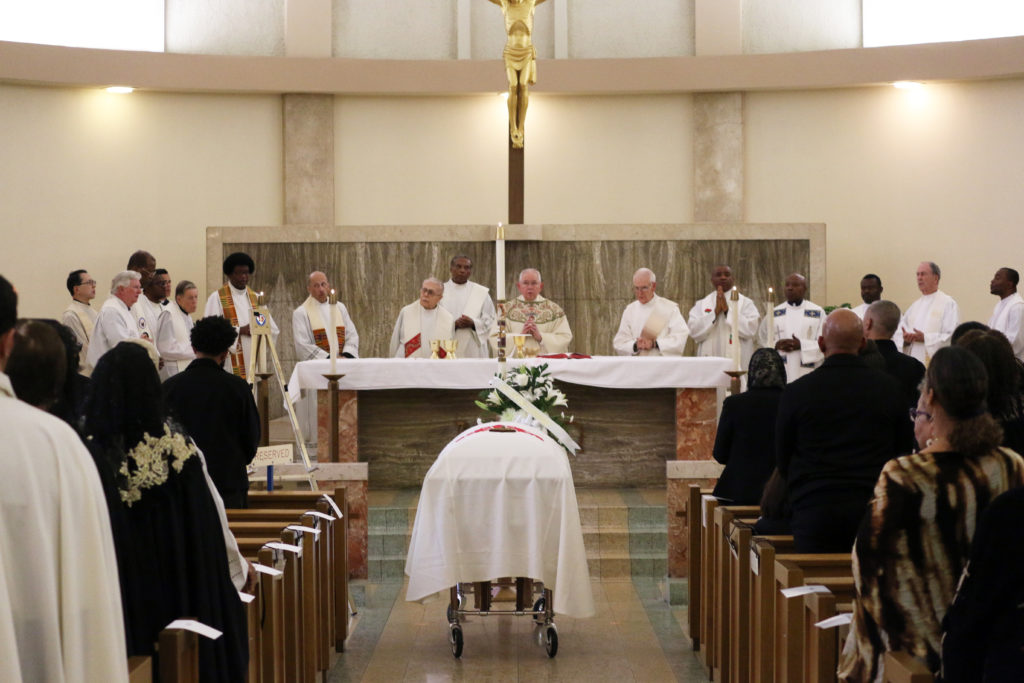
The tributes to Shaw at his funeral, held April 24 at St. Bernadette Church in Baldwin Hills, described a man whose faith and unassuming personality made him hard to dislike.
Arthur C. McFarland, the past supreme knight and chief executive officer of the Knights of Peter Claver, the Black Catholic fraternal order to which Shaw also belonged, recalled a time when Shaw convinced him to help with a fundraising mission that he’d already declined.
“How can you say no to a person who so positively impacted all of us?” said McFarland. “Andy at his core was a godly man.”
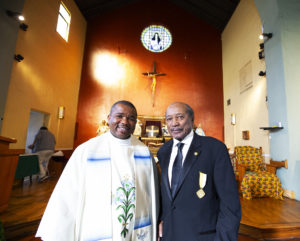
In his homily, close friend Father Gregory Chisholm, SJ, compared Shaw to a character from the Gospels: Nathanael, the man in whom Jesus Christ saw “a man with no guile.”
“A person without guile isn’t trying to present themselves in a way tailored for you to respect or expect,” said Chisolm, who first met Anderson and Audrey when he was assigned to Holy Name Church in the late 1990s. “Anderson was entirely comfortable being the person he is. Being with Andy, getting to know him, working with him, was … an encouragement for my soul.”
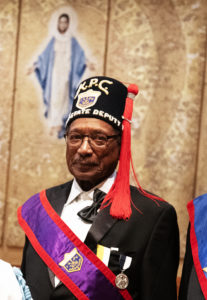
Besides the Knights of Peter Claver, both Anderson and Audrey also belonged to the Equestrian Order of the Holy Sepulchre of Jerusalem. A decade ago, there were no Black members from LA in the order. But as soon as the Shaws joined, other knights said, several more soon followed.
“His hands were just in everything, but he did it in a humble way,” said Margie Romano, who leads the order’s Western Lieutenancy.
Greg and Sharon Warner, who were close to Shaw at St. Bernadette’s and through the Knights of Peter Claver, said Shaw was a shy man but an excellent speaker, despite his reluctance.
“He never wanted to speak [at events],” said Greg. “He was just very smart and would get up there with no notes.”
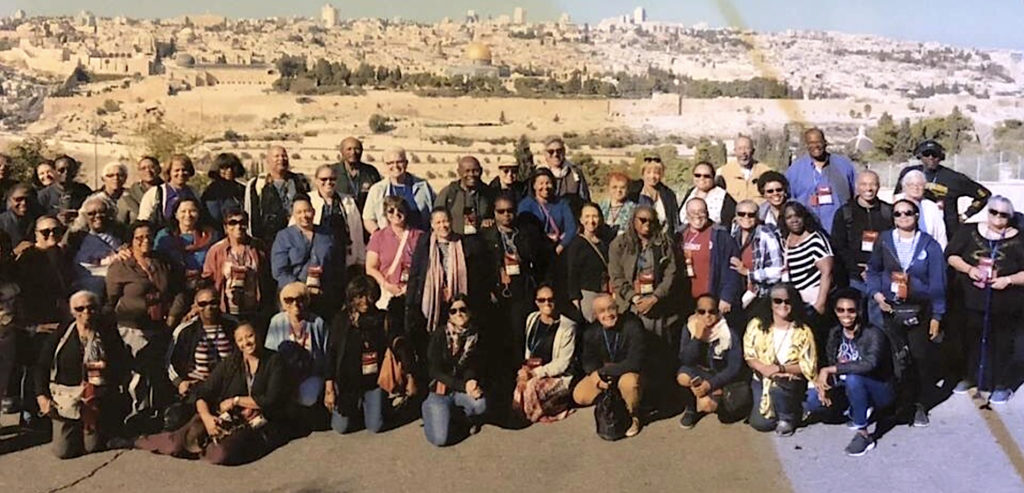
Audrey said that one of the proudest moments for Shaw was a pilgrimage in 2018 to the Holy Land and Italy that they organized through the AACCFE. The couple had expected a few dozen Black Catholics from the archdiocese to sign up. Instead, 60 came. During the Rome portion of the trip, the pilgrims even got the attention of Pope Francis when they started singing Gospel music in St. Peter’s Square.
“[That pilgrimage] was one of the most exciting experiences of our lives,” said Chisholm, who was the group’s chaplain. “It was one of the most ambitious and remarkable expressions of Anderson’s purpose.”
Much of Shaw’s work over the years was focused on spreading awareness about the contributions of Black Catholics. In 2020, for example, he told Angelus that he believed Black Catholic History Month should be celebrated in all parishes, not just ones where there are Black people.
“The Catholic Church is still struggling with its past, when most of the [racial or ethnic] churches were ‘national’ churches like the Polish Church here in Los Angeles that still draws Poles from all over the archdiocese,” Shaw told Angelus in 2017. “And so I think that still exists in the minds of some people about us Black Catholics.”
Audrey said that in the years before Shaw’s death, he was becoming increasingly concerned about ways the archdiocese could help unite all Black Catholics of African descent in the archdiocese — whether from the Caribbean, South America, or Africa — to overcome historical and cultural divisions.
To that end, Shaw had organized two appreciation events, gathering more than 50 African priests serving across the archdiocese in recent years.
“He had plans to do a lot more on that project,” said Audrey. “He was passionate about it.”
Whoever succeeds him at the AACCFE, Race believes, will find that Shaw did more than anyone realized.
“Andy left things in a situation where you just could step right in, and you don’t have to reinvent the wheel,” said Race. “The calendar is set, the vision is there.”