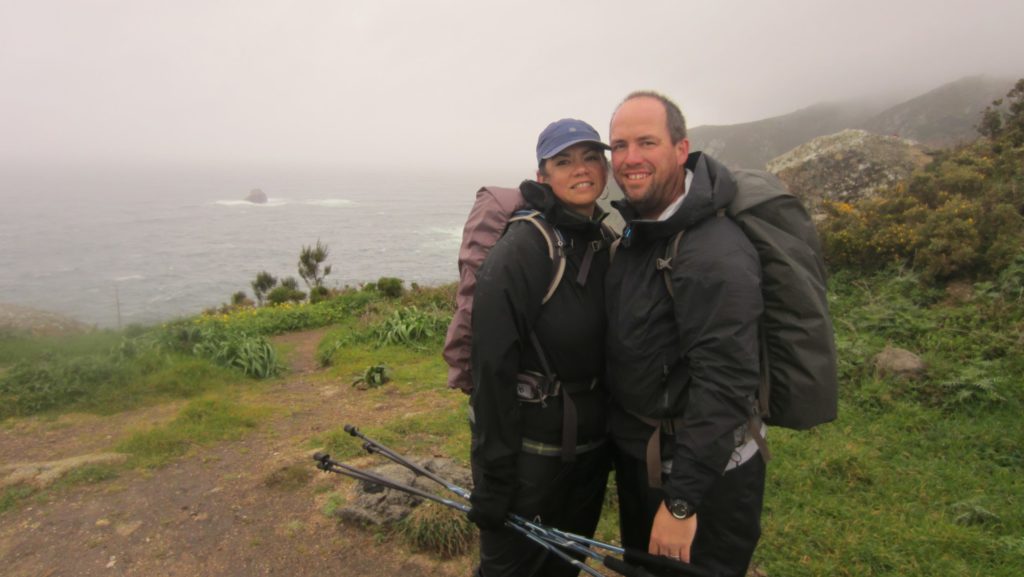
It has been 13 years since my husband and I walked the Camino de Santiago de Compostela after losing our youngest son, Gus, to cancer at the age of 10.
Neither of us had even heard of the 1,000-year-old religious pilgrimage until we happened to come across the movie “The Way” in January of 2012. In retrospect, I am not entirely sure what compelled us to want to walk the Camino at all. After all, we were not an especially “active” couple. While we played T-ball, soccer, and basketball with our three boys, we were not, at the time, too fond of lengthy walks. We didn’t like to park too far away from the door when shopping, let alone go on extended hikes.
Perhaps we thought the Camino would be a good thing to do in gratitude for Gus’ healing since we never imagined we were going to lose Gus at all. He had responded well to the radiation therapy and was technically in remission. We were certain that he would beat the aggressive neuroblastoma again, like he had when he was two. Nevertheless, something about the Camino moved us and we resolved to walk it when Gus lost his battle with cancer on June 24, 2012, 10 days after the passing of his paternal grandmother and just hours after her funeral.
The morning of the memorial service, Gus got sick immediately after getting out of bed. Knowing his immune system was still low from another round of chemo after the relapse in May, I rushed him to the hospital while the rest of the family attended the service. Within hours it became clear that Gus’ little body was systematically shutting down from sepsis. When my husband came soon after, the entire funeral party accompanied him and stayed with us until Gus passed. The doctor remarked that it was the largest gathering they’d ever had for such a little boy.
Everything about losing one’s child is shocking and unnatural: returning home to pick up toys and clothes that will never be used again; getting calls about missed appointments and activities; picking out a niche, urn, and finding the right words to encapsulate your child’s life on a plaque. The chaotic routine of parenting suddenly stops, and the sweet sounds of childhood are replaced by an oppressive silence. It was unbearable. We realized we suddenly had the “time” to walk the Camino and it felt necessary.
After a few months of practicing walking around Los Angeles at varying distances and terrains, we arrived in Spain equipped with fitted backpacks, specialty trail shoes, carbon fiber walking sticks, and suitcases stuffed with extra clothes and supplies that would be transported forward by taxi each day to our next stop per our “adventure” company’s schedule. After seeing our suitcases off, affixing our pilgrim shells to our backpacks and attending Mass at a small church at the start of “The Way,” we began our Camino on a partly cloudy Easter Sunday morning in March 2013.
Over the next 10 days, my husband and I walked more than 150 miles from Sarria to Finesterre in what can only be described as a transformative journey that revealed the fullness and meaning of life. We met people along the way who helped carry our burden and allowed us to carry theirs. We learned to find comfort in the silence that is a natural by-product of having to navigate hills, creeks, rocks, trees, and the dung that is characteristic of the picturesque rural landscape. Most days, the heavens wept with us, soaking us just enough to be uncomfortable and then warming us with the soft Galician sun a few hours later.
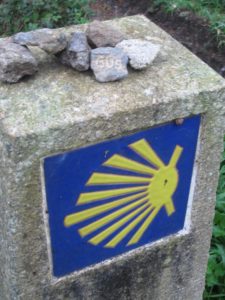
We discovered that faith was an act of surrender. We had walked miles before we realized that we had been blindly following the yellow arrows on the kilometer markers, asphalt, and street signs without once questioning if they would lead us to our destination. We understood that months before our journey began, God had already thought of the small reprieve from the most excruciating part of the walk to Finisterre with an “included” car ride to the top of a nearly vertical hill in unrelenting rain.
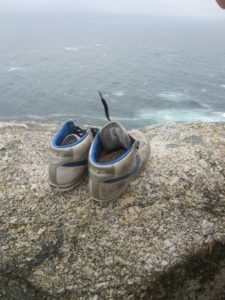
Most importantly, we came to understand that even the most seemingly insignificant gestures, like leaving rocks with Gus’ name on them, could have a profound effect on those that followed. We ended our Camino by leaving one of Gus’ favorite tennis shoes at the furthest edge of the cliff we could reach. We didn’t really want our experience to end, but gale-force winds and pelting rain made it clear it was time for us to bring our journey to an end.
We thought we’d return to Spain to walk a different route of the Camino the following year, but when we got back to our life, we discovered we no longer had “the time.” We realize now that our Camino never actually ended that day.
Had we not embarked on the Camino 13 years ago, we could not “walk” like we do now. Physically walking is a necessity now, and we have become “outdoorsy”: we hike, we camp, we crave nature. Accompanying people in joy and grief is acknowledged as a privilege. Silence is no longer oppressive, but necessary to sit in prayer and listen for God and even, sometimes, Gus.
Signs and coincidences are the love taps we need to reassure us we are still on the path. And faith in ourselves, our marriage, our family, and God has never been stronger. We are not spared from loss, pain, or adversity, but hope and pray that we carry our burdens now with more grace.
Finally, we seek and find joy more regularly because life is just way too short. Yes — it is a buen camino.