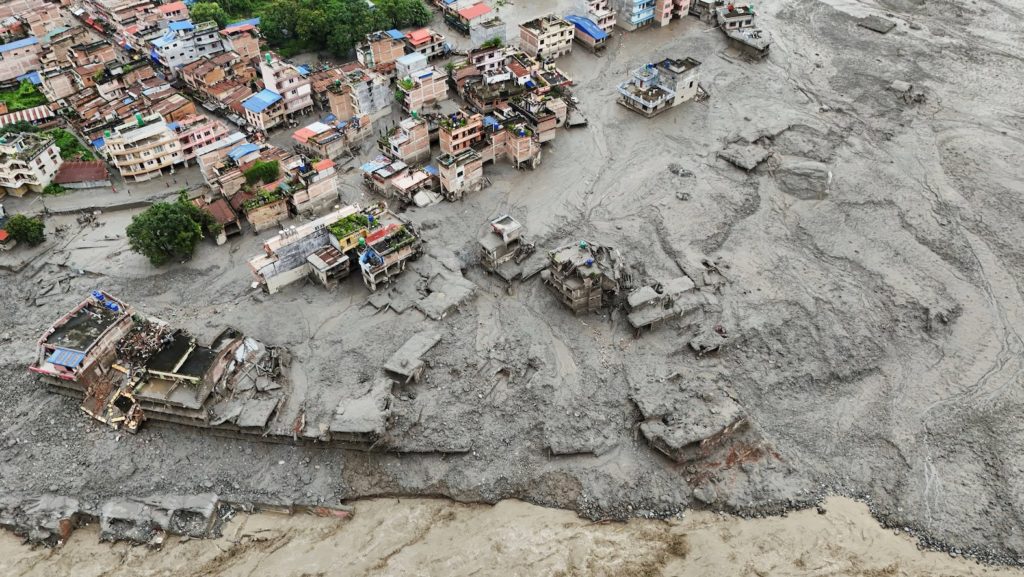
Pope Leo XIV expressed his sadness by the devastation wrought by a glacial collapse in the Nepal-China border, causing a deadly wave of floods and mudslides that killed 168 people with hundreds more feared dead.
In a telegram sent on the pope’s behalf Aug. 27, Cardinal Pietro Parolin, Vatican secretary of state, expressed the pontiff's condolences upon learning "of the loss of life and devastation caused by the flash floods in Nepal."
"Commending the souls of the deceased to the clemency of the Almighty, His Holiness sends heartfelt sympathies to the bereaved, together with the assurance of his spiritual closeness to those affected by this tragedy," Cardinal Parolin wrote.
"Likewise offering prayers for the emergency personnel engaged in the ongoing rescue efforts, he invokes upon all divine assistance and protection," he added.
According to The Associated Press, the U.S. Geological Survey initially reported an earthquake 41 miles north of Kathmandu Aug. 26. However, further analysis revealed that the seismic event was caused by a 5.2 magnitude glacial collapse.
The disaster was a grim confirmation of warnings given earlier this year regarding the effects of climate change on nearby glaciers.
In March, researchers from the International Centre for Integrated Mountain Development (ICIMOD) released a report revealing that glaciers across the Himalayas were melting at an accelerating rate and warned that concrete action was needed to avoid further disasters to communities in the area.
"This isn’t a distant problem; it’s a crisis unfolding in real-time, with new disasters every summer and monsoon," said Pema Gyamtsho, the director general of ICIMOD. "The fact that ice loss rates have doubled this century should shock us all into action."
In an interview with the Vatican’s missionary news agency, Fides, published Aug. 27, Father Silas Krishna Bogati, the apostolic administrator of Nepal, called the catastrophic event as "the worst disaster in the country's history."
"It was terrible. A flood coming from the mountains, and directed violently towards the valley, overwhelmed everything: people, homes, bridges, structures. Villages, markets, and roads were swept away. It is a serious wound for the nation," Father Bogati told Fides.
BREAKING: At least 380 people missing after flash flood hits near Nepal-Tibet border pic.twitter.com/iCRpXJaBAe
— BNO News Live (@BNODesk) August 26, 2026
Father Bogati told Fides he was "shocked" and offered prayers for the dead, the missing, and "those suffering because of this catastrophe."
"We have about 25 Catholic families in the disaster area; they appear to be safe, but we are very worried about them," he said. "We entrust them to God, we pray for their safety, and we will do everything we can to help them."
The apostolic administrator of Nepal also said that a priest of the vicariate, Father James Britto, was stranded after "he had gone to celebrate Mass on the other side of the river and was stranded." According to Father Bogati, the bridge the priest had crossed was swept away by the floods.
As of Aug. 27, more than 1,300 people are missing in Nepal and Tibet, more than a hundred of whom were visiting Mount Kailash, a pilgrimage site sacred to several Eastern religions, including Hinduism and Buddhism, AP reported.
"There are Nepalese, but also foreigners and tourists who were in these areas on an excursion: it is a pilgrimage route to Mansarovar, a sacred Hindu site that is also a trail for hikers and trekkers," Father Bogati explained.
The priest told Fides this was "the second time a disaster of this kind has occurred in that area, but this time it is of enormous proportions."
He also said the local Church's Caritas office was launching an appeal "to partners around the world" for assistance.
"We will do our part," Father Bogati said.
Catholic Relief Services (CRS), the U.S. Catholic Church’s international aid agency, said it was closely monitoring the situation in Nepal and announced it was "coordinating with Caritas Nepal and local partners to assess urgent needs and determine how best to support affected communities."