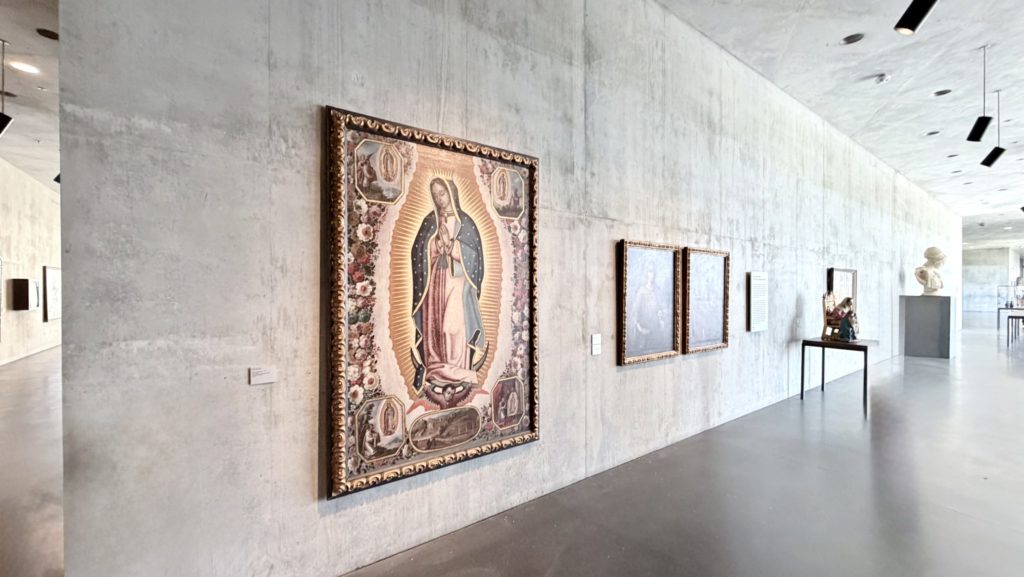
Finally, finally, we can drive down Wilshire Boulevard between La Brea and Fairfax unimpeded. After six years of construction and reams of controversy, finally, the $724 million LA County Museum of Art (LACMA) renovation is done.
Four buildings were demolished. Three remain: the Broad Contemporary Art Museum, the Resnick Pavilion, and the Pavilion for Japanese Art.
But the showpiece, of course, is the new building: the David Geffen Galleries.
Floating 30 feet above the ground, thrillingly spanning Wilshire Boulevard, from the outside the structure resembles a long, undulating caterpillar with windows along its sides.
Inside, the idea was to demolish hierarchies in favor of leaving visitors to discover the art on their own, in a kind of free-flowing stream. “Let your curiosity be your compass,” advises Michael Govan, LACMA’s director.
Reviews have been mixed. The Wall Street Journal titled theirs: “LACMA’s David Geffen Galleries Are a Formless Maze.”
The New York Times noted: “Wandering without a compass can be fun, but it gets wearying … a visit can feel less like a trip through a treasury than through a catacomb.”
“A Stunning New LACMA Descends Upon a City in Crisis” trumpeted The New Yorker by contrast. “[Architect] Peter Zumthor’s building recalls a spaceship loaded with several thousand artifacts of life on Earth, ready to leave this planet behind.”
But is that a compliment?
Frankly, I was prepared to hate the place. It’s going to be like one of those overpriced restaurants where the insufferable celebrity chef is more important than the food, I figured. It’s going to be a dumbed-down hodgepodge.
Instead, from first to last, I was utterly enchanted.
Everyone complains there’s no front, back, or entrance, but you have to get in somehow. One way is via a narrow, sidewalk-width opening through a metal gate off Wilshire, sort of where you would have entered the old LACMA.
I stepped through — and found myself in the Land of Oz.
My first impression was of big, wide expanses of space stretching in every direction. (The shaded public area beneath the galleries alone comprises 3.5 acres). Tickets and bookstore are to the left, Erewhon Café to the right, and that caterpillar-like gallery looms above.
You’re greeted at the top of the stairs by what looks like a hideous deformed horse with two rear ends made out of vomit-colored cement — but hey, it’s LA. (I later learned this 2023 sculpture, the gallery’s one discordant note, is meant to depict “the grotesque and repetitive cycles of imperial ruin and colonial overreach.”)
I averted my eyes, moved on, and stopped dead in my tracks: three fabulous, lidded Mayan bowls just sitting there waist-level, out in the open, on a table! No glass case, just a discreet “Don’t Touch” ideogram.
Those were part of the exhibit “Keepers of the Cosmos in Mesoamerican Art.” Next, “Modern Silver in Mexico and Peru” included dazzling altar plaques — one with a “Eucharistic pelican” — and gorgeously adorned herb boxes.
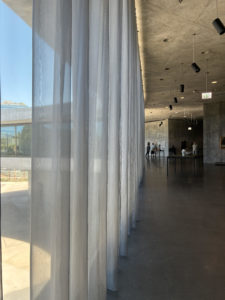
The 78 galleries are divided into four areas: the Pacific Ocean, the Indian Ocean, the Mediterranean Sea, and the Atlantic Ocean. With 111,000 square feet of interior space, the walk around the perimeter encompasses almost a half mile. As you wander, floor-to-ceiling windows are shaded by silvery shimmery curtains made of some space-age fabric through which everything outside appears to float.
It’s not exactly a maze, but it’s almost impossible not to become disoriented. Who cares, though? There’s a surprise around every corner: “Textiles of the Andes,” “Luxury Arts of the Great Mughals,” “Stonework from Mesoamerica and the Caribbean Coast.”
There’s no way I would have been able to take in that range of eras and geography on any given single visit to the old museum.
At the same time, no gallery felt overwhelming: the idea seems to have been quality over quantity. The objects — almost 3,000 from the museum’s collection of more than 150,000 — have been chosen with care and thought, beautifully and intelligently arranged.
I pored over shards of Korean pottery, passed a wall of African barkcloth and, around the corner, came across a Rosie Lee Tompkins quilt called “Hit and Miss Strip” (1983) that I once saw at the art museum in Shelburne, Vermont.
On a nearby wall hung a terrific sculpture from the Ghanaian artist El Anatsui, “Fading Scroll” (2007): a glimmering 39-foot-by-11-foot “drape” made entirely from flattened aluminum liquor bottle neck labels and copper wire.
Don’t miss the two stunning galleries of Spanish-Colonial art.
If you need a rest, there are long low wide benches, covered in buttery leather, where you can sit down, check your phone, or look out the window.
From any given point on the perimeter, you can check out the palm trees, the billboards, the office buildings, the endless teeming parade of beautiful people, the traffic on Wilshire Boulevard that flows west all the way to the Pacific.
To me, the new museum is the city at its very best: the design; the cutting-edge, slightly off-kilter creativity; the incorporation of the landscape and light; the outside-the-box originality that will inevitably garner both raves and rants.
In my excitement, at one point I waylaid a guard. “I love the new gallery!” I blurted. “What is with all the people who are complaining about it? Do you love it?”
“Yah … iz cool” he agreed.
“Well thank you for … helping to take care of the place!” I told him. “It’s just fantastic.”
Take what you like and leave the rest, as they say. I’ll take it all.