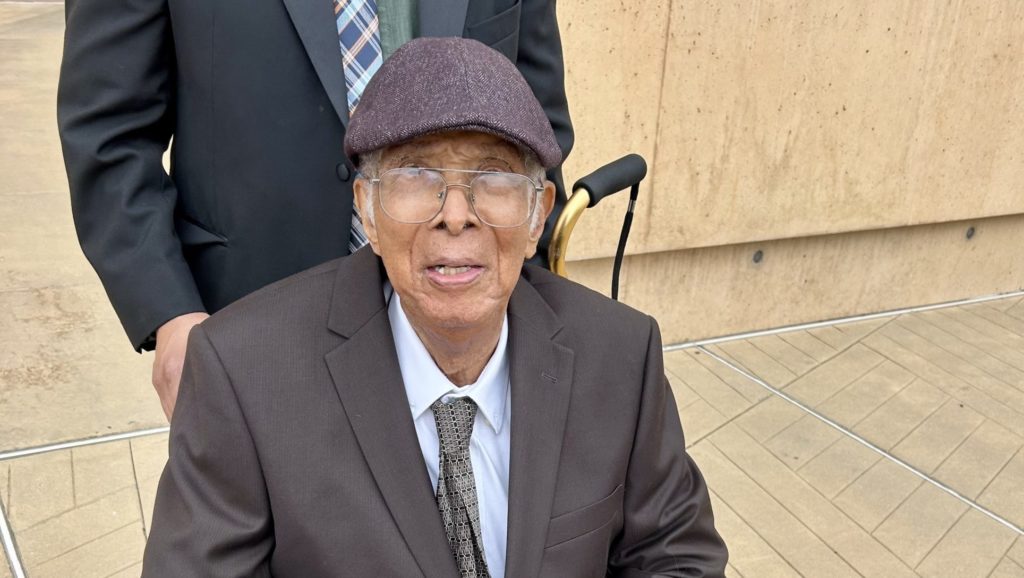
Hosea Alexander Sr. was a standout athlete, a military veteran, and a pioneering rocket scientist who worked on some of NASA’s earliest space missions.
But for the last 51 years of his life, all the honors and trophies he’d collected couldn’t compare with what he loved being the most: a deacon.
“Now that you’re retired and a deacon, you’re doing more now than when you were working,” Alexander’s wife, Genevieve, would tease him.
And Hosea Alexander was not just any deacon.
Known for his outgoing, folksy manner and brilliant intellect, Alexander belonged to the first class of permanent deacons ordained by Cardinal Timothy Manning in 1975, a few years after the ministry was formally restored by St. Pope Paul VI. Because the men were ordained in alphabetical order by last name, he liked to remind people that technically, he was the first permanent deacon in the history of the Archdiocese of Los Angeles.
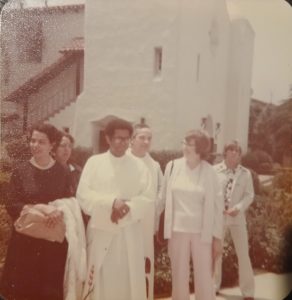
Alexander died July 9 at the age of 95. He was a convert who went on to mentor generations of permanent deacons while at the same time helping shape the archdiocese’s outreach to Black Catholics.
Born in Arkansas in 1930 to parents of Cherokee and African American heritage, Alexander was raised in St. Louis — mostly by his maternal grandparents — before enlisting in the Army in 1948. While he was never deployed, he earned multiple honors and promotions, along with a reputation as a talented boxer and football quarterback.
At Fort Riley, Kansas, Alexander made friends with the Catholic chaplain, Father Francis Xavier Murphy, CSsR, the same priest who would go on to write world-famous dispatches from the Second Vatican Council under the pen name Xavier Rynne. Alexander had been raised Protestant, but had been attending Catholic Masses and had read St. Thomas Aquinas’ “Summa Theologica.”
“I can see, Mr. Alexander, that you already know all this stuff,” Murphy told him as he was preparing to enter the Catholic Church.
After he was discharged, Alexander enrolled at the University of Notre Dame to study engineering. He met Genevieve while working a summer job in Los Angeles in 1955, a time when many Black and Creole families were migrating from the South to Southern California. The couple married a few months later and eventually moved back to Indiana, where Alexander finished his degree in 1962, becoming one of the school’s pioneering “Black Domer” engineers.
Returning to LA, he worked in early flight testing and fuel tank design for several major engineering firms, including NASA’s Jet Propulsion Laboratory, Rocketdyne, and Hughes Aircraft.
But his time at Notre Dame had also given him something else that would change the direction of his life: a deep devotion to the school’s namesake, the Virgin Mary.
“Everything in his life centered around the Church and the rosary,” said Elmer Pratt, a fellow Knight of St. Peter Claver and close friend of more than 30 years.
“At night, you were going to do a rosary,” recalled the youngest of Alexander’s five children, Vincent. “It wasn’t like you were going to bed. You were going to do a rosary.”
Pratt believes that devotion helped him discern his vocation to the diaconate. Hosea and Genevieve were parishioners at St. Agatha Church in Mid-City, and when their friends in a group of local African-American Catholics suggested he think about this recently restored ministry of the permanent diaconate.
“At that point in his life, he was a successful engineer in aerospace and could have stayed there, or could have just retired to almost anything,” said Pratt. “But he retired basically to go into the deacon program.”
Alexander’s first years were a time of “experimentation” as the Church was still figuring out exactly what deacons were supposed to do, said Deacon Peat Wilson, a friend of Alexander’s who was ordained in 1982.
“In the basic formation, they didn’t know what to teach us, and the priests had no idea what to do with us,” said Wilson, a deacon at St. Rose of Lima in Simi Valley. “We had no standard procedures. We had to develop those, and Hosea was one of those who stood up and spoke out about what should be done.”
Later on, those experiences helped Alexander mentor generations of younger deacons. Wilson said Alexander always saw his mission as more about evangelizing the local community than simply administering sacraments.
“In the African-American community, they didn’t have enough people to get to the marketplace,” said Wilson. “Our first objective was to learn how to minister in the marketplace. That’s why it was so wild, because nobody ever did anything like that.”
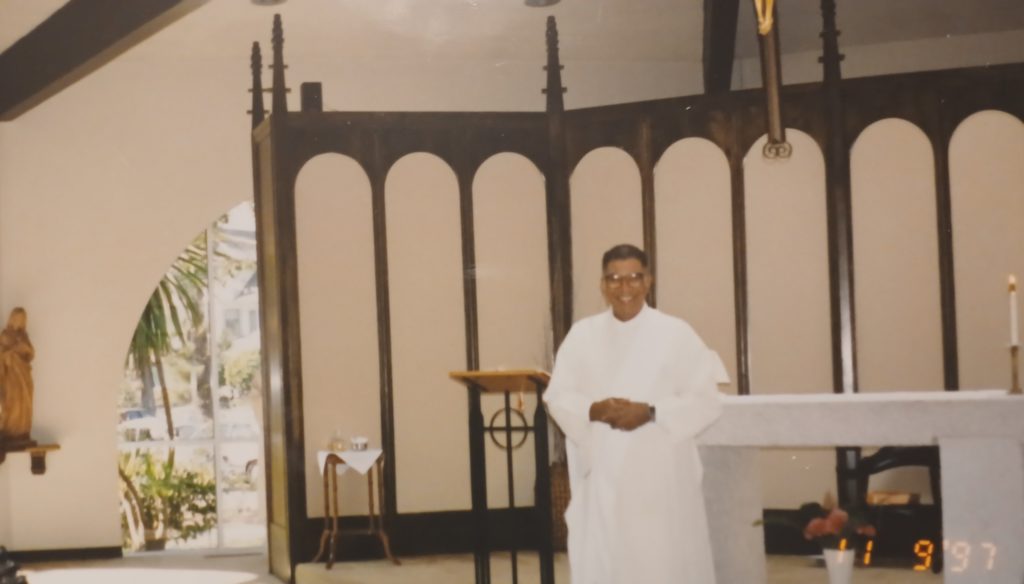
Officially, Alexander served as a deacon at St. Agatha, and later, Holy Spirit in Mid-City and Holy Name of Jesus Church in LA’s Jefferson Park area. But from the beginning, he was a deacon in demand.
“Wherever there is one Black person in a church, I want you to go preach there,” Cardinal Manning told him after ordination.
Cardinal Manning and his successor, Cardinal Roger Mahony, both turned to Alexander for advice on the permanent diaconate and outreach to Black Catholics.
“He was truly a prophetic pioneer for the entire archdiocese, and he set a new standard for all permanent deacons who followed him,” said Mahony, who often asked Alexander to assist him at confirmations and other liturgies in parishes with Black Catholics.
Over the years, Alexander added his own personal flavor to that ministry. He was known for his bilingual duets and, inspired by the story of King David processing with the Ark of the Covenant, would dance while carrying the Book of Gospels during the entrance procession at Mass. “God is good … all the time” was one of his trademark lines, and his snappy recitation of a scriptural rosary became a staple at vigils for deceased parishioners.
Despite losing Genevieve in 2022 and undergoing health problems in his final years, Alexander stayed active to the end, helping lead nightly Zoom rosary sessions with Scripture readings, music, sharings, and prayers for the sick.
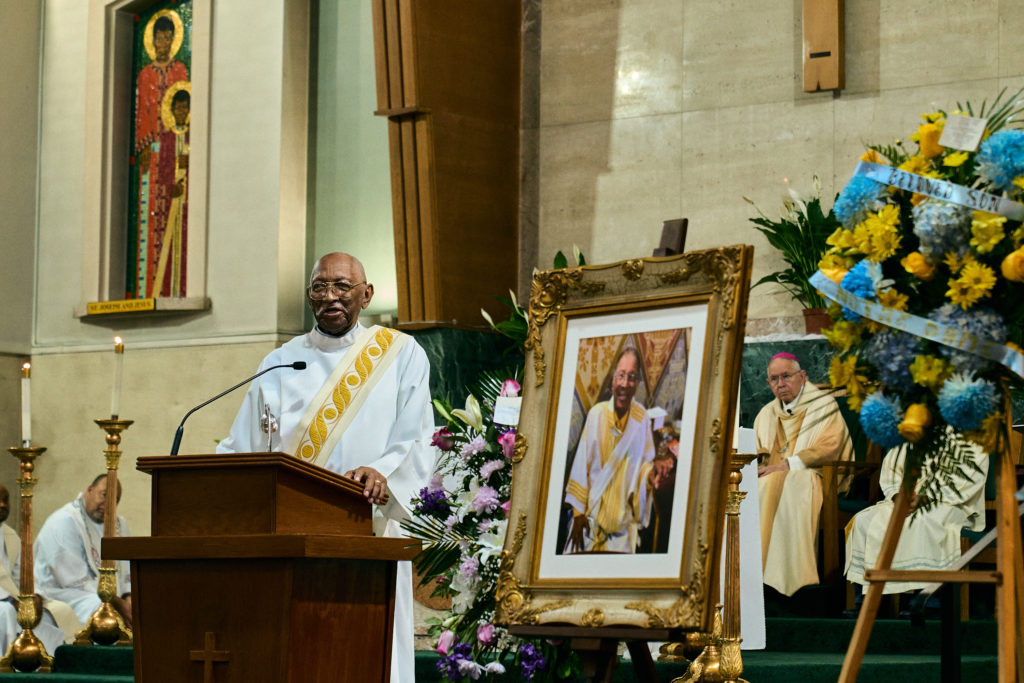
At his Aug. 14 funeral Mass at Holy Name of Jesus, an ensemble choir that included his son Vincent brought more than 300 people to their feet before, during, and after the Mass — just as Alexander would have wanted.
The funeral’s celebrant, Archbishop José H. Gomez, observed that he’d just been with more than 300 LA deacons for their annual gathering on Aug. 8, the feast of St. Lawrence Martyr, and called the size of their annual gathering a testament to Alexander’s legacy.
“What [Deacon Alexander] started has now turned into a huge blessing for the archdiocese,” said the archbishop.
Alexander’s son Eddie, an internal medicine doctor in Los Angeles, admitted that his father set an impossible standard for everyone else to follow, but never made a big deal out of it.
“He had a few extra gifts, let’s put it that way.”