It was around 2019, a year before COVID-19 hit, that I realized a seismic shift had taken place in the American psyche — maybe soul would be a better word.
I was talking to a friend I’d known for more than 20 years. Not a close friend but a friend I’d hired to work on my website a few times. A guy who’d been to my apartment, with whom I’d shared coffee, with whom I’d talked art, photography, music, literature.
I may have mentioned in passing trying to let go of resentments or praying for people who have hurt us.
“Love doesn’t prevail!” he barked. “Love doesn’t triumph. Look at the racism. Look at our ‘elected officials.’ ”
“Love rarely prevails in a way that brings about a worldly triumph,” I stammered. “But love is about the conversion of the human heart, not winning. And in some way we’re not given to see on this earth, I believe love always prevails.”
To illustrate, I mentioned St. Maximilian Kolbe, the Polish priest who offered himself in place of a fellow inmate with wife and children to die in the starvation bunker at Auschwitz.
“That didn’t do any good!” my friend scoffed. “We need to start blowing things up and burning stuff down. The really brave, original, radical people are realizing that we need to start exercising the freedom to hate.”
I’m not sure what was more horrifying: that an otherwise intelligent human being would believe “the freedom to hate” to be an original idea, or that his heart was not moved by the witness of St. Maximilian.
I haven’t run into that friend since, but I’ve thought of him many times. I thought of him when recently rereading “Heart of Darkness” (Tribeca Books, $9.24), the Joseph Conrad novella upon which the Francis Ford Coppola film “Apocalypse Now” is based.
In it, young Charles Marlow captains a steamboat up the Congo River for a Belgian ivory trading company. Upon arriving at the Company’s Outer Station, he hears whispers of the enigmatic Kurtz, a well-educated European who has worked as a painter, journalist, and ivory trader. Now, deep in the interior, rumor has it that he’s gone over the edge and is engaging in all manner of barbarous and exotic practices of the dark arts.
For some obscure reason, Marlow becomes obsessed with Kurtz. He admires him — why, the reader doesn’t quite know. His quest becomes to meet him.
When they do finally meet, Kurtz is a pitiable figure. He’s dying. He can barely speak. People have talked incessantly about his great powers of oratorical persuasion, but he never utters a single word of insight or wisdom.
From the beginning, Marlow has seen and been appalled by the unspeakable suffering imposed by the ivory traders upon the natives of the Congo. Now, Kurtz’s credo turns out to be: “Exterminate all the brutes.”
The freedom to hate.
“Heart of Darkness” is a brilliant work of literature: cunningly constructed, multi-layered, and open to infinite interpretations.
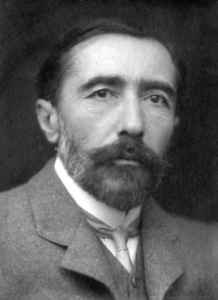
Conrad apparently loathed Christianity.
In a letter to a friend: “It’s strange how I always, from the age of 14, disliked the Christian religion, its doctrines, ceremonies and festivals. … Christianity has lent itself with amazing facility to cruel distortion … and has brought an infinity of anguish to innumerable souls — on this earth.”
Those without Christianity, however, are led to other kinds of distortions. The Catholic faces the full truth of the human condition: both the horror of the darkest of the dark; and the light so light that it is light itself.
To see the world as a fraud and a sham, unrelentingly bleak, is to absolve oneself of the terrible responsibility to hope; of carrying the tension of the paradox of reality.
Like my friend, Marlow admired the man who had gone beyond the bounds of civilized, polite society. Like Kurtz he wanted to indulge in the freedom to hate, or a variation of it: something radical, new, courageous.
But just as goodness can be sentimentalized, evil can be glamorized. There is nothing interesting, new, or glamorous about evil. Kurtz displayed severed heads on spikes; his subjects crawled before him. This has all been done before: cannibalism, child sacrifice, torture, slavery, mutilation, man arrogating to himself the role of God. It ends in gibbering madness, rot, death. There is nothing beyond evil but more evil. At the heart of darkness is simply darkness.
Kurtz’s last words — “The horror, the horror” — could have been pointing to Marlow’s pathetic fascination with him.
Kurtz’s fiancée, the “Intended,” is by Marlow’s lights delusional in her love and far too naive to face the harsh truth.
She does have one redeeming quality: her capacity and willingness to suffer, and Marlow stops just short of ridiculing her for it. In fact, the lie he tells her, with which the book ends, may be the one truly noble, courageous act in the entire novella.
In telling her that Kurtz died with her name on his lips, Marlow feels he has fatally compromised his integrity; betrayed his own search for truth. In fact, he consented to bear the burden of Kurtz’s evil, and of his lie, alone. He set the Intended free to marry another; to keep the flame of love for Kurtz ever alive in her heart.
His act was resurrectional. It introduced the one glimmer of hope, for all involved, into the story.
That’s how I read it anyway. But may mankind continue to ponder Conrad’s “Heart of Darkness” — and to exercise the freedom to love — for many years to come.