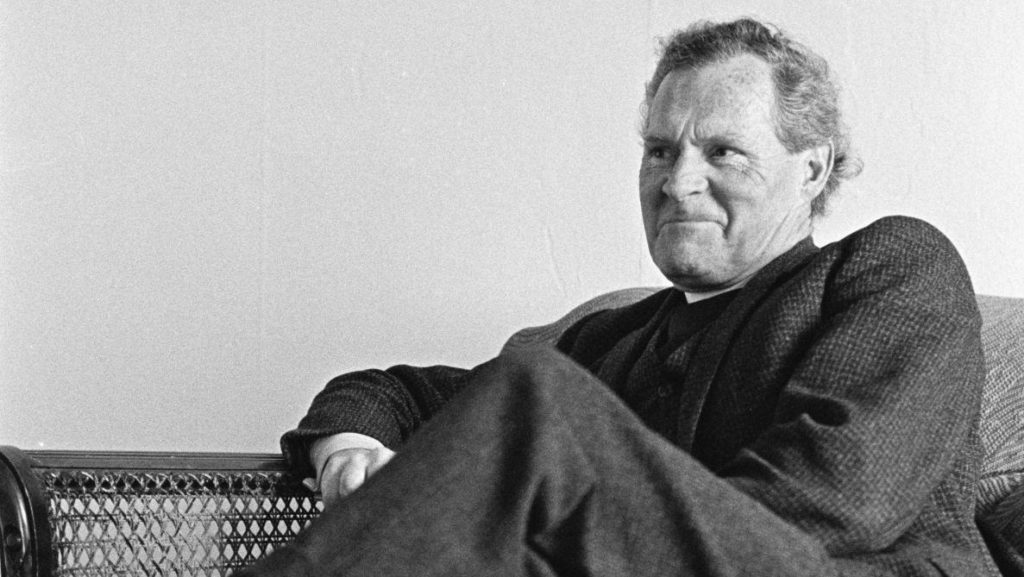
R.S. Thomas (1913-2000), Anglican pastor and acclaimed Welsh poet, was a mass of contradictions. He fiercely championed the Welsh language but wrote in his native English. He was a vicar who had zero capacity for small talk, a face like Heathcliff’s, and the demeanor, said some, of an ogre.
He was married for 51 years to the painter Elsi Eldredge, whose considerable talent was both eclipsed and largely ignored by Thomas. “A stranger couple it would be hard to find outside of fiction,” noted a neighbor. Yet the two lived in companionable harmony, in a house whose temperature was barely above freezing. They sometimes went for days without speaking. Elsi collected dead mice and the skulls of rabbits. Thomas baked bread that he might bring to his parishioners.
They had one son, Gwydion, who lived in total isolation from other children for the first eight years of his life and was then shipped off to boarding school. “I grew up in a house without electricity, a place of freezing fog, which in summer burst into life, and there were hayfields with curlews and lapwings’ eggs. Mine was a magical childhood. And they sent me away.”
His father once explained, “If you hadn’t gone away we wouldn’t have had the time to write and paint.”
“Someone had to pay the price for tramping round those cold vicarages with those two leading the high artistic life,” Gwydion later remarked. “The only thing was, I paid for it.”
Thomas followed “an absolutely rigid routine, day after day, decade after decade,” according to Gwydion Breakfast, then he disappeared “to study,” as he put it. “To read and write.” 11 a.m. bread and cheese. More reading and writing in the afternoon. From 5 to 8 he’d visit the sick. 8 o’clock, supper, then to bed.
Byron Rogers’ “The Man Who Went into the West: The Life of R.S. Thomas” (Aurum Press Ltd., $18.77) won the prestigious James Tait Black Memorial Prize for biography in 2007 and is the perfect introduction to this maddeningly paradoxical figure.
Rogers (1942-2025) was 17 when he first met the poet at St. Michael’s, the Welsh church in Eglwys Fach where, from 1954 to 1967, Thomas served as vicar. He wrote at that point about the farmers of mid-Wales. “He wrote about religious faith when, for many, this seemed little more than whimsy. He attacked modern life, modern technology, the English encroaching into Wales, the Welsh responsible for the decline of their own culture and language. There was no comfort in his poetry, and no answers.”
There never would be.
He hated hymns, despised Christmas cards, and once had the pews of his village church painted black.
It’s not entirely clear that Thomas even believed in God, much less the basic tenets of Christianity. In a 1972 BBC film, he observed:
“The message of the New Testament is poetry. Christ was a poet, the New Testament is a metaphor, the Resurrection is a metaphor.”
Sharon Young, Gwydion Thomas’s first wife, reminisced about meeting her future father-in-law for the first time, at 19. He didn’t want his son to date her and had refused to speak to her and stormed out of the room.
She was stunned.
Yet she had been reading his poems since she was 15 and thought them wonderful.
Meeting Thomas was startling, but “it told me something about the mystery of art that I’d never been taught, what at that time I didn’t even want to know, that some people had an ability to create work that was not of their personality at all. For a man with such personal difficulties to write such sublime poetry… it was just as though something came through at times.”
And for all his supposed coldness, many testified to his tenderness, his sense of humor, his hospitality, and generosity with money. He faithfully visited the old and the sick, even if he didn’t have much to say to them.
He adored birds — in fact, those closest to him sometimes remarked that he seemed to love birds more than people.
He published 25 volumes of poetry over his lifetime, and won numerous literary prizes, including a nomination for the Nobel in Literature.
In a short 1995 video portrait, Thomas stands on the rocks above the sea, and notes: “If I'm going to be remembered at all I suppose it'll be on the strength of a few poems that I've written. But… as a man I hope that other people will sort of benefit from my example of one who loved to be in the open air, loved the things of this Earth and was given the ability to both hear and see them.”
He died five years later.
And one can hardly read his 1975 poem “The Bright Field” without thinking that for all his doubts, he had a vicar’s heart all along.
I have seen the sun break through
to illuminate a small field
for a while, and gone my way
and forgotten it. But that was the
pearl of great price, the one field that had
treasure in it. I realise now
that I must give all that I have
to possess it. Life is not hurrying
on to a receding future, nor hankering after
an imagined past. It is the turning
aside like Moses to the miracle
of the lit bush, to a brightness
that seemed as transitory as your youth
once, but is the eternity that awaits you.