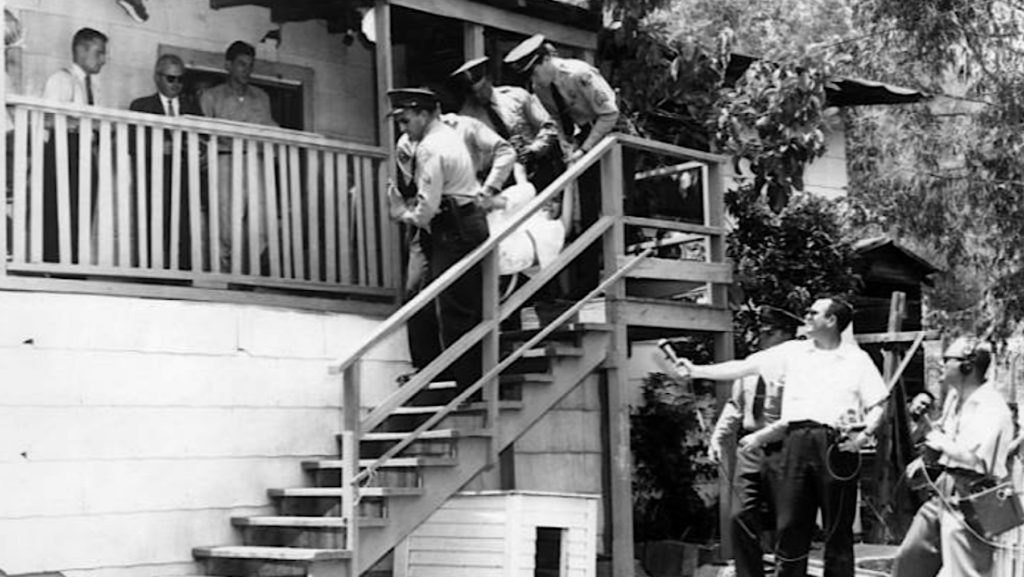
The story of how Chavez Ravine was demolished — and the people who lived there were displaced in the 1950s to build Dodger Stadium — is one of LA’s darkest chapters.
Evicting people from their longtime homes and bulldozing the streets on which they had lived, worked, and worshipped for generations would have been bad enough. But to add insult to injury, city planners first cast the vibrant, thriving, largely Mexican-American community as a slum.
Then, as now, the operative factors were racism, politics, and a housing crisis.
Many of the people had moved to the Ravine in the first place because of anti-Latino discrimination and redlining. The displacement started around 1951 when residents were told they had to move because the city planned on building low-income housing. The vast majority of the Ravine’s 1,800 families vacated. But from 1953 to 1958, the referendum was cancelled, the political winds shifted, and the housing never came to pass.
Instead, in 1957-1958 the city negotiated a deal with Walter O’Malley, the Brooklyn Dodgers owner who wanted to move the team to California. Outrageously, the city traded him more than 300 acres of Chavez Ravine land to privately build Dodger Stadium — then took the land by eminent domain.
The few remaining residents were forced out of their homes and those who refused to leave had their belongings and persons removed by sheriff’s deputies.
In a number of iconic photos taken on May 8, 1959 (known as “Black Friday”), 66-year-old Avrana Arechiga, the family matriarch, threw stones at the deputies in resistance — and one can hardly blame her. Minutes after she and her daughter were dragged kicking and screaming from their home, authorities bulldozed it.
The story of Chavez Ravine has since been told through myriad books, art exhibits, and documentaries.
In the 1970s, former resident Louis H. “Lou” Santillan helped found the organization Los Desterrados (“The Uprooted” or “The Exiles”). Its purpose was to preserve the memories and records of the displaced communities and to maintain ties by, among other means, an annual reunion picnic in Elysian Park: a tradition carried on by Lou’s son Eddie that continues to this day.
Standing on the shoulders of Los Desterrados and other community efforts through the years, on July 23, 2026, Loyola Marymount University (LMU) launched something new: an online, community-curated digital archive in which former residents tell their stories by contributing photos, letters, oral histories, and other memorabilia.
Started in 2015 by former Palo Verde resident Carol Jacques, now 83, and LMU professor Priscilla Leiva, “Chavez Ravine: An Unfinished History” currently comprises around 222 such items, and the call is out for more.
The aim is to invite the voices of community members from the 1910s to the early 2000s; from the Ravine’s first residents all the way up to their great-grandchildren.
Unlike other Chavez Ravine projects, the contributors here have the option to retain full copyright to the archival items they contribute. The proprietary rights to the story, a kind of narrative power, thus stay where it belongs: in the hands of the people who lived there. Additionally, the online, community-curated archive is meant to be “an ongoing project of civic remembrance and atonement.”
To many of us who know the story only superficially, the Ravine was an undifferentiated mass. In fact, it comprised three distinct neighborhoods: Palo Verde, La Loma, and Bishop.
The archive brings its residents alive. Agapita Ayala, a resident of the Bishop neighborhood, tends the family vegetable garden. Teodoro Rivas sits on a hillside of agave plants in La Loma holding a Jack Russell terrier puppy. Kids stand up in their cribs, play ball, explore Elysian Park, go to school, get baptized, confirmed, and eventually married, and go off to war. Residents attend meetings of the Chicano County Employees Association, travel to Delano to join rallies for striking farmworkers, and lobby for immigrant health rights.
Bishop neighbors Rosa Molano and Nena Marmolejo stand proud and smiling by a vine-covered fence, Rosa’s arm draped over Nena’s shoulder. The back of the photograph reads “May 10, 1942 Mother’s Day.”
The oral histories are especially interesting.
Former Palo Verde resident Alfred Zepeda, for example, remembers how, before being displaced, the families had gotten together and held fundraisers at St. Peter’s Church, at the north end of what is now Chinatown. They tried to hire lawyers to fight the eminent domain order, “especially when they found out O’Malley was circling the land in a chopper.”
Young Alfred didn’t know till the very day — January 30, 1952 — that he and his family would be moving. Most of the other families had already left. In his memory, the place looked like a war zone. Abandoned houses, broken windows. “You’d seen pictures of Europe after the bombing of Germany. That’s what it looked like. Houses torn apart, vandalizing. … No one on the streets anymore.”
By all accounts, most displaced residents received less than market value for their properties. But the archive shows that in a way the financial losses were the least of it. Emotional, social, and spiritual scars went deep: the destruction of community roots, traditions, and networks; the psychological trauma of watching police authorities seize homes and streets; the betrayal by the city in which residents had lived, and that they loved.
Nonetheless, the title “An Unfinished History” connotes that the demolition of the Ravine hardly comprised the whole of the displaced persons’ stories. They went on to build new lives, to buy other homes, to continue to be a vital part of the larger LA community.
May their archive continue to grow. And long may they live.