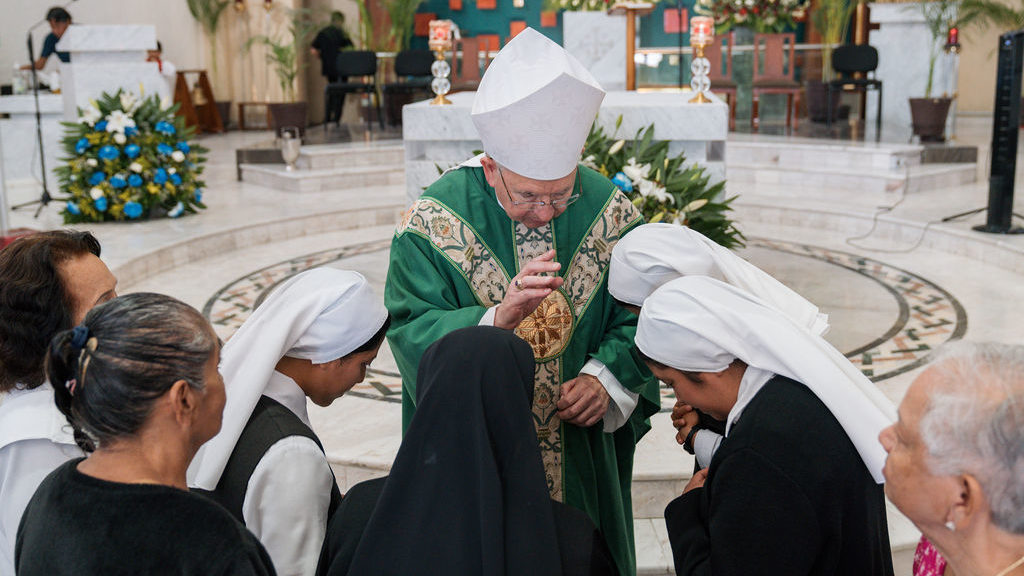
On Saturday, I celebrated Mass at the Basilica of Our Lady of Guadalupe in Mexico City for more than 300 pilgrims from parishes across Los Angeles.
It was beautiful, a moment of joy. I was joined at the altar, under the miraculous image of Our Lady, by four of our bishops, more than a dozen priests, and several deacons.
Together we offered more than 45,000 petitions and prayer requests from the family of God here in the Archdiocese of Los Angeles, asking Holy Mary to intercede for all our needs.
This is the seventh pilgrimage I’ve been privileged to lead and this one felt special, as we prepare to celebrate the 495th anniversary of Our Lady’s appearances to St. Juan Diego later this year.
It also felt fitting to make this pilgrimage in the days following our nation’s 250th anniversary celebrations.
I have been saying for many years now: America was not founded by the men who signed the Declaration of Independence in Philadelphia in 1776.
America’s spiritual roots trace back more than two centuries before that — to the missionaries, mystics, and martyrs who proclaimed Jesus in the wildernesses and settlements of this new land. And their mission originated in those five visitations of Our Lady of Guadalupe in Tepeyac in December 1531.
Guadalupe is our story — it is the story of America and the Americas. It is the story of our countries’ beginnings and also the story of the Church’s beginnings here.
I read the story of these apparitions, the Nican Mopohua (“It is told”) as an American scripture, telling of the coming of the Gospel to the New World, written down in the language of this continent’s first peoples, its pages revealing God’s providential purposes for these peoples, and all those of the Americas. This is America’s origin story.
This mysterious text dates to sometime before Juan Diego’s death in 1548 and is based on his testimony and that of his uncle, Juan Bernardino, who also saw and spoke to the Virgin, and that of Bishop Juan de Zumárraga, who received the miraculous image on the tilma.
The story that unfolds in the Nican Mopohua is an adventure written in dramatic, poetic language that contains rich deposits for theological, pastoral, and spiritual reflection.
In these pages, we find insights into the mystery of Holy Mary, the nature and mission of the Church, the dignity and destiny of the human person; this text speaks about the family, the meaning of suffering and death; it speaks about paradise and the redemption of creation, and God’s loving plan for all peoples.
Although the Immaculate Conception dogma will not be declared for centuries, Mary describes herself in the Nican Mopohua as “Perfect Virgin, Holy Mary of Guadalupe.”
The imagery of the text shows her to be the new Eve, bringing a new creation. She is the Mother of all the living, and the helper and handmaiden to the Lord and his divine plan.
She comes to Mexican people, but to all the peoples of the Americas:
“I am truly your compassionate mother, and of all the other people of different ancestries, those who love me, those who cry to me, those who seek me, those who trust in me.”
Mary comes to Guadalupe as she always comes in history: as the maternal face of God’s love.
The story of December 1531 can be read as a quest, a journey, like a medieval tale of knights and chivalry, as Juan carries out the mission entrusted to him by Our Lady.
But it is a story of vocation. Her first words to Juan Diego, “Where are you going?”, recall those that God addressed to his prophets, the word he addresses to each of us in our baptism. What are we doing with our lives? What are we doing for Jesus, for his mission?
Throughout this pilgrimage I had a strong sense that we are still living in the “new world” and Holy Mary of Guadalupe’s mission — to bring about the birth of Jesus Christ in every American heart — continues in your work and mine.
She is still “Lady of the Ages, Queen of the Centuries,” her miraculous image still “gathers in itself all times, unites all years, encompasses all centuries,” as she was described in a sermon preached at Tepeyac in 1731, to mark the 200th anniversary of her apparition.
As we prepare to celebrate the anniversary of this great event in American history, let us all look for new ways to bring this powerful vision to the people of our time.
Pray for me and I will pray for you. Our Lady of Guadalupe, pray for us!