Most Christians instinctively treat Easter as the climax of the liturgical year. It is the feast of feasts, the celebration of Christ’s victory over death. But the Scriptures themselves suggest that Easter is not an endpoint so much as a beginning — an opening toward something still to come.
To see this, we have to recover a more ancient, more biblical sense of the relationship between Passover and Pentecost.
In the Old Testament, Passover marks Israel’s liberation from Egypt. It is the night of deliverance, when the blood of the lamb preserves the people from destruction and sets them on the road to freedom. But the story does not end at the Red Sea. Liberation is not the goal in itself. Israel is freed for something greater: the covenant at Sinai. Fifty days after Passover, at Pentecost, the people receive the Law. Their freedom is given form, direction, and purpose. They are not merely released from bondage; they are constituted as a people.
The New Testament follows the same pattern, but with a startling deepening. Christ is our Passover. By his death and resurrection, he delivers us from sin and death. The early Christians knew this so well that, in most languages, the word for Easter is simply the word for Passover: Pascha. The connection is not poetic; it’s structural. The cross and Resurrection are the new Exodus.
But again, the story does not end there.
In the Gospel of John, especially in the Farewell Discourse, Jesus speaks insistently of what comes next. He tells his disciples that it is “better” for them that he go away, because only then will the Advocate come. This is a puzzling claim if we think of Easter as the culmination of everything. How could anything be better than the visible presence of the risen Christ?
The answer lies in Pentecost.
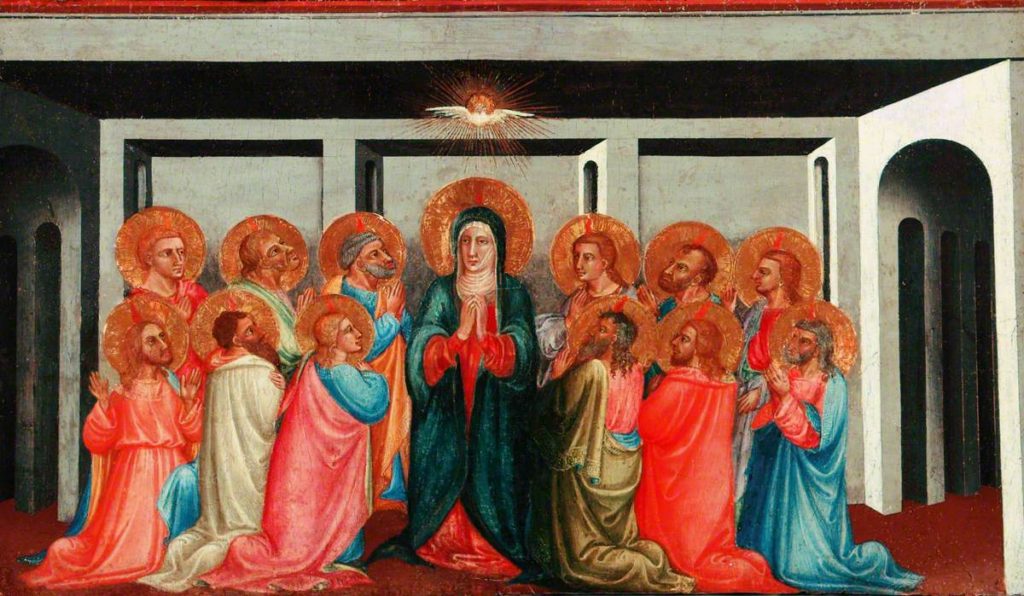
Fifty days after the Resurrection, the Holy Spirit descends upon the disciples. What Sinai was to Israel, Pentecost is to the Church. The Law is no longer written on tablets of stone but on human hearts. The disciples, once fearful and uncertain, are transformed into bold witnesses. They are not simply forgiven; they are recreated. They become, in a real sense, the Body of Christ, animated by his own Spirit.
Seen in this way, the liturgical season from Easter to Pentecost takes on a new urgency. It’s not a gradual winding down after the high point of Easter Sunday. It’s a time of expectation. The Church, in its ancient practice of mystagogy, understood this well. The newly baptized were instructed more deeply in the mysteries they had received, as if retracing the steps of the apostles during those 40 days when the risen Christ spoke to them of the kingdom.
We are invited to do the same. Easter has happened. The victory is won. But the gift is not yet complete — not until it is fully realized in us.
If Passover is liberation, Pentecost is transformation. And the Christian life unfolds in the tension — and the promise — between the two.