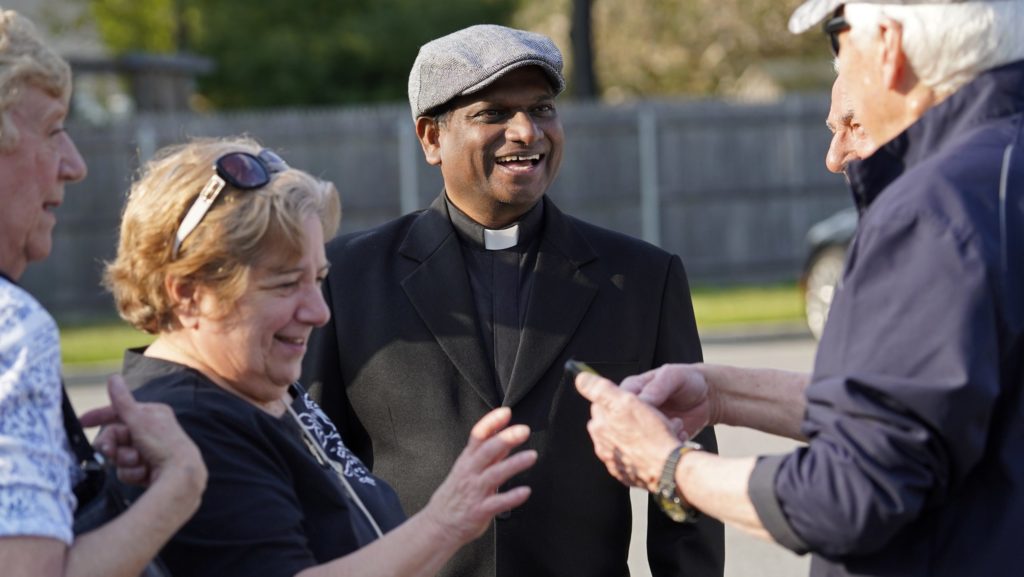
The Catholic Church in the United States has a history of relying on foreign-born clergy from its earliest days.
Massive immigration from Europe included Catholic clergy, including priests from France and Ireland who served the immigrant Church. Immigrant priests left a great mark on newly developing dioceses in places like California and Florida, where the so-called FBIs (Foreign Born Irish) were until lately an essential factor in pastoral ministry.
There are dioceses — especially rural ones — where foreign-born priests are nearly the majority. They are often from Asia and Africa, and unlike those who once immigrated alongside people from their own countries, these priests are not here principally to attend to immigrants like themselves, but rather to supply the shortage of priests in rural areas and give attention to majority Anglo parishioners.
Today, roughly one-fourth of the clergy attending U.S. parishes are foreign-born. These include those who are working with special visas, as well as green-card holders and naturalized citizens. In 2023, a State Department change of policy under President Joe Biden meant that EB-4 green card applications for religious workers were “reinterpreted” and the result was a backlog of as many as 150,000 cases. My predecessor as pastor fell into that category and had to leave the United States, which is why the bishop transferred me to the parish.
The growing numbers of foreign-born priests represent a change that has its pluses and minuses. One problem is that language and cultural differences affect pastoral care: American Catholics, who are, with few exceptions, descendants of immigrants, have some bizarre traces of xenophobia they must have picked up by osmosis. Some, whose grandparents spoke with accents, are surprisingly intolerant — or at least bothered — by homilies delivered by those speaking English as a second (or third or fourth) language.
“I could not understand him,” is a familiar refrain.
I am a little sensitive about the complaints because I grew up hearing accents. My grandmother was a German from Poland and, when I was a paperboy in my ethnic neighborhood, I had customers from five different European countries. As a priest, practically the majority of my ministry has been spent speaking Spanish with an accent. I hope that my parishioners will pardon my accent or even be amused by it because they are very tolerant people.
I have two worries about the growing number of foreign-born clergy in the United States. One makes me ask: Why do we need to import priests, like we do farmworkers and personnel attending our aging population? One bishop in El Salvador said the crisis of vocations is really a crisis of faith. The dominant culture teaches young people to seek happiness in terms of self-fulfillment. There is a school of pastoral recruitment vocation that seems to echo the U.S. military’s “Be all you can be.” Vocations should be directed to pleasing God, not to self-realization.
My second concern is that boys and young men might not relate to foreign-born priests in a way that fosters commitment to service in the Church in the priesthood. This is unless there is some common tie, like background or nationality. When I was in the mission in El Salvador in the ’80s, I said that the missionaries did not inspire young men to be priests, but the boys wanted to become Americans like us. Their feet were in a little town in another country, but their imagination was in Los Angeles.
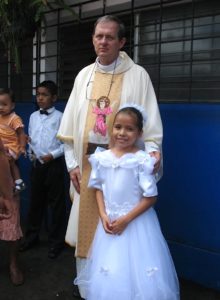
There are also two very positive aspects about the situation of priests from other countries serving here. One is that it reminds us that we are a global Church, that the word “catholic” means “universal.” An Italian missionary sister once told me her pastor always told his people, “Our parish includes the whole world.” Our parish life should be a reflection of the universality of the Church, both in members and in ministers: We are part of a whole that is much bigger than ourselves.
The second is that our faith in the sacraments should be bolstered. Recently, a man in a nursing home told me about a special experience of prayer he had. When a new priest came to the home as chaplain, he had a hard time understanding him, not only when he preached but how he pronounced the prayers of the Mass. The man had attended Mass daily but decided to go to the chapel only on Sundays.
“I was praying in the chapel before Mass,” he told me. “It never happened to me before, or since, but I swear Jesus spoke to me, saying: ‘You don’t need to worry about understanding Father’s words. I understand him, and that is what matters.’ ” Ever since, he never misses daily Mass.
When I was in the seminary, a rector gave us a talk once that sounded peculiar to us. He said that in the old days, people understood the priesthood especially in terms of the sacraments that a priest had the ability to celebrate. “Ex opere operato” was the guarantee that grace would be obtained by his ministry, because of the correct words and gestures. Nowadays, people seem to expect “ex opere operantis,” that grace is connected to the personality of the minister of the sacrament, and how he relates to the community. “One day,” said the priest, who was someone who had worked on formation on a national level, “it could change and the people will be more concerned in the grace that comes from the sacrament, not the celebrant.”
When my parishioners cannot go to Mass in Spanish, some say they would rather not attend. I tell them, whatever the language, whoever the priest, the Mass belongs to Jesus who makes himself present. God understands what the priest does and says at the altar and that is enough for a believer. Obviously, spiritual growth demands instruction and engagement with the Word of God, and that involves language and culture. But we are essentially a sacramental people and are sensitive to the presence of Jesus in the sacraments.
Besides these considerations, the devotion of the minister transcends his linguistic ability. And many of our non-native clergy are outstanding examples of priestly spirituality. Sometimes I think their nostalgia for where they came from invests their prayer with more intensity. Homesickness has a metaphysical and mystical dimension sometimes.
Meanwhile, we must work on more homegrown vocations and thank God that our prosperity gives us the advantage of an international clergy.