When I was a boy, my classmates and neighborhood friends were fixated on playing “war.” We consumed every old black-and-white war movie that came on TV. We played war games with heavy wooden and metal toy guns that looked like the real thing. We built plastic models of warplanes, warships, and every other type of war-related vehicle.
World War II had ended only a decade and change before I was born, so my friends and I only saw war through the prism of innocence. I am forever grateful my childhood knowledge of war was so ridiculously removed from reality.
The adults were not overly concerned about our militaristic choice of play, but one day, before another battle was to begin, “our side” was busy making a flag for our fort by painting an Iron Cross on it, and my Uncle Rich did intervene. None of us would have considered a swastika. But the Iron Cross looked “cool.”
It did not look cool to my Uncle Rich, who joined the Army Air Corps in 1942 and became a tech sergeant on a B-24 heavy bomber stationed in Scotland. He saw the Iron Cross on our flag and read us the riot act. He said he spent three years trying to wipe that symbol off the face of the earth, and here we were “playing” with it.
We thought he was overreacting. We thought it was not a swastika, so it was OK. But we were not inside the fuselage of a B-24 heavy bomber flying over Düsseldorf, where a lot of planes and anti-aircraft guns with swastikas and Iron Crosses painted on them were shooting at us.
It was my first lesson on how a picture or symbol can tell a lot of stories.
My friends and I may not have been exposed to the harsh realities of one war, but we had a strange familiarity with the Cold War that followed. People my age remember where they were on the last Friday of every month during the school year. It is a memory with a soundtrack too — the wail of multiple air-raid sirens going off all over Los Angeles.
There was always that first moment of worry, until we looked at the calendar. Once relieved by seeing that it was the last Friday of that month, down we went, underneath our school desks, “practicing” the proper emergency protocols if the Cold War we lived in ever got hot. Of course, the nuns who taught us stayed stoically seated in their teacher’s chairs, unmoved by potential nuclear disaster.
It was a time of clarity for us, especially for Catholics. It was a time of “us” versus “them,” with “them” being the communists. Like World War II, the Red Scare of the late 1940s and 1950s preceded me, and I was left with only what the adults around me had to say about them. It was clear among all the Catholic families we knew — and this was a time when all the families we did know were Catholic — who the bad guys were, and what ideology posed the biggest threat.
Though even as a child I doubted I was ever going to see a couple of divisions of the Soviet Red Army come marching through the Sepulveda Pass and occupy Van Nuys, there was a reality to communism that seemed to back up most of the things the adults around me were saying.
Today, a lot of adults do not see communism as any kind of threat, and the anti-communism of the 1950s through the 1980s is viewed derisively as a kind of nutty, almost comical American fixation. Now, you cannot watch any kind of political protest or march on the streets of Los Angeles, or anywhere else in the country, without seeing the symbol that Stalin and Mao shared while they were imprisoning and killing millions. Many of the people marching under this sign are not old enough to remember Sept. 11, so forget about trying to tell them about the Stalin-imposed Ukrainian famine, Mao’s Cultural Revolution, or all the other “minor” atrocities perpetrated by their lesser fellow travelers.
I am just too set in my ways and too much a product of my time, but I cannot look at a hammer and sickle and not feel revulsion, the moral equivalent of that swastika. I do not believe it is a coincidence that St. Pope John Paul II had a special connection to both symbols, having been subject to the tyranny of both ideologies they represented.
And as with so many things, that saint has something to teach us about how to respond to those kinds of symbols. It is not with hate, or even the revulsion that each crooked symbol makes me feel personally.
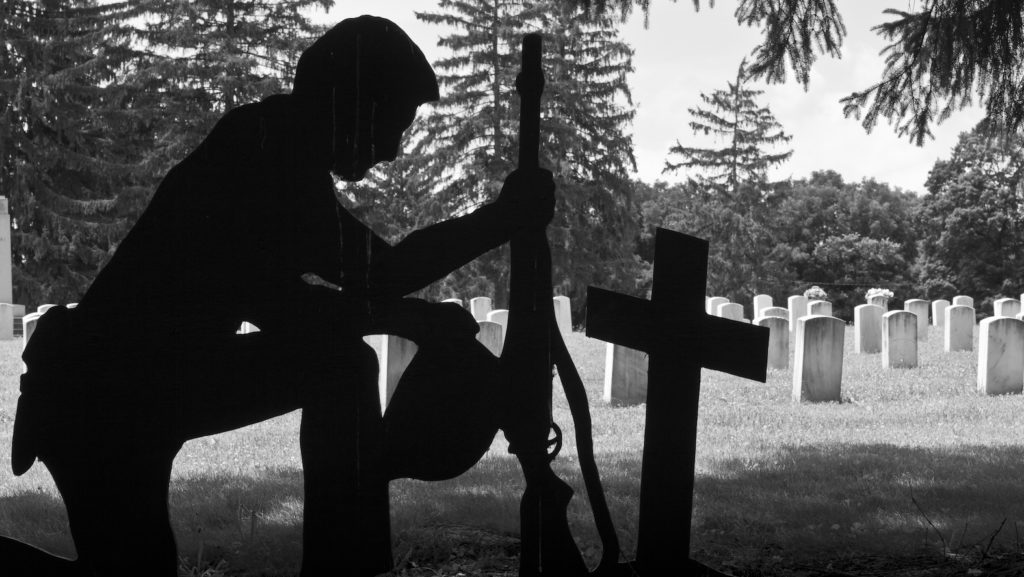
St. Pope John Paul II countered these symbols with symbols of his own — the cross, the Immaculate Heart, and the rosary, to name a few. It worked marvelously well for him; may it do that for the rest of us as well.