“Our relationship with life seems to be in a crisis today,” Pope Leo XIV writes in “Magnifica Humanitas” (“Magnificent Humanity”).
This is a deep insight.
In his encyclical and in his addresses and writings, the Holy Father has continued to call our attention to this crisis, which he sees expressed not only in the movements to promote euthanasia, abortion, and “surrogate” motherhood, but also in the destruction of war.
And as the pope notes, the transhumanist movement reflects even darker ambitions — to use science and technology not just to improve human life and ease human suffering, but to “perfect” the human person and offer us a kind of “immortality,” that will allow our “consciousness” to live on long after our bodies die.
The great solemnity that we celebrate this week is the answer to this crisis in our relationship to life, and this culture where so often, he says, “the words and choices of death may seem to prevail.”
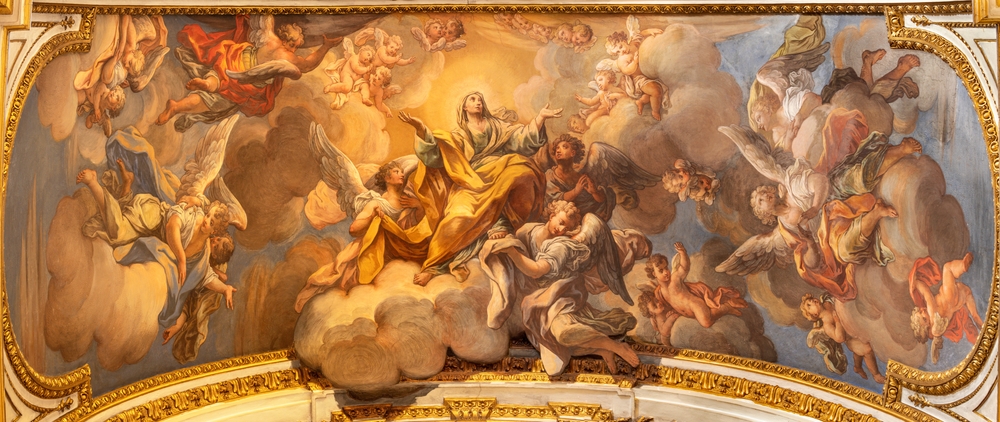
The Blessed Virgin Mary’s Assumption into heaven, body and soul, calls us to remember that death is not the enemy of life or something to be feared and defeated. Death is not the end. Death is a beginning, the natural threshold that we must all pass over to enjoy eternal life with God, to live forever in what the saints call the love that never ends.
The Assumption calls us to set aside our fears and look to the glorious destiny that has been promised to each and every person. Where Mary has gone, we know that we can go too.
This is a powerful truth in every age.
When Pope Pius XII declared the dogma of the Assumption in 1950, it was at the end of a half-century period that had seen two world wars, the genocide of millions of the Jewish people, the nuclear bomb attacks on Hiroshima and Nagasaki, an influenza outbreak that infected and killed nearly 100 million worldwide, and the rise of brutal atheist-totalitarian regimes in Russia and China.
In this time of widespread death, cruel disrespect for the human person and human body, and a spreading sense that the individual does not matter, the proclamation of the Assumption dogma came as both the answer and the antidote. The Assumption told a troubled world that God was still in charge, that his love and mercies endure forever.
From the earliest days, the Church believed and taught that the Blessed Mary was the first of us to experience the resurrection promised in Christ, but that she was not to be the last. Her Assumption was the pledge that the resurrection of the body promised to all of us is true.
Early accounts of the Assumption tell us that when it came time for Mary’s earthly life to end, the 12 apostles were summoned by angels from the ends of the earth, to be with Our Lady at her bedside in Jerusalem.
This is a beautiful idea. We too, like the apostles, should stay close to the Mother of Jesus, who shows us always the way to her Son, and whose resurrection gives our lives hope, purpose, and direction.
Her Assumption is our destiny, and her Assumption is still the answer and the antidote to what the popes call a culture of death.
The Assumption tells us that God’s love is stronger than death and stronger than our fears of our limitations and vulnerabilities, our fears of growing old and dying. Death will never get the last word in our lives. Death will surely come to each of us, but our bodies are destined to rise, as Blessed Mary’s did.
We need to deepen our faith in the resurrection of the body, and we need to look for new ways to proclaim this truth to our neighbors.
The truth is that Jesus’ love for us begins before we are born and continues after we die. From before the foundation of the world and for all eternity we are precious in the Lord’s eyes. Each of us is loved by God and wanted by God, and he creates us to know joy and love in this life and to live forever with him in the life to come.
These beautiful truths are the answer to our neighbors’ anxieties about life and their fears of infirmity and death. Even now we can begin living the joy of the resurrection, even now we can live the victory of life and love over fear and death.
Pray for me and I will pray for you.
And let us ask our Blessed Mother Mary to strengthen our faith in the resurrection, and watch over us “now, and at the hour of our death.”