Sam Quinones is a familiar name around Southern California.
A staff writer for the LA Times from 2004 to 2014, he has written extensively on Mexican communities and culture, and is the author of four nonfiction books, among them “Dreamland” (Bloomsbury Publishing, $19.99) and “The Least of Us” (Bloomsbury Publishing, $19.99), both about the opioid crisis.
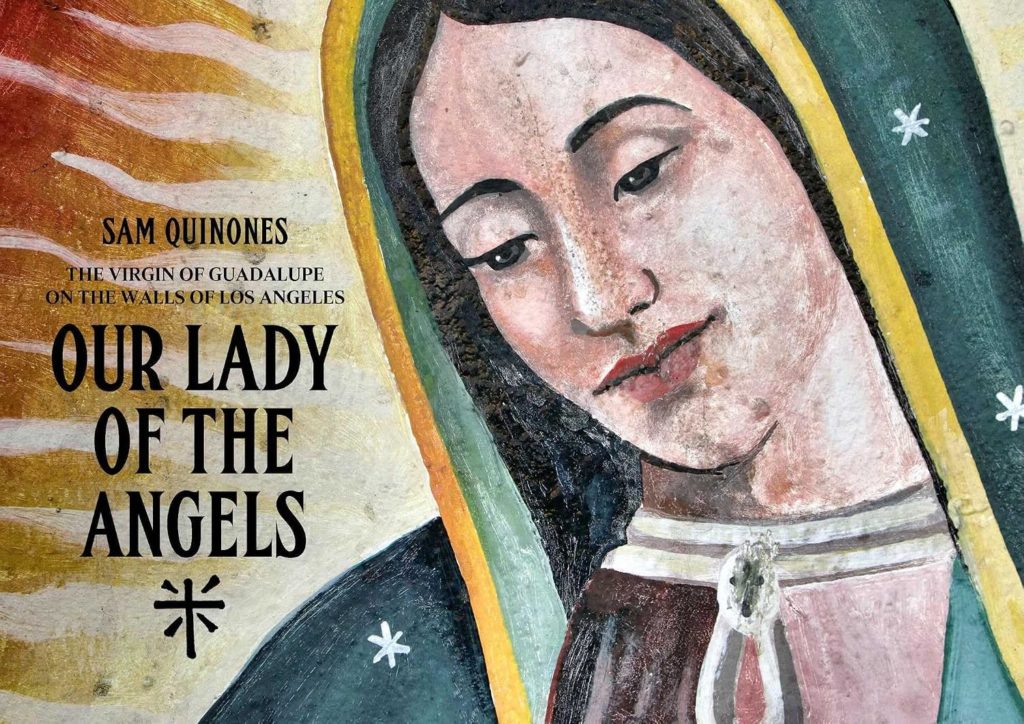
His newest venture was 17 years in the making: a bilingual book of photographs and text called “Our Lady of the Angels: The Virgin of Guadalupe on the Walls of Los Angeles” (Angel City Press at Los Angeles Public Library, $30).
An LA native, Quinones developed a soft spot for Our Lady during the many years he lived in Mexico. “I saw how working-class and poor people resorted to her for a refuge that was not provided by life. Their feeling for her was deep and authentic. Some mom pushing a baby stroller and there’s the Virgin, looking down in this sweet, understanding, patient, protective way.”
Traditionally, the Virgin has shown up in immigrant or historically marginalized communities, where people have neither money for security nor faith in police protection.
Back in LA, around 2009 Quinones started taking random photos of Our Lady of Guadalupe murals from his car: South LA, certain neighborhoods in Pasadena. “Real quick, bam, and move on.”
Over time, he amassed a bit of a collection. Slowly, the desire grew to explore the murals, and the culture that surrounded them, more deeply.
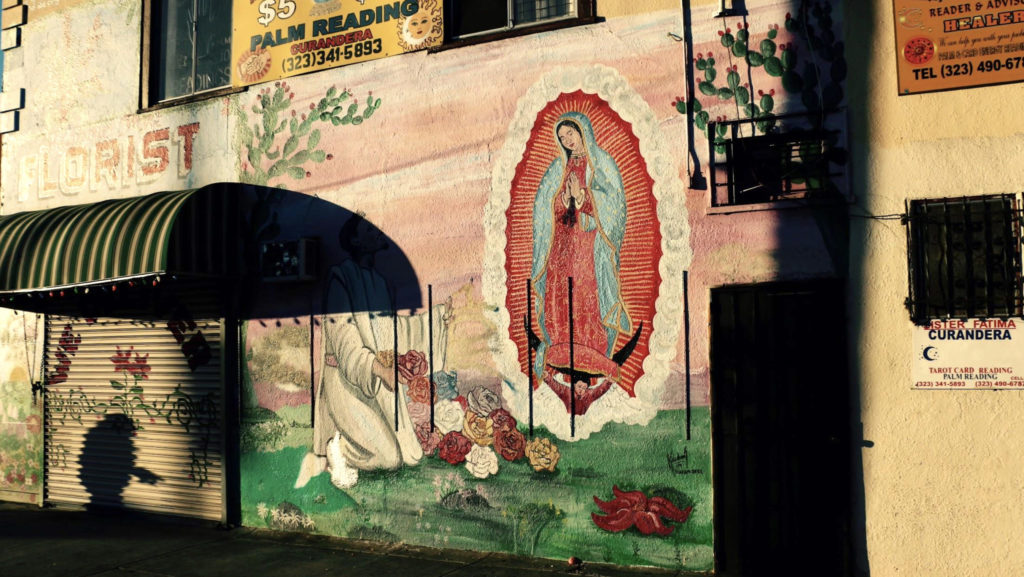
He started going out around 4 or 4:30, the “magic hour” for photographers. Playing with the shadows, spending time, waiting. “Watching what happened around any given mural regarding human interactions. People in their daily lives, walking from school, on a skateboard, going to the laundry.”
Sometimes he used a Canon 70D; other shots he took with his iPhone.
Over time the photos got better: more complex, more layered, drenched in the aching Southern California light that, depending on your mood that day, can seem either apocalyptic or awash in redemptive hope.
There’s an OLG template of sorts: the blue mantle of stars, the downcast eyes, the hands folded in prayer, the miraculous shower of December roses the Virgin revealed to Juan Diego in 1531 on that famous hilltop in Mexico. But each homage to “La Virgen” is also a unique expression. Each is a small urban witness, memento, treasure.
Murals stand lonely sentinel on inner-city street corners, but more often than not, a sole pedestrian, or street preacher, or a guy in a hoodie on a bike is passing by.
A teenager with a backpack walks by an image of the Virgin flanked by the flags of Mexico, Central America, and the U.S.: to the side is the legend “Beer Wine Liquor.”
A woman in capris and Vans sneakers pushes a utility cart of freshly folded laundry: the Virgin stands vigil. The long pea-green wall of Nino’s Meat Market is flanked by a small image of the Virgin (“Mi Morenita”), and the shadows of what could be a hunched-over woman and a young boy.
As LA Times columnist Gustavo Arellano notes in the book’s foreword:
“In these pages, you will see Sam’s shots of Guadalupe murals across Los Angeles, with his soaring prose telling the story of how she came to be so common and so essential. What I love about Sam’s take is that it shows how diverse she is. Artists imagine her surrounded by flags, roses, Christmas lights. On top of a mountain, above a stream, behind a small altar where the faithful leave votive candles and flowers. Sometimes, she’s just a small square in a wall; other times, her entire face takes up the side of the store. Her skin varies from the color of oat milk to a chocolate brown.”
Our Lady is public folk art, an emblem of solidarity, community, and the strong entrepreneurial instinct among immigrants. “I’m one of you,” the shop owner is saying.
In fact, the murals appear almost exclusively on small businesses, rather than private homes. Interestingly, when he began to design an interactive map of the 200 or so murals he’s discovered, he found they cluster overwhelmingly on major east-west or north-south commercial thoroughfares: Avalon, Central, San Pedro, Florence, Vernon.
An affordable form of advertising, Our Lady, Quinones observed, “appeared alongside bottles of bleach and corn oil, cell phones and milk cartons, letting customers know that she might bless both the store and the person who shopped there.”
Over time Quinones saw murals painted over, disappear, or transform with changed ownership.
“It was just a constant evolution, a constant morphing of the mural world.”
For years, it was an unspoken law that even gang members — who use graffiti to establish territorial borders, declare alliances, or menace rivals — did not deface the Virgin. Her image thus served as a form of protection for householders and small business owners.
But slowly, even that has changed. Taggers, whose graffiti focuses on artistic stylization and self-promotion, have little respect for the Virgin.
Moreover, with LA property values rising even in historically marginalized neighborhoods, mom-and-pop businesses are moving out, developers are moving in, and the Virgin is slowly disappearing.
“Not disappearing, Sam,” I told him. “Assumed into heaven!”
Sure enough, this gorgeous book ends on an uplift:
“Yet though she may not be present as often as in the past, it’s comforting to know that from the walls of many markets, car washes, and flower shops … she smiles down on us still … patiently, quietly, there when we need her.”