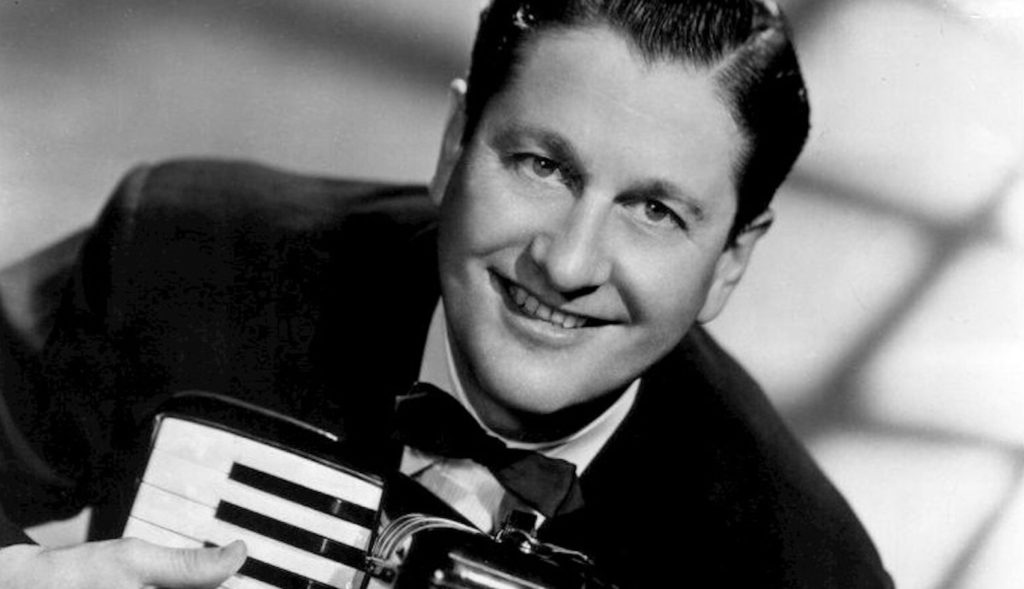
When I was young, my family’s only television was controlled by my grandmother. This meant my TV fare consisted mainly of Ed Sullivan, “As the World Turns,” and, once a week, “The Lawrence Welk Show.”
Welk, a German-accented band leader, seemed a grandfatherly presence, overseeing a traditional type of music variety show popular at the time, with some comedy, some singing and dancing, and — to my young male mind — the compelling presence of the Lennon Sisters.
That is about all the thought I’ve ever given to Welk until meeting Lance Richey, the president of the University of St. Francis in Fort Wayne, Indiana, and, I can safely say, the foremost authority on all things Welk.
Since Richey is a professor with a Ph.D. in philosophy and religious studies, I could be forgiven for assuming that the last person in the world he might be interested in would be a Catholic North Dakotan farm boy with a fourth-grade education, an immigrant’s son who did not learn English until adulthood.
Yet Richey sees Welk as a dominant, if underappreciated, figure in American popular musical culture in the mid-20th century. From the Big Band era to the Beatles and beyond, Welk drew thousands to his soldout concerts, had a long-running and highly successful television show on ABC, and extended his “brand” to investments in a Southern California resort community, a fast-food offering called a Squeezeburger and a radio shaped as a champagne bottle (a nod to a description of his band’s musical style as “light and bubbly as champagne.”)
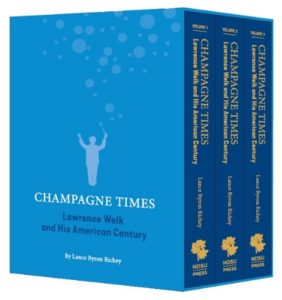
Welk was, it turns out, an American overachiever, and for the past 10 years, Richey has been researching and writing a magisterial three-volume opus, a 1,240-page biography of the man titled “Champagne Times: Lawrence Welk and His American Century” (North Dakota State University Press).
For Richey, Welk is a quintessential American success story. Welk was, by his own admission, not much of a farmer, but he had an accordion and a relentless drive to succeed. He was a band leader who relocated to Los Angeles in 1950 in order to take advantage of new media technologies like television to extend his fame and his reach.
Richey told Angelus that Welk “died one of the wealthiest men in show business,” and attributed his success to “a farmer’s work ethic and willingness to work tirelessly to accomplish whatever he set his mind to.” It was a long climb for a man who was at least as good at marketing and management as he was at assessing the musical tastes of his audience.
Richey said Welk was raised in a “fearsomely rigorous immigrant Catholic household.” His father “was a stern man who never missed Sunday Mass,” even when the North Dakota temperature was below zero. His father was about religious discipline and the fear of God. His mother “embodied the warmer, more moving side” of the Faith.
Like many pre-Vatican II Catholics, Welk did not make a public show of his faith but was an observant Catholic who, his wife said, missed Sunday Mass only once in his busy career, because of misinformation about the Mass time.
The tension in Welk’s life, however, was the balancing of the personal and the professional. Traveling almost constantly for his band's nationwide performances, he was often an absent figure at home.
For Richey, one lesson of this driven and successful man is that “you cannot have it all.”
“Life is a series of choices, and Welk’s impoverished upbringing on the farm and deep psychological need to prove his father wrong about his decision to become a musician, drove Welk to sacrifice family relationships for the sake of his career,” Richey said. Despite his long absences, Richey noted, “he was a very faithful husband for 61 years of marriage, and a good son of the Church.”
His faith stood him in good stead during many crises, such as the time early in his career when his entire band quit on him. “He went to church,” Richey said, “and prayed before the cross, coming to understand (as he later wrote) that only God can be relied upon perfectly and that we all hurt one another constantly, intentionally or not, so forgiveness is best.”
Long after many big bands had come and gone, Welk had a television show that lasted till 1982 and continues today as reruns on public radio stations. His secret, Richey says, may be that he respected his listeners’ tastes rather than trying to “improve” or “educate” them. He had “an innate sense of what an audience or customer wanted and a willingness to put that ahead of his personal preferences.”
Richey said he came away from his decade of research understanding “more deeply what it meant to live through the profound cultural, political, economic, and religious changes of the 20th century as a person of faith. Welk did that and held on to his faith,” Richey concluded. “We should be so lucky.”