My wife, adult son, and our grandson embarked on that staple of Americana: the traditional road trip. We first caught a plane to Philadelphia, picked up a car, and have been roaming the southern United States ever since.
The primary objective of this trip was to celebrate America’s 250th anniversary at George Washington’s Mount Vernon on the Fourth of July. Before and after, my son dragged my wife, his mother, across countless Civil War battlefields along the way. The trip was in the planning stages for months. But, as with all good travel, it is the unexpected and unplanned encounters that create the lasting memories.
The Fourth of July at Mt. Vernon was as expected. There was a lot of talk about “liberty.” Even the most jaded and sophisticated American citizen would have a hard time not feeling a pang of patriotism sitting on the back lawn of the United States’ first president and watching fireworks explode over the Potomac River. It was a different vibe altogether than it was back home in Los Angeles.
I remember the Bicentennial well. I did not know anyone who did not have something big planned — a block party, a special trip, and many other ways to celebrate this country. Things are so different today.
When I told a co-worker about our family plan to celebrate the 250th at Mt. Vernon, she responded with, “Oh, that’s the holiday, right?” I might as well have told her I was going to Altadena to celebrate Arbor Day.
It was refreshing to be in another part of the country that is not like the part I reside in, a place where people wear their love for the country on their sleeves. We are far too sophisticated for such sentimental and “simple” forms of celebration on the West Coast.
But just as George Washington’s estate and museum did not disappoint, it did not deliver any new revelations or inspiration that I have not already gleaned from this remarkable man’s life.
But because my son and I believed that my wife had not had her fill of American history on this trip, we visited another presidential home. We eventually visited four in total, which was good for both my son and me and for all the poor souls in purgatory, for whom my wife had offered up her suffering.
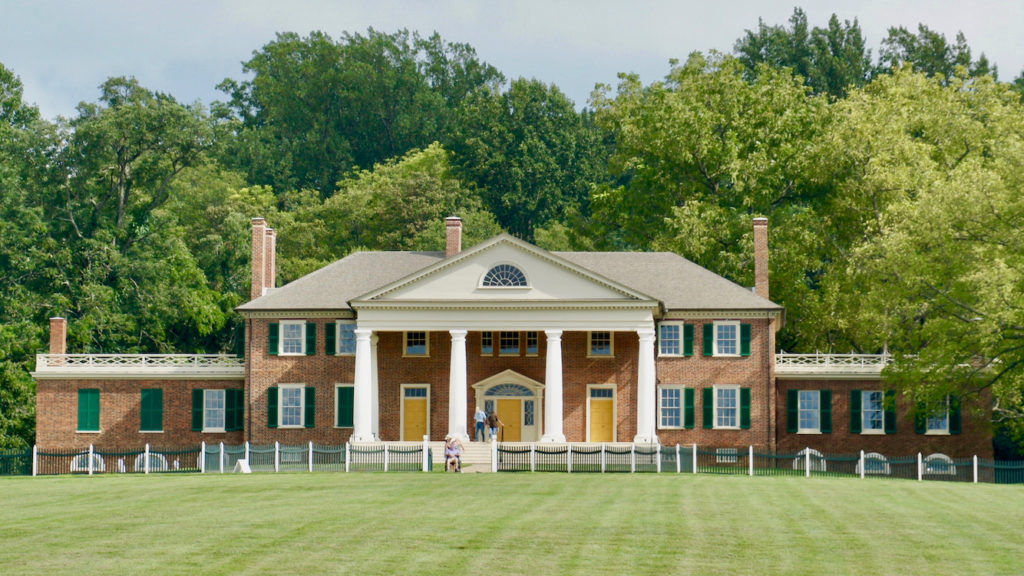
The presidential estate where I encountered the unexpected was called Montpelier. You know you’ve made it in life when your house has its own name. This is where James Madison worked on the U.S. Constitution, and this was the place on our trip where that word liberty popped up again — and again.
If it were not for the fact that James Madison was a contemporary of so many giants of America’s founding, he would certainly be more renowned than he is. He truly was the “father” of the Constitution and especially the first 10 amendments.
The house was elegant and beautifully maintained. As we were guided by a docent from room to room, we came upon what today would be called a den, but in Madison’s day was known as a parlor. It was a room for gathering after a good meal, or in Madison’s case probably after a long debate about the nature of human freedom with his friends.
This room was overflowing with his friends in the form of marble busts. They were the other giants of the American founding: Lafayette, Franklin, Jefferson, and Washington, of course. But among these American Protestant and/or agnostic men was a bust of equal stature of Bishop John Carroll, the first American prelate from the Diocese of Baltimore. There he was, a Catholic monument in the midst of the American Founders Hall of Fame — I did not see that coming.
Our tour guide said the bust of Bishop Carroll was put there by President Madison not because he had any Catholic leanings — he was a staunch Presbyterian — but because he was a dedicated defender of religious liberty, and defended the rights of Catholics and Protestant denominations to worship freely and without encumbrance.
The complexity of men like Madison and Washington, who risked their lives for liberty (there’s that word again), but owned hundreds of slaves at the same time, I am grateful for their foundation and how the development of constitutional “doctrine” eventually broadened the promise of liberty to all.
I am also grateful that what Madison championed, symbolized by the placement of a bishop’s bust in his house, dovetailed with the Church’s own embrace of truths, especially as it related to religious liberty. Madison gave us American Catholics the Constitution, and the Church in turn gave the world Dignitatis Humanae (“Of Human Dignity”), through Vatican II, which read: “This Vatican Council declares that the human person has a right to religious freedom. This freedom means that all men are to be immune from coercion on the part of individuals or of social groups and of any human power, in such wise that no one is to be forced to act in a manner contrary to his own beliefs, whether privately or publicly, whether alone or in association with others, within due limits.”