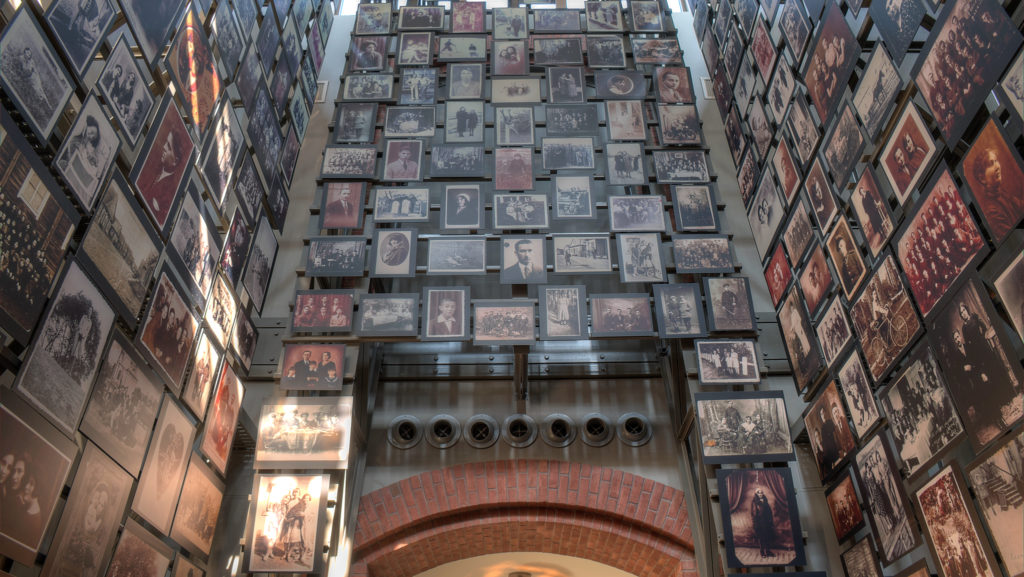
The United States Holocaust Memorial Museum in Washington, D.C., is a relentless immersion in the horrors of the Nazi genocide. A visitor starts on the top floor, beginning with the rise of Adolf Hitler and his enablers and thugs, then descends level by level, like Dante’s trip into hell, down to the homicidal madness that was the Final Solution — the mass extermination of the Jews and other unwanted peoples.
What is striking at the beginning is how the Hitler regime legitimized the hatred of the Jews, law by law, outrage by outrage. In the museum, a television monitor scrolls on an endless loop the dozens of antisemitic laws the regime implemented from its beginning to isolate and dehumanize Germany’s Jewish population. More disturbing for Americans is a small plaque nearby that notes that Germany’s inspiration for this escalating cruelty was our own Jim Crow laws. The post-Reconstruction efforts by the White South to reinstitute the cruelties of slavery did not go unnoticed by Hitler. While the harassment was first intended to humiliate and force the self-deportation of Germany’s Jewish citizens, it eventually escalated to concentration camps, then extermination camps.
A trip to the Holocaust Museum remains, I believe, a requirement for anyone who wants to seriously discuss the state of Israel today. It explains the widespread support that once existed in the West for a Jewish state in the aftermath of the Nazi horrors.
And while the United States was relatively unsympathetic to the plight of Jews seeking to flee Germany before the war, it was an enthusiastic supporter for the protection of the Jewish state after the war. This support may have peaked with the vicious attack by Hamas on Oct. 7, 2023, that killed 1,195 Israelis. Since then, the scale of Israel’s retaliation — the systematic destruction of Gaza and the mounting death toll (an estimated 42,000), Israel’s continued encroachment on the West Bank and now the destruction in Lebanon — has forced many to reconsider their support. The callousness of the government and of extremists in Israeli society has created a backlash of sympathy for Palestinians.
This backlash, while understandable, can be troubling for those of us shaped by the aftermath of the Holocaust. The growing incidents of antisemitic language and assaults are also profoundly disturbing. At the same time, support for Israel’s government is sinking, even among American Jews, as longtime friends of Israel try to distinguish between support for its citizens — Jew and non-Jew — and condemnation of its government and its leaders.
It is not helpful that some critics of Israel’s military actions are accused of being antisemitic simply for expressing opposition to the military’s brutality. This makes no more sense than saying critics of the U.S. government are anti-American because they oppose the president’s military action against Iran.
There are signs of hope, however rare. Hope comes from being able to meet the other and to share the pains of history — the Holocaust, on one hand, the Occupation, on the other. Such efforts to bridge the ocean of hatred and fear dividing Israeli Jews and Palestinians are occurring, despite the generational seeds of hate and fear that have been sown and continue to be sown. For now, this is a conversation that must happen person to person.
There are two recent examples of such efforts at accompaniment.
Aziz Abu Sarah and Maoz Inon both lost relatives to the hatred. Inon’s parents were killed during the Oct. 7 attack. Abu Sarah’s elder brother died from torture suffered at the hands of Israeli interrogators. Yet these two men became friends and have authored “The Future is Peace,” chronicling the trauma and grief that unites rather than divides them.
Similarly, but with a far grander historical scope, is a brilliant novel by Colum McCann called “Apeirogon.” An apeirogon is an infinitely sided sphere, and McCann’s multi-sided novel tells the very real story not just of Bassam Aramin and Rami Elhanan, but also of both the Jews and the Palestinians and the land and history they share.
Aramin lost his young daughter to an Israeli soldier’s bullet just after she had bought some candy. Elhanan lost his young daughter to a Palestinian suicide bomber while she was shopping for school books. These two men formed a friendship that ultimately led them to share their stories around the world. Telling the world is one thing, however. Convincing their own people is another.
What is most striking about their story is that Aramin, a young, angry man nursing his hatred in an Israeli prison, was profoundly transformed by a documentary he saw on the Holocaust. Equally transforming, Elhanan sees through his friend’s eyes the extraordinary damage done by the punishing and degrading isolation imposed on Palestinians by Israeli laws and Israeli troops.
Fear and hatred must not win out. That friendship and empathy are possible even across such a gulf of experience is a sign of hope. We must cling to that hope for now.