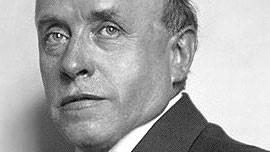
Georges Rouault (1871-1958), considered one of the most notable Christian artists of the 20th century, painted works that include “Christ on the Outskirts,” “The Crucifixion,” and “The Old King.”
A French Expressionist and devout Catholic, Rouault was born in the Belleville quarter on the outskirts of Paris. “In the faubourg of toil and suffering, in the darkness, I was born. Keeping vigil over pictorial turpitudes, I toiled miles away from certain dilettantes,” he later wrote.
His father was a cabinetmaker, and Rouault’s first job was as an artisan’s assistant to a restorer of stained-glass windows. “My time there was short, but it marked me with a seal that was legendary, epical,” he said. Ever after he would remember the spirit of the anonymous medieval artists who had made the windows but refrained from attaching their names to their work.
In 1908, he married Marthe Le Sidaner; they had four children.
As early as 1913, one critic, Gustave Coquiot, exclaimed, “One must be a monk to understand him.”
Rouault was deeply affected by the outbreak and aftermath of World War I. He became friends with the notoriously irascible Catholic writer Léon Bloy, and later with the philosopher Jacques Maritain and his wife, Rāissa, both converts.
He painted fugitives, clowns, prostitutes, beggars, and corpses — the casualties of war, materialism, and a complacent bourgeoisie. But Rouault’s work was human rather than “political.”
As Rāissa Maritain observed, “The quality of a work does not depend on its subject, but on its spirit.” Jacques Maritain noted, “This kind of ‘realism’ is in no way a realism of physical appearances; it is realism of the spiritual significance of what exists (and moves and suffers and loves and kills); it is realism permeated with the signs and dreams that are commingled with the being of things.”
Rouault’s masterpiece is widely considered the series of mixed-media intaglio prints called “The Miserere,” which he exhibited in 1948. He was close to 80 at the time.
With its nuanced blacks and grays, the series depicts the horror and sorrow of human suffering, and every human being’s complicity in that suffering. “Are We Not All Convicts?” the title of one asks. In another, a drawing of a smug, well-fed man is entitled “We Think Ourselves Kings.” A third, “Street of the Lonely,” could with its evocation of existential isolation be the street that I — or you — live on.
The political turmoil, threat of mass destruction, and rise of the right that marked Rouault’s era have only intensified in our day.
In “Rouault: A Vision of Suffering and Salvation” (William B. Eerdmans, $19.14), author William A. Dyrness observed:
“In 1952, a writer for the religious periodical ‘La Croix’ asked Rouault what he thought of religious or sacred art. As usual, Rouault refused to be brought into the debate. He said simply that, to talk about art in the Church, one must first of all love painting.”
In a 2010 interview for the literary and arts quarterly “Image”, artist Makoto Fujimura added:
“Rouault is inviting you not only to the surface of the painting, but to the sacramental vision that understands the painting as mediating a greater reality. … For Rouault making art was prayer, too. It was a daily discipline and ritual that drew him closer to God. … He was influenced by the Expressionists, but he wasn’t one of them. He didn’t want to express himself; he wanted to be sanctified in the process. He’s about being faithful to internal realities, but also the brokenness of the world. He was very committed to the margins of society. By identifying with the poor, with prostitutes and marginalized people, he thought he would meet Jesus — which is very much a Catholic perspective, and biblical, as exhibited in the writings of Isaiah or Jeremiah.”
To that end, Rouault was an exemplar of the vocation of art as a mission and a calling.
Biographer Pierre Courthion tells the following story:
“I once put [a question] to both Matisse and Rouault: would you continue to paint a desert island, where you had lost all hope of ever again communicating with your fellow men? Matisse’s reply was emphatically in the negative: ‘There are no artists without a public. … An artist wants to be understood, a painter to be looked at.’ Rouault, however, was more reserved: ‘I am sure I would continue to paint, even without a single viewer, even with no hope of one.’ I understood that for him, after the inevitable withdrawal into himself, which is the source of all works of art (although this may, at first, appear to be egotistical), creation leads to an act of generosity, a gift to the community, visible or invisible. This must be so for any man whose genius derives from God alone.”
Finally, in the words of Rouault himself:
“The most insignificant little picture — done in prison or palace, by anyone at all (perhaps by [a] poor devil of a painter who did not ask to be born or to be a painter) — this insignificant little picture, however technically inexpert, will rebuff all our sensible, reasonable doctors of the arts for maybe a hundred years.”