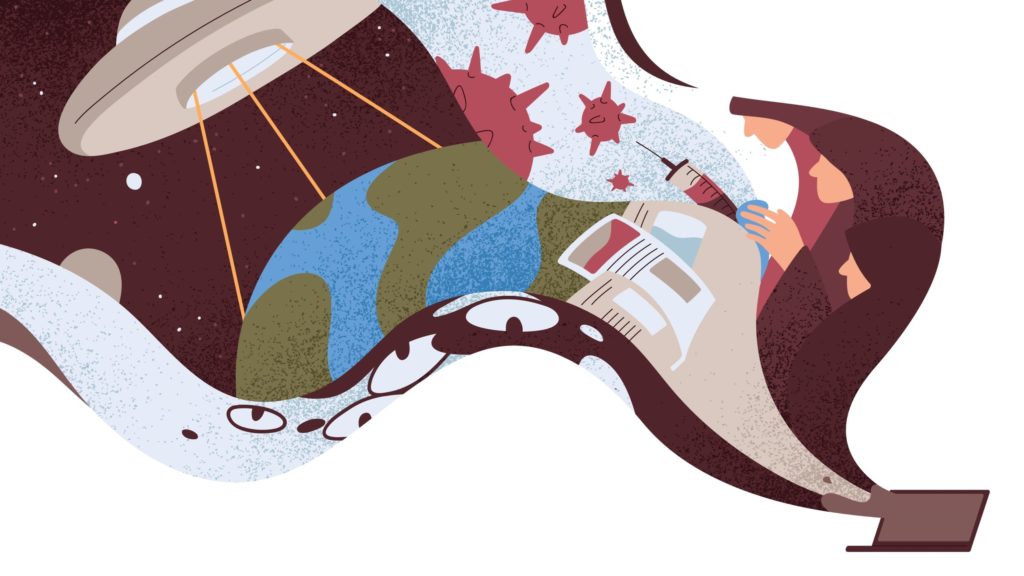
When my sister Fran, God rest her soul and may eternal rest be granted unto her, retired from her City of Burbank job, she turned to the internet as a kind of hobby. At first, she used it to go “all in” with family genealogy. As she was in all things, she doggedly dove into the task and was able to trace a strain of the Brennan family back to the 17th century and the Lord Mayor of a prominent Irish town.
We teased my sister relentlessly about her findings, wondering out loud why so many of these genealogy apps seem to easily find ancestors with storied pasts, but seldom find out our ancestors were stable boys or chamber maids.
But it was not so amusing when her attention turned to other internet rabbit holes. In the last few years of her life, when she was so racked with pain from rheumatoid arthritis that she could not even get out of bed, she could still lift the lid of her laptop. She began watching “experts” about the moon landings. More precisely, she started watching and believing the moon landings were a technical impossibility and were nothing short of a scam and government conspiracy.
No matter how strongly I argued about the ability to move through a weakened point of the Van Allen belt, or showed her photographic evidence taken by 2026 satellites of the Apollo moon-landing locations, my sister would not be moved. In the end, we agreed to disagree and moved on from Neil Armstrong, staying on happier topics like family history and Greer Garson movies.
Now, here I am, retired from my day job, but still quite busy with things to do and words to write. Yet, I, like my sister, have succumbed to jumping down an internet rabbit hole. I am happy to report it is not the dark matter of commentary on how bad the state of the Church is today. I continue to keep that fratricidal universe at a safe distance.
The COVID pandemic became headline news again, and information about the efficacy of the vaccine and the nature of the responses tempted me to look up some online articles. That was a mistake, as the gremlins who live in my laptop were alerted and almost instantaneously fed me a rising tide of videos from an array of scientists and medical professionals with strong and plausible insights about COVID in particular and virology in general.
These men and women, all with a lot of initials at the back of their names, made stupendously counter-intuitive claims about everything I thought I knew about medical science. I had fallen off this wagon and began to watch more of them.
The apt term for what I was doing is “doom scrolling.”
It did not help that I had also been watching a lot of YouTube lectures from the late Nobel Prize-winning Richard Feynman, discussing space and how time itself may not be what we mere mortals believe it to be. Of course I can understand about 10% of what Feynman says. I have a good friend though, a serious Catholic who is also a man of science and logic, and from whom I can glean 20% of what he says.
Thankfully, my friend served as my recovery sponsor and in time talked me off the ledge. I still have reasonable doubts about a lot of things, but I am not going to be buying a tinfoil hat, and I firmly resolve that the Earth is a sphere, orbits around the sun, and resides in a galaxy that is moving at great speed — thank you, Dr. Feynman.
As comforting as it is to know that God oversees this galaxy, he also bestowed on us a rational mind and the ability to use it. It is not second-guessing the Lord to seek answers from the natural world he created. Even if we go off the rails sometimes by scrolling through internet videos on how viruses do not even exist, we can still question things and not give science the same kind of absolutes we attach to the dogma of our faith. We may not be able to fathom the concept of time and space, or ever fully understand the properties of light speed — it does not matter, as the seeking is the process.
But always check your sources, and go easy on the scrolling.