Four years after Poles welcomed millions of Ukrainians fleeing Russia's full-scale invasion, Catholic leaders from both countries are urging their peoples not to let historical disputes undo that solidarity as disputes over World War II history inflamed relations between Poland and Ukraine.
Cardinals from both countries, attending the June consistory with Pope Leo XIV, warned in a joint statement that the greatest danger may not be disagreement itself, but the language used to express it.
Ukrainian Cardinal Mykola Bychok and Polish prelates Cardinal Konrad Krajewski, Cardinal Kazimierz Nycz and Cardinal Grzegorz Rys, together with Major Archbishop Sviatoslav Shevchuk -- head of the Ukrainian Greek Catholic Church -- issued a joint appeal urging both peoples not to allow old wounds to become new divisions.
In a June 29 statement, they called for a "disarmament of language on both sides" and encouraged both nations to continue the path of reconciliation begun under St. John Paul II. They said they spoke up during the consistory, feeling "invited to take special responsibility for the community of the Church and to support the ministry of the Successor of St. Peter."
The appeal comes amid fresh political friction between Warsaw and Kyiv. In June, Polish President Karol Nawrocki revoked the Order of the White Eagle previously awarded to Volodymyr Zelenskyy after the Ukrainian president approved naming a Ukrainian military unit in honor of the Ukrainian Insurgent Army, or UPA.
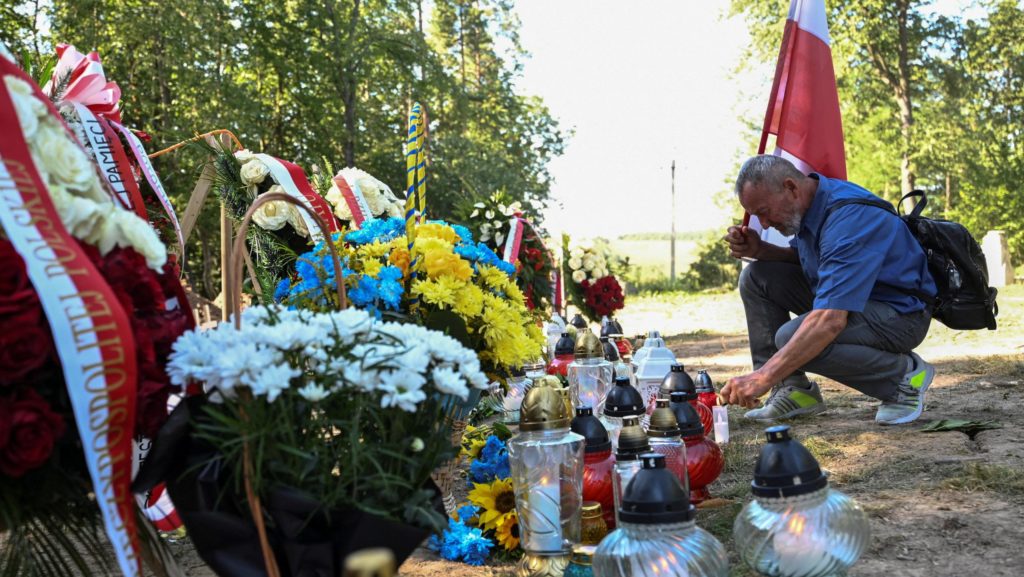
Polish-Ukrainian relations remain deeply marked by the violence that engulfed Volhynia and Eastern Galicia during World War II. The Volhynia Slaughter remains the deepest historical conflict between Poles and Ukrainians. Between 1943 and 1945, in Volhynia and parts of Eastern Galicia, UPA carried out a campaign of ethnic cleansing against the region's Polish population.
Historians estimate that about 100,000 Polish civilians were killed, many in brutal attacks on villages. About 10,000 Ukrainians also died in retaliatory violence carried out by Polish underground formations and civilians, although on a significantly smaller scale. The memory of those events continues to influence politics and public opinion in both countries, even as modern Poland became one of Ukraine's strongest allies after Russia's full-scale invasion in 2022, welcoming millions of refugees.
Against that backdrop, Church leaders argue that remembering history and preserving neighborly relations should not become opposing goals.
"Building the common good requires evangelical language: clear, but not humiliating; courageous, but not aggressive; true, but not closing the path to forgiveness," the prelates said.
Saying they are "saddened" to see the "growing tensions and resurgent hostility between Poles and Ukrainians," the cardinals and Major Archbishop Shevchuk said, "It is even more painful that this is happening at a time when Ukraine continues to experience the horrors of war, and Poland has shown great solidarity with millions of Ukrainian brothers and sisters in recent years."
They also noted that "all this is happening as Ukrainian Catholics celebrate the 25th anniversary of the Polish Pope's historic visit to Ukraine."
"In the tumult of the Second World War when the need for solidarity and reciprocal help would have been particularly urgent, the dark action of evil poisoned hearts, and weapons caused innocent blood to flow," St. John Paul said in July 2003, two years after his historic visit to Ukraine. He urged that "Ukrainians and Poles rid themselves of their sorrowful memories and, seeing past events in a new perspective, look at one another with reconciled eyes, striving to build a better future for one and all."
The renewed appeal of the prelates, experts say, seeks to protect both historical truth and the trust built over decades.
"The consistory meant that the cardinals who signed the appeal met in Rome, most likely held consultations with the pope and Major Archbishop Shevchuk, and these circumstances made this the moment when the common message appeared," Father Stefan Batruch, pastor of the Ukrainian Greek Catholic parish in Lublin, told OSV News.
"The content of the appeal reminds us not to forget or omit, in our discussions, the earlier and very important statements of the popes concerning Polish-Ukrainian relations," Father Batruch told OSV News.
The appeal also recalls decades of dialogue between the Catholic Church in Poland and the Ukrainian Greek Catholic Church, including joint pastoral letters, declarations and humanitarian cooperation following Russia's invasion of Ukraine.
Bishop Arkadiusz Trochanowski of the Ukrainian Greek Catholic Eparchy of Olsztyn-Gdansk welcomed the declaration, saying it demonstrates that "responsibility for the future of our nations begins with personal conversion, mutual respect and readiness to forgive."
He also emphasized that "reconciliation does not mean turning away from history, but means the courage to look at it in the light of the Gospel and not allow the pain of the past to become the source of new hatred."
Historian Igor Halagida, a scholar of Polish-Ukrainian relations at the University of Gdansk, Poland, believes the current debate has lost sight of its central concern. "In today's discussion, people forget what is most important -- the victims, all the victims," he told OSV News.
Halagida also noted that dialogue between the Church in Poland and Ukraine "has continued uninterrupted since 1987," long before the current political disputes and even before Ukraine regained its independence.
For Father Jaroslaw Moskalyk, a Ukrainian Greek Catholic priest and professor of theology at Adam Mickiewicz University in Poznan, Poland, the new statement represents another step in a much longer process rather than reaction to a political moment.
"The Church, which is not engaged in politics, offers a broader perspective on relations between the two peoples -- certainly not through the prism of short-term or one-sided political gains," he told OSV News.
"The growing wave of mutually unfriendly gestures introduced into public debate can only intensify negative emotions and awaken antagonistic tendencies," he said. "In consequence, it may lead to a serious regression in relations and squander years of reconciliation efforts, including those undertaken by the Churches."
The Church, he stressed, does not seek to settle historical disputes. "The role of the Church is not to resolve contested historical questions between two nations, especially those involving complex and often tragic circumstances," Father Moskalyk said. "Its mission is to serve the truth, including the truth about painful experiences of the past."
Asked whether it is still possible to speak honestly about the Volhynia massacres while building reconciliation, Father Batruch answered without hesitation.
"It is absolutely possible to speak honestly about difficult historical issues, provided that an interdisciplinary, nonpartisan joint commission is established to examine all disputed questions and issue an appropriate statement," he told OSV News. "The challenge is a clear political will among the leaders of all major political groups for such a body to be created," one that "could conduct reliable research."
"In political discussions, even on the most difficult issues in our mutual relations, radical and categorical public statements should be avoided," he said. "Such language is closely connected with emotions, and emotions expressed without moderation deeply wound and destroy the dignity of the other side."
The signatories of the joint declaration argue that Christians must pursue historical truth together with mercy and reject a culture that turns memory into a weapon.