This trip was necessary. This trip was essential.
Six months into his pontificate, the global press was still trying to decipher the personality of Pope Leo XIV. Those of us who cover the Vatican were starting to resign ourselves to the fact that this pope had no interest in making headlines — which would make our job increasingly difficult.
Many of us hoped that the Jubilee of Youth in early August would be his triumphant debut. We saw flashes of one during a surprise appearance to greet thousands of youth in St. Peter’s Square in English, Spanish, and Italian — but then struck a sober tone at an outdoor vigil and Mass outside of Rome with a million young people.
These months have shown how effective the Vatican “machine” is at surrounding a pope, a system that in seeking to “Italianize” him, loses sight of the fact that the Catholic Church needs a pontiff capable of speaking to the world in a language it can understand. The Holy Spirit seemed to agree, giving us a Holy Father who speaks English and Spanish fluently.
However, improvisations or interventions in those languages — in which he is more likely to reveal his true personality — are rare: Speeches are usually prepared for him only in Italian.
To us journalists, there was one hope left: the new pope’s first trip. Originally conceived by Pope Francis as an ecumenical pilgrimage to mark the 1,700th anniversary of the Council of Nicea, the voyage was strengthened by Leo’s decision to add Lebanon to the itinerary, a country that seems to be once again on the brink of war.
Everything was a mystery: Will he speak to journalists? Will he return to press conferences on the way there, like John Paul II or Benedict XVI, or will he continue to hold them on the way back? Will he allow spontaneous questions like Francis, or will they have to be approved in advance? Will he stop by to greet journalists, or will he see us as unwanted companions? Everything remained to be seen.
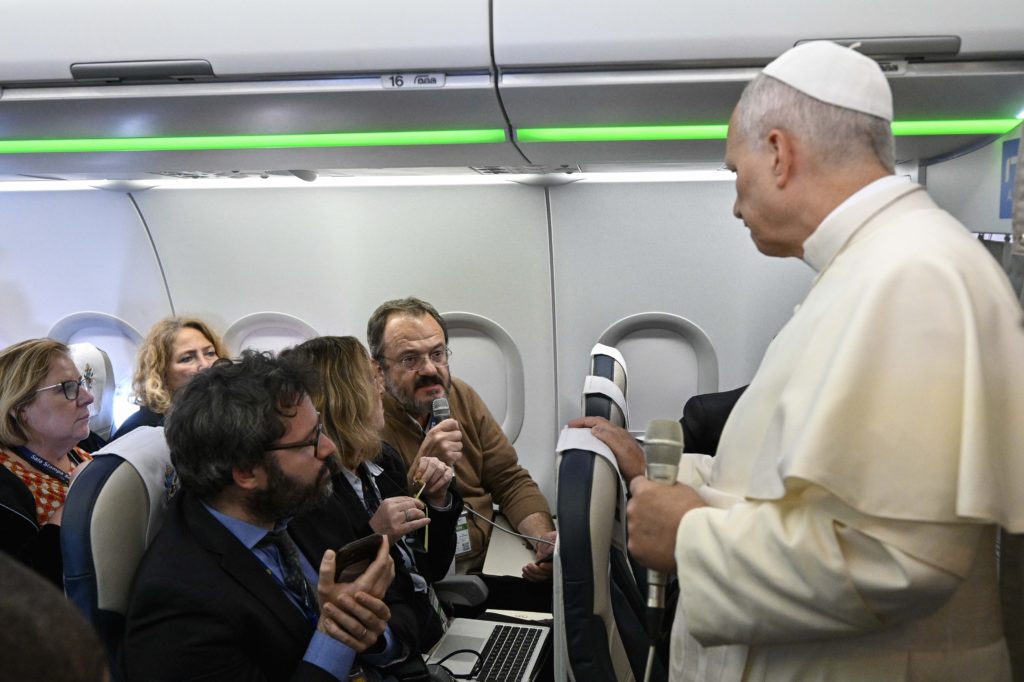
When he showed up in our section of the papal plane wearing his glasses and in visibly good spirits, our anxieties dissipated. He graciously received a Byzantine-style icon of the Virgin of Guadalupe from the dean of the Vatican press, Valentina Alazraki of Televisa Univisión, “to guide the steps of an American pope, American by birth, South American at heart.”
After the welcome, the pope took the floor and, in English (surprise!) wished us a Happy Thanksgiving and thanked us for the service we as journalists do “to the Vatican, to the Holy See, to me personally, and to the whole world.” Leo wanted to convey a message with this visit, and he was counting on the 80 journalists traveling in his plane to help him.
He greeted each of us individually. When he reached my seat, I decided to speak my mind.
“Holy Father, Catholics and the media love it when you speak in Spanish. I hope you will do so more often.” The pope smiled affably. In reality, I was just verbalizing the desperate cry of the Vatican press.
In Turkey, the pope’s message focused on ecumenical issues. In the capital city of Ankara, he was given a state welcome and delivered a speech to civil authorities emphasizing Turkey’s role as a bridge between two worlds. He also made a call to care for creation and emphasized the role of women in all aspects of society — a courageous message in a Muslim country.
But the high point of this leg of the pope’s trip came the next day in Iznik, a small town on the edge of a beautiful lake where ancient Nicaea once stood.
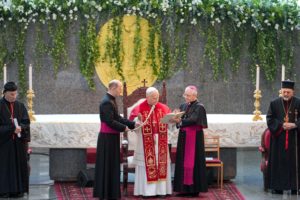
Standing before the ruins of the fourth-century Basilica of St. Neophytos — where scholars believe the famous Council was actually held — the pope, the Ecumenical Patriarch Bartholomew I, and representatives of other Christian rites and confessions stood together, calling for unity and professing the Nicene-Constantinopolitan Creed together. The visuals made for a powerful scene.
In his remarks, Leo called on those present to “overcome the scandal of the divisions that, unfortunately, still exist” and to “nourish the desire for unity for which the Lord Jesus prayed and gave his life.”
He would focus his efforts along these lines throughout the trip. Particularly significant was the fact that on the feast day of St. Andrew, brother of St. Peter, the successors of both apostles met at the Divine Liturgy to deliver a message oriented toward reconciliation.
Even Patriarch Bartholomew said that the theological issues separating Catholics and Orthodox Christians (the disagreement over the “filioque” clause in the Nicene Creed and the doctrine of papal infallibility) are being studied in search of solutions that would lead to a reunification of both churches. Meanwhile, there was no significant news regarding a long-awaited joint Easter date.
After the ecumenical apostolic blessing from the balcony of the patriarchate, we headed to the airport and — surprise! — the pope decided to hold a small press conference on the flight between Istanbul and Beirut. He answered two questions from Turkish colleagues before revealing that the ecumenical leaders had discussed a large-scale event in 2033 to mark the 2,000 years since the resurrection of Jesus Christ.
“The idea has been accepted, but we have not yet issued the invitation,” said Leo. “The possibility would be to celebrate this great event of the Resurrection, for example, in Jerusalem in 2033. We still have several years to prepare for it.”
Upon arriving in Beirut, a very different scenario awaited us. This was a country with multitudes of Christians ready to welcome the pope. Lebanon overwhelmed us with its affection and enthusiasm for Leo.
The visually spectacular welcome prepared for the pope at the Presidential Palace gave way to the sobering, dramatic reality of Lebanese society today: a country which, after wars, insurgencies, an economic crash, and tragedies like the 2020 Beirut harbor explosion, seems to see no future ahead.
The pope, aware of the impending “brain drain” caused by these conditions, asked the authorities: “What can be done so that young people in particular do not feel compelled to leave their homeland and emigrate? . . . Christians and Muslims, together with all religious and civil sectors of Lebanese society, are called upon to make their own contribution and to commit themselves to raising awareness of this issue among the international community.”
To the young people, he said: “Blessed are the young people who stay or return, so that Lebanon may remain a land full of life.”
The pope’s call on Lebanon’s young people not to leave their country stood out during the visit, along with more familiar messages of peace and coexistence.
During the flight back to Rome, the pope again visited the journalists’ cabin and, after answering the more political questions, shared a few anecdotes and showed a side of his personality that we had been waiting months to discover.
We saw Leo smiling, carefree, and spontaneous. He answered questions in the language in which they were asked. He confirmed that he is at his best in English and Spanish. The pope seems to be understanding that his ministry must be open to the world — a world that does not understand Italian.