Midway through his first trip to Africa as the spiritual leader of 1.4 billion people, Pope Leo XIV was forced to offer a gentle correction to the press corps traveling with him.
“There has been a certain narrative that has not been accurate,” he said as he was flying from Cameroon to Angola, noting that much of the coverage of his 11-day journey across Africa had become “commentary on commentary,” often shaped more by political reactions rather than by the trip itself.
The remark came after a week in which U.S. President Donald Trump publicly criticized the first American pope, prompting some observers to interpret Leo’s speeches as indirect replies. The pope dismissed that reading, noting that key addresses — including a major appeal for peace in Cameroon — had been prepared well before any political controversy.
“I primarily come to Africa as a pastor, as the head of the Catholic Church, to be with, to celebrate with, to encourage and accompany all of the Catholics throughout Africa,” the pope said.
A closer look at what Leo said and did across Algeria, Cameroon, Angola, and Equatorial Guinea reflect his vision of the Church far beyond any problems with the White House or in the Middle East.
Algeria: Fraternity rooted in St. Augustine
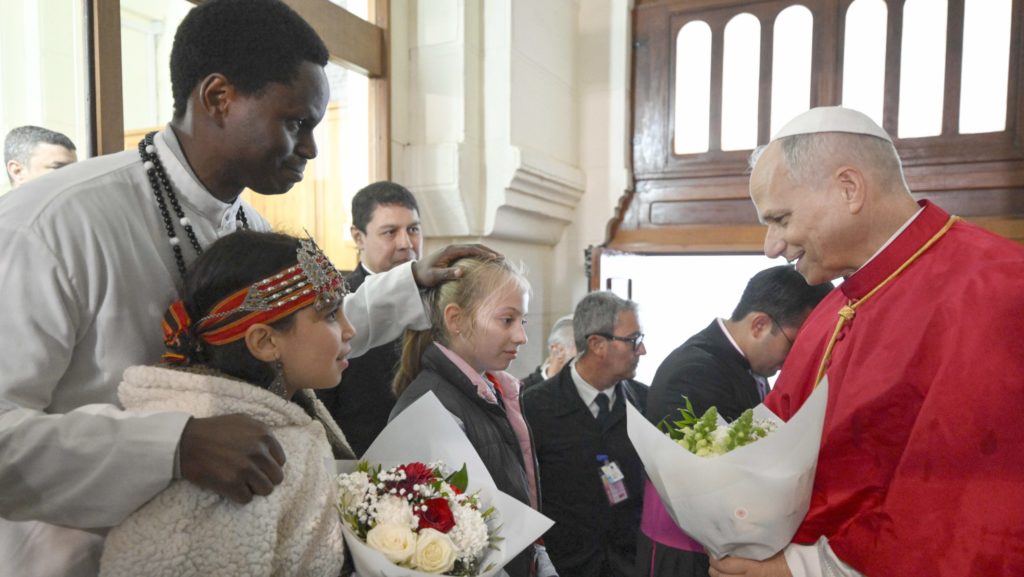
The journey began in Algeria, a country where Christians are a tiny minority in a predominantly Muslim society. For Leo, however, the visit carried deep personal significance as the land of St. Augustine, the North African bishop whose theology shaped the pope’s own Augustinian spirituality.
Speaking at a mosque in Algiers, Leo said that because seeking God “is also to recognize the image of God in every creature,” it is important to “learn to live together with respect for the dignity of every human person,” and to “live in harmony and build a world of peace.”
In another speech, he used that message of coexistence to praise Algeria’s tiny Christian minority: “A considerable part of this country’s territory is desert, and in the desert, no one can survive alone. The hostile environment dispels any presumptions of self-sufficiency, reminding us that we need one another, and that we need God.”
Far from geopolitical positioning, the Algeria leg of the trip underscored a vision of the Church as a bridge — between religions, cultures and histories.
As for the legacy of Augustine, Leo told journalists that he remains an important figure not only for Catholics, but for anyone searching for the truth.
“And yet he is still a very important figure today as his writings, teachings, spirituality, invitation to search for God, and for the truth is something that is very much needed today; a message that is very real for all of us today, as believers in Jesus Christ, but also for all people.”
Augustine, one could say, serves as a lens through which Leo framed his entire visit — one centered on dialogue, truth, and the possibility of coexistence despite differences.
Cameroon: Peace in a wounded land
If Algeria highlighted interreligious fraternity, Cameroon revealed the pope’s insistence on peace in the face of conflict.
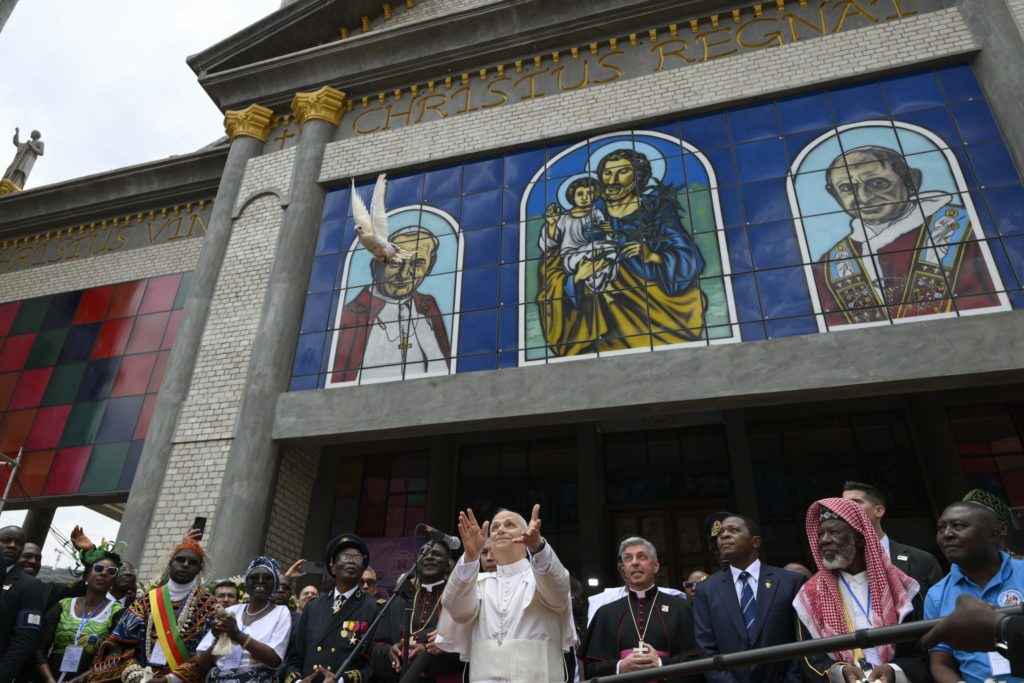
In a nation where a brutal internal conflict has torn the country since 2017, this was literally a peace mission for Leo. English-speaking separatists announced a three-day pause in fighting to coincide with his visit.
In Bamenda, a region scarred by a separatist crisis that has claimed more than 6,000 lives, Leo described the area as a “bloodstained yet fertile land” and praised the resilience of its people.
“I am here to proclaim peace,” he told those gathered.
“Peace is not something we must invent: it is something we must embrace by accepting our neighbor as our brother and as our sister,” said Leo in this gathering for peace, held in Bamenda’s cathedral.
In Cameroon, commonly referred to as “Africa in Miniature” because it showcases the entire continent’s diverse geography, climate, and culture within a single country, the pontiff spoke of the reality of the entire continent: “The masters of war pretend not to know that it takes only a moment to destroy, yet often a lifetime is not enough to rebuild.”
“Those who rob your land of its resources generally invest much of the profit in weapons, thus perpetuating an endless cycle of destabilization and death,” he said. “They turn a blind eye to the fact that billions of dollars are spent on killing and devastation, yet the resources needed for healing, education, and restoration are nowhere to be found.”
Speaking to university students and staff in Yaoundé, Leo echoed a call he made to young people in Lebanon last December to stay in their home country, rather than migrate.
“In the face of the understandable tendency to migrate — which may lead one to believe that elsewhere a better future may be more easily found — I invite you, first and foremost, to respond with an ardent desire to serve your country and to apply the knowledge you are acquiring here to the benefit of your fellow citizens,” said Leo.
Angola: Healing history and confronting injustice
In Angola, Leo turned his attention to healing — both historical and ongoing.
Addressing civil authorities in Luanda, he warned against economic systems that treat people and resources as commodities: “It is necessary to break this cycle of interests, which reduces reality, and even life itself, to mere commodities.”
At the Marian shrine of Mama Muxima, he urged believers to take responsibility for shaping a better world: “It is love that must triumph, not war… build a better, welcoming world, where there is no more war, injustice, poverty, or dishonesty.”
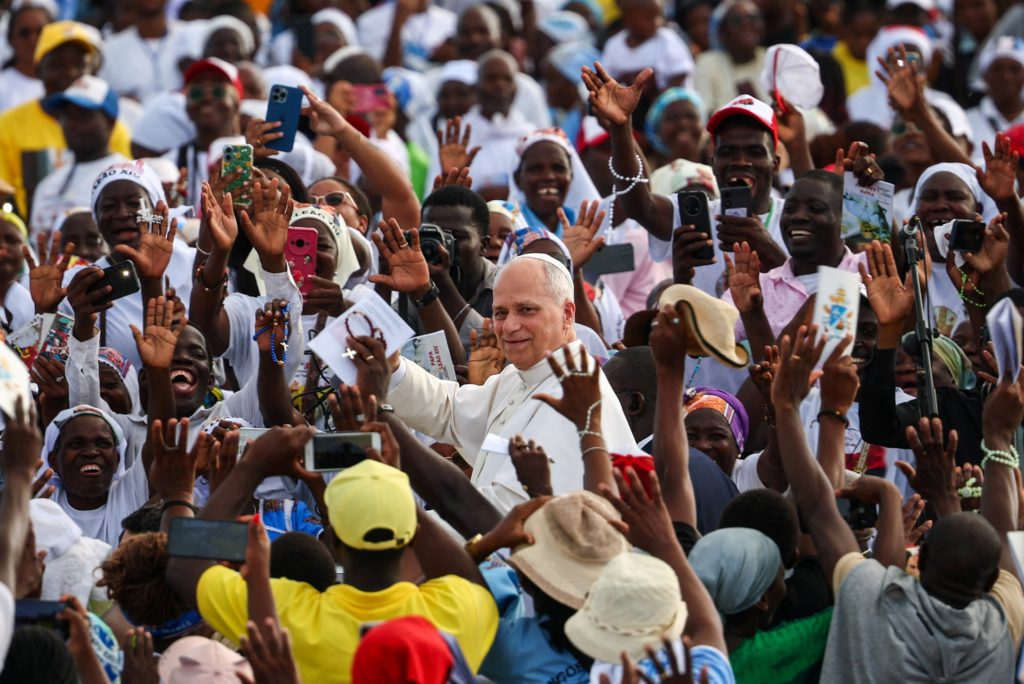
The Church of Our Lady of Muxima, a famous pilgrimage site, was also tied to the history of the transatlantic slave trade, where enslaved Africans were baptized before being sent to the Americas.
Leo, whose own ancestry includes both enslaved people and slave owners, prayed the rosary at the sanctuary, recalling it as a place where generations have brought both “joy” and “great suffering.”
Equatorial Guinea: Presence in the peripheries
The final leg of the trip, in Equatorial Guinea, points to another defining aspect of Leo’s papacy: a commitment to presence in places often overlooked.
Though one of the few Spanish-speaking countries in Africa, Equatorial Guinea remains largely absent from global attention. Yet it represents a young and growing Church navigating complex realities.
Though this issue of Angelus went to print before Pope Leo arrived in Equatorial Guinea, it’s worth pointing out that he was expected to be welcomed by a local tyrant: Teodoro Obiang Nguema Mbasogo has presided over the country since 1979. Obiang, who came to power through a coup, but promising democracy, is widely regarded as an autocratic leader who leads a regime of widespread corruption, abuse of power, human right violations, and nepotism.
A pastoral map, not a political one
Taken together, the four stops reveal a coherent vision: interreligious fraternity in Algeria, peace in Cameroon, healing and justice in Angola, and presence in overlooked peripheries in Equatorial Guinea.
This is not a reactive itinerary, nor a series of coded political statements. It is, rather, what Leo himself described — a pastoral journey.
“We go on the journey,” he told journalists, “proclaiming the Gospel message.”
In that light, the real story of his first trip to Africa is not an imaginary political exchange but a map of priorities — one drawn in the language of peace, dignity, and presence in places the world often overlooks.