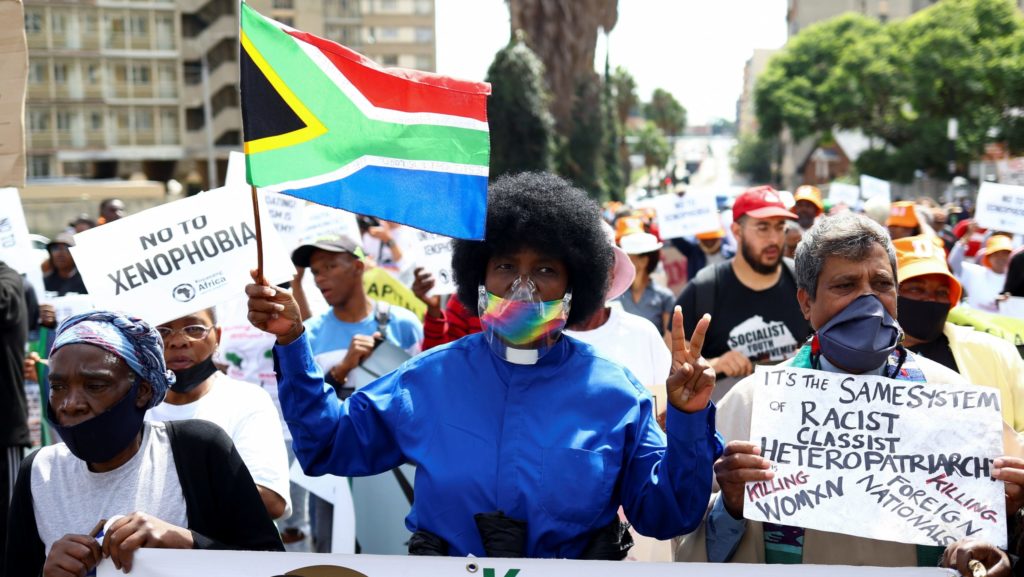
As xenophobic attacks continued to unfold in South Africa, Catholic bishops in Africa urged the government to quickly tame the violence, amid reports of deaths and injuries.
Cardinal Fridolin Ambongo Besungu, president of the Symposium of Episcopal Conferences of Africa and Madagascar, known as SECAM, condemned the violence as un-African amid armed groups marching to flush out the foreign black African migrants.
Cardinal Ambongo said SECAM is "deeply concerned" about the recent events, which "have been marked by acts of xenophobic violence against nationals of other African countries."
The statement was issued May 5, following the attacks on black African migrants.
Such attacks are not new since the end of apartheid in South Africa, but fears have mounted as the latest wave continued to surge.
Since late April, mobs -- armed with clubs, machetes and spears -- have been seen marching through the streets of key cities, demanding the departure of foreign nationals from other African countries. The protesters are rallying around lack of jobs, high unemployment and insecurity.
Attacks and intimidation have been reported in key towns, including Pretoria, Durban, Cape Town, East London and Johannesburg, among other places. In most regions, vigilantes have stopped people and asked them to present their documents before demanding they leave their country.
Properties believed to be owned by foreign nationals are being targeted, looted or vandalized, with several deaths confirmed, including five Ethiopians and two Nigerians, according to local press reports. The deaths and attacks have since drawn international concerns.
"Any violence directed against foreigners constitutes not only a grave violation of the human person but also a negation of the foundations of universal brotherhood and the Africa we want," said the cardinal in the SECAM statement.
The cardinal expressed "fraternal and ecclesial solidarity" with the Southern African Catholic Bishops' Conference "for its prophetic stance in support of African migrants who are victims of discrimination and xenophobia," and extended SECAM's sympathy "to all victims of this violence and to their families, who have been severely affected."
South African Catholic bishops have frequently condemned the violence, describing it as acts against human dignity.
"Irrespective of legal status, all have a right in South Africa to access medical care and a right to schooling," Cardinal Stephen Brislin of Johannesburg emphasized in October, when attacks were already occurring. "No group has the authority to abrogate the prerogative of law enforcement by mob action."
South Africa's national statistics agency indicated that there are about 3 million immigrants living in the country, roughly 5% of the population, including from Zimbabwe, Nigeria and Ghana.
Nigeria has since announced voluntary repatriation with at least 130 nationals registering to return home. Ghana has repatriated a national who was captured in a video being harassed in Johannesburg.
Cardinal Ambongo said the South African attacks violated African principles and continental law, undermined Africa's fundamental rights and contradicted the continent's core values, such as African solidarity, the spirit of Ubuntu -- "I am because we are."
He called on the African Union to fully assume its role as guardian of continental values, ensure the effective implementation of African legal instruments on human rights, and to encourage the establishment of prevention and early warning mechanisms against xenophobic violence.
"The credibility of Africa, which aspires to become a key player on the international stage, is at stake," said Cardinal Ambongo as he called on the people to reject all forms of violence, hatred and stigmatization, discourses that divides African peoples, and to promote a culture of encounter, dialogue, and African brotherhood.
"We are all called to rediscover an ethic of closeness, where the stranger is not perceived as a threat but recognized as a brother or sister of whom we are the guardians," he added.
The African Union, through its Commission on Human and People's Rights, expressed a grave concern at the attacks. Solomon Ayele Dersso, the AU's country rapporteur in South Africa, called on the South African government to take action with prompt, concrete and sustained measures to prevent recurrence and ensure accountability.
"Take decisive measures to dismantle and prevent the operation of vigilante groups engaging in unlawful enforcement activities," urged Dersso in an April 27 statement.