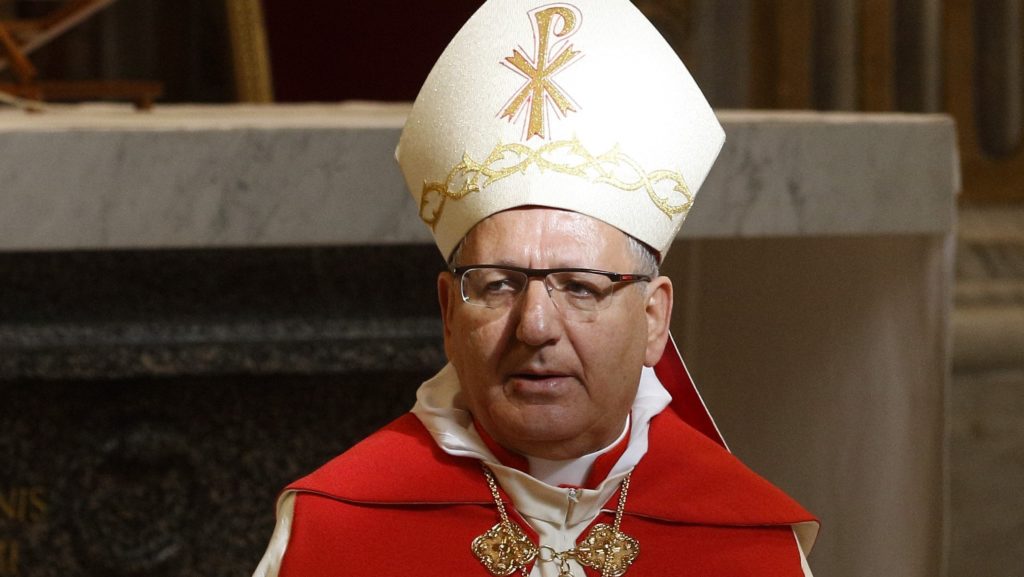
Pope Leo XIV has accepted the resignation of Cardinal Louis Sako, the Iraq-based Chaldean Catholic patriarch of Baghdad, ending his 13-year tenure leading Iraq’s largest Christian denomination, the Vatican said.
According to a March 10 statement published by the Vatican press office, Cardinal Sako's resignation was accepted under Canon 126, Paragraph 2, of the Code of Canons of the Eastern Churches, which governs the resignation of patriarchs.
The canon states that the synod of bishops of the patriarchal church is responsible for accepting a patriarch's resignation after consulting the pope, "unless the patriarch approaches the Roman Pontiff directly."
In a separate statement released by the Chaldean Patriarchate, Cardinal Sako said that after turning 75 in 2024, he had discussed his resignation with Pope Francis. However, the late pontiff "encouraged me to remain."
The cardinal said that he decided "in full freedom" to submit his resignation March 9 to Pope Leo XIV "so that I may quietly dedicate myself to prayer, writing, and simple service."
"He accepted it, and I requested that it be officially announced today at noon, March 10," Cardinal Sako said. "To prevent any misinterpretation, I confirm that no one forced me to do this; rather, I requested the resignation of my own will."
In his statement, the cardinal highlighted his 13 years as Chaldean patriarch as "years of loving pastoral care, follow-up, and growing up" amid "extremely difficult circumstances" and "great challenges" for Christians in Iraq and the wider Middle East.
After thanking God, the faithful of Baghdad, as well as the bishops, priests and staff of the Chaldean Patriarchate, the cardinal said he would "not forget them in my prayers" and apologized "to anyone whom I may have offended."
Acknowledging the difficult circumstances for the Middle East in the wake of the U.S. and Israel-Iran war, Cardinal Sako expressed his hope that the next patriarch will possess "solid theological culture, courage, and wisdom -- someone who believes in renewal, openness, and dialogue, and who also has a sense of humor."
"I will respect him and never interfere in his work," he wrote. "I am confident that God will take care of His Church."
Cardinal Sako concluded his statement in an unusual manner by detailing his current assets.
According to the prelate, his financial assets which he has included in his last will and testament include 40 million Iraqi dinar ($30,520.77), $5,000 and 5,000 euros ($5,823.72) "from my salaries during 52 years of priestly service, in addition to another sum which is my share from the sale of my family home in Mosul."
"I do not own a house or a car, but my true wealth is my devoted service and the 45 books and many articles I have published. Remember me in your prayers," he wrote.
Born in Zakho, Iraq, on July 4, 1948, Cardinal Sako studied in Mosul and was ordained a priest in 1974.
After further studies abroad, he returned to Iraq in 1986 and served as a pastor in Mosul for 11 years. He also served as rector of the Chaldean Patriarchal Seminary in Baghdad from 1997 to 2002.
He was appointed archbishop of Kirkuk in 2003, eight months after the U.S.-led invasion of Iraq. He was elected to lead the Chaldean Church in 2013 and five years later was named a cardinal by Pope Francis.
In recent years, the Chaldean patriarch faced several internal challenges. In July 2023, he left Baghdad after Iraqi President Abdul Latif Rashid revoked a decree that formally recognized the cardinal as Chaldean patriarch in the country and his authority to administer the Chaldean religious endowment.
Cardinal Sako and local Iraqi media viewed it as an attempt to usurp the patriarch's position as head of the Chaldean Church that was allegedly instigated by Rayan al-Kildani, head of the Babylon Brigades, a Chaldean Catholic militia that shares close ties with Iran.
After remaining in Irbil for almost a year, he returned to Baghdad in 2024 after Iraqi Prime Minister Mohammed Shia' Al-Sudani confirmed Cardinal Sako’s standing as patriarch of the Chaldeans in Iraq and the world.
However, another problem emerged when he presided over the July 15-19 Synod of the Chaldean Church.
The absence of five bishops -- Archbishop Bashar Warda of Irbil, Bishop Paul Thabet of Alquoch, Bishop Azad Sabri Shaba of Dohuk, Chaldean Archbishop Amel Shamon Nona of Sydney, and Bishop Saad Sirop Hanna, the apostolic visitor for Chaldean Catholics in Europe, -- was noted by the cardinal, who implied the bishops "had a hand in withdrawing the presidential decree" to "push me to resign in order to seek succession."
The patriarchate subsequently published another statement saying that the 2023 revocation of the decree "suggested to some that it was the end and made their mouths water," directly accusing Archbishop Warda of gathering support from the clergy for the cardinal's removal.
In a message sent to OSV News in September 2024, Archbishop Warda said tensions between himself and Cardinal Sako were due to misunderstandings, and he denied accusations he was working against the patriarch.
"I categorically reject accusations of corruption … and I will continue to deal with this issue through the relevant church channels," he said.
The announcement of Cardinal Sako's resignation also comes as the Chaldean Catholic Church confronts difficulties in its global diaspora.
In the same bulletin announcement, the Vatican said Pope Leo had also accepted the resignation of Bishop Emanuel Shaleta of the Chaldean Catholic Diocese of St. Peter the Apostle in San Diego.
Bishop Shaleta was arrested at San Diego International Airport March 5. Authorities in California charged the bishop with multiple counts, including embezzlement and money laundering, and one count of "aggravated white collar crime enhancement."
In a March 8 statement addressed to the Chaldean diocese, Cardinal Sako urged the faithful "not to allow division and discord, nor to give place to voices lying in wait to attack our Church" and to allow "the legal procedures take their course in revealing the truth and upholding justice."
"I assure you that I stand with justice, and for this reason I am in communication with the Holy See, hoping that the proper measures will soon be taken for the good of the diocese," he said.