Pope Leo XIV ended his stay in Lebanon with what he termed "a heartfelt appeal: may the attacks and hostilities cease."
"We must recognize that armed struggle brings no benefit," he said at the Beirut airport before returning to Rome Dec. 2. "While weapons are lethal, negotiation, mediation and dialogue are constructive. Let us all choose peace as a way, and not just as a goal!"
Throughout his stay in Lebanon Nov. 30-Dec. 2, the pope repeatedly called for peace, justice and a concerted effort by all Lebanese to build a better future for themselves and their families.
In fact, after Mass and before praying the Angelus Dec. 2, he implored "the international community once again to spare no effort in promoting processes of dialogue and reconciliation," and he appealed "to those who hold political and social authority here and in all countries marked by war and violence: Listen to the cry of your peoples who are calling for peace."
"The Middle East needs new approaches in order to reject the mindset of revenge and violence, to overcome political, social and religious divisions, and to open new chapters in the name of reconciliation and peace," he said. "We need to change course. We need to educate our hearts for peace."
However, he never mentioned by name Hezbollah, the militant Islamic fighters who target Israel from Lebanon, nor did he mention Israel, which has been striking Lebanese cities and towns for more than two years, claiming they were targeting Hezbollah.
At the airport farewell ceremony, he expressed hope for the involvement of "the entire Middle East in this spirit of fraternity and commitment to peace, including those who currently consider themselves enemies."
At 6:30 a.m. on the last day of Pope Leo's first foreign papal trip, a double rainbow appeared in the sky over Beirut's Zaitunay Bay.
The pope began the day visiting a Catholic-run psychiatric hospital and then praying at the Beirut port, site of the chemical explosion in 2020 that killed more than 200 people, injured some 7,000 and left an estimated 300,000 people displaced.
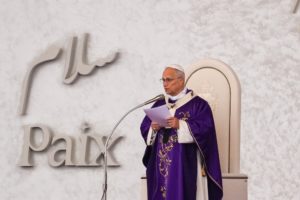
"I was deeply moved by my brief visit to the Port of Beirut, where an explosion devastated the area, not to mention many lives," the pope said at the Mass he celebrated afterward on the waterfront nearby.
"I prayed for all the victims, and I carry with me the pain, and the thirst for truth and justice, of so many families, of an entire country," the pope said. Family members of those killed when improperly stored ammonium nitrate exploded joined him for the prayer at the site where there are still mountains of rubble, piles of burnt-out cars and heaps of tattered clothing and cloth.
The Melkite and Maronite bishops of Beirut were also present as were Lebanese Prime Minister Nawaf Salam and Haneen Sayed, the government minister for social affairs; her mother was killed in the blast.
Pope Leo laid a wreath, lighted a candle and prayed before greeting the families and survivors who still bear the scars of their injuries. A young woman, crying, asked for a hug, which the pope gave her before putting his hand on her head and blessing her.
In his homily at Mass, Pope Leo said the beauty of Lebanon "is overshadowed by poverty and suffering, the wounds that have marked your history. In this regard, I just visited the port in order to pray at the site of the explosion."
"The beauty of your country is also overshadowed by the many problems that afflict you, the fragile and often unstable political context, the dramatic economic crisis that weighs heavily upon you and the violence and conflicts that have reawakened ancient fears," the pope said without being more specific.
The day's Gospel reading, Luke 10:21-24, begins by quoting Jesus, who "rejoiced in the Holy Spirit and said, 'I give you praise, Father, Lord of heaven and earth.'"
Pope Leo told the estimated 100,000 people at the Mass that he knows it is not always easy to praise God.
"Sometimes, weighed down by the struggles of life, worried about the many problems around us, paralyzed by powerlessness in the face of evil and oppressed by so many difficult situations," he said, "we are more inclined to resignation and lamentation than to wonder and gratitude."
But, the pope told them, the Gospel "invites us to find the small shining lights in the heart of the night, both to open ourselves to gratitude and to spur us on to a common commitment for the sake of this land."
The faith and charity of Lebanese Christians, the willingness to dialogue and collaborate with members of other religions are all "small lights that shine in the night, small shoots that sprout forth and small seeds planted in the arid garden in this era of history," he said.
"Cultivate these shoots," the pope told them. That is the way to avoid discouragement and "to not give in to the logic of violence and the idolatry of money, and to not resign ourselves in the face of the spreading evil."
"Lebanon, stand up," he said. "Be a home of justice and fraternity! Be a prophetic sign of peace for the whole of the Levant," a term referring to the area that borders the Eastern Mediterranean and traditionally includes Turkey, Lebanon, Syria, Israel, Palestine and Jordan.